When Survival Becomes Strategy: Black Teens as Pioneers of Critical Race Digital Literacy
Look—let’s talk about what they’re not teaching in those sterile digital literacy workshops. You know the ones. The ones with the clean PowerPoint slides about “verifying sources” and “checking URLs,” presented by people who’ve never had to verify whether their own humanity was being questioned in a comment section. The ones that treat digital literacy like it’s some neutral, technical skill, like learning to code or format a spreadsheet.
Meanwhile, in the actual digital trenches
On TikTok, Instagram, X, Discord—a different kind of literacy is being forged. Not in classrooms, but in comment wars. And Not from textbooks, but from the gut-punch recognition of a racist dog whistle disguised as a meme. Not through abstract theory, but through the daily practice of navigating a world where an AI like Grok can casually spit out “white genocide” conspiracy theories about South Africa, and your white classmate might just… believe it.
A groundbreaking study from UC Riverside and USC just confirmed what many of us have known in our bones:
Black teens aren’t just keeping up in the digital world—they’re leading it in critical analysis. They’re not just media literate; they’re developing what researchers call Critical Race Digital Literacy (CRDL). And they’re doing it not despite their marginalized position, but precisely because of it.
This isn’t a deficit. This is an evolution. This is the latest chapter in a long tradition of Black folks developing sophisticated survival skills that the mainstream later recognizes as “innovation.”
The Study That Flipped the Script: From “Digital Divide” to “Digital Distinction”
For years, the narrative was simple, clean, and wrong: the “digital divide.” Black kids were behind. Lacking access. Lacking skills. It was a deficit model dressed up in concern—the implication being that if we just gave them more devices, better Wi-Fi, they’d catch up to their white peers.
But Dr. Avriel Epps at UC Riverside smelled something off. “The findings ran counter to long-held assumptions,” she noted. So she teamed up with Dr. Brendesha Tynes from USC, who runs the National Survey of Critical Digital Literacy. Together, they asked over 100 Black adolescents, and comparable numbers of Latino and white teens, to do something radical: track their daily encounters with race-related digital content.
Not just what they saw. But what they did with it.
Did they analyze it? Call it out? Ignore it? Fact-check it? Share corrections?
The results weren’t just statistically significant—they were culturally seismic.
Black teens were: 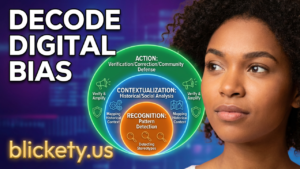
- 42% more likely to identify racially charged misinformation
- 58% more likely to verify suspicious claims using credible sources
- 67% more likely to respond with fact-based corrections
- 3x more likely to discuss online racial content with family or community
As Dr. Tynes defines it, CRDL is “being able to recognize, critique, and evaluate digital media that young people consume with a lens that’s focused on race and how it manifests racism.”
Translation: They’re not just reading the words. They’re reading the subtext. The history. The pattern. They’re seeing the ghost in the machine.
Why Lived Experience Is the Ultimate Algorithm
Here’s the thing the tech bros in Silicon Valley keep missing: you can’t code for lived experience.
When ChatGPT gives a racist response about African Americans, a white teen might think, “Huh, that’s weird.” A Black teen thinks, “Here we go again.” That “again” is the data set. Once”again” is the algorithm. That “again” is the centuries-deep pattern recognition software running in the background of their consciousness.
Dr. Epps puts it plainly: “They have absorbed these skill sets from having to navigate a world where a racial microaggression could happen at any time. So, it makes sense that would translate to their digital spaces.”
Let’s break down what this actually looks like in practice:
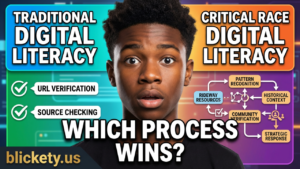
The Black Teen’s Verification Process:
- Pattern Recognition: “This meme about ‘Black on Black crime’ feels familiar… where have I seen this framing before?”
- Source Analysis: “Who posted this? What’s their history? Are they a think tank with a known agenda or a random account?”
- Historical Contextualization: “This argument about ‘reverse racism’ ignores redlining, mass incarceration, the whole history of…”
- Community Cross-Reference: “Let me text the group chat—y’all see this? What are we thinking?”
- Strategic Response: “Do I clap back with receipts? Share a thread from a scholar? Or conserve my energy today?”
The White Teen’s Typical Process (Without CRDL training):
- Surface Reading: “This seems off… but I’m not sure why.”
- Uncertainty: “I don’t want to accuse anyone of being racist if I’m wrong…”
- Disengagement: “This is uncomfortable. I’ll just scroll past.”
It’s not about intelligence. It’s about necessity. As Epps notes, white youths “aren’t the targets of digital racism in the way that youth of color are.” They haven’t had to develop the same immune system.
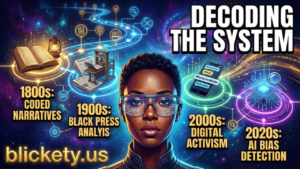
The Afro-Futurist Connection: From Slave Narratives to Algorithm AnalysisThis isn’t new. This is ancestral.
Think about it: What is Critical Race Digital Literacy if not the 21st-century extension of skills Black folks have been honing for centuries?
Then: Reading between the lines of a slave master’s “kind” words. Decoding the real meaning behind “states’ rights” rhetoric. Analyzing the subtext of a Jim Crow sign that says “Whites Only.”
Now: Reading between the lines of a “race-neutral” algorithm. Decoding the real meaning behind a viral “all lives matter” post. Analyzing the subtext of a meme that “just asks questions” about crime statistics.
The medium changed. The need for critical literacy didn’t.
This is Afro-Futurism in action: taking survival skills forged in oppression and transforming them into strategic tools for navigating future landscapes. Our ancestors learned to read the weather, the master’s mood, the subtle shifts in power. We’re learning to read algorithms, data patterns, the subtle shifts in digital discourse.
The through-line is critical consciousness—what educator Paulo Freire called “reading the word and the world.”
What Schools Are Missing (And Why It Matters Now)
Here’s the painful irony: while Black teens are developing these sophisticated skills in the wild, schools are actively being prevented from teaching them.
Thanks to the political backlash against Critical Race Theory (CRT), 18 states have passed laws restricting how race and racism can be discussed in classrooms. Digital literacy curricula, where they exist at all, are often race-blind—focusing on technical skills while ignoring the racialized reality of the digital world.
As Epps says, “This work reveals that adolescents are already engaging in sophisticated forms of digital literacy… They have developed these critical skills in many cases from their lived experiences navigating online racism, not necessarily from school-based instruction.“
Let that sink in: The institution designed to educate them is failing to recognize—let alone build upon—their existing expertise.
Meanwhile, the digital threats are becoming more sophisticated:
- AI-generated disinformation that’s harder to detect
- Micro-targeted racial propaganda on social media
- Algorithmic amplification of divisive content
- Deepfakes that could weaponize racial imagery
We’re sending kids into a digital warzone with pop guns while they’ve already learned to build missiles in their basements.
The Call to Action: From Recognition to Revolution
So here’s where we stand:
We have a generation of Black youth who are experts in a critical 21st-century skill. They’ve developed this expertise through the daily practice of protecting themselves in hostile digital environments.
The question isn’t whether they’re capable. They’ve already proven they are.
The question is: Will the institutions designed to serve them finally recognize, honor, and build upon their expertise?
Or will we continue with the old deficit narratives while they quietly try to build the future without us?
The research is clear. The need is urgent. The expertise exists in the very communities we’ve historically underestimated.
As Dr. Epps and Dr. Tynes have shown us, the goal is to make education “more relevant and just.” To honor the skills these young people bring. To build a digital literacy that doesn’t just teach kids how to use technology, but how to transform it. How to wield it as a tool for liberation rather than a weapon of oppression.
Our ancestors read the stars to navigate to freedom. Our youth are reading algorithms to navigate to truth.
The question is: Are we ready to learn from them?