
Introduction: The Morning My Watch Lied to Me
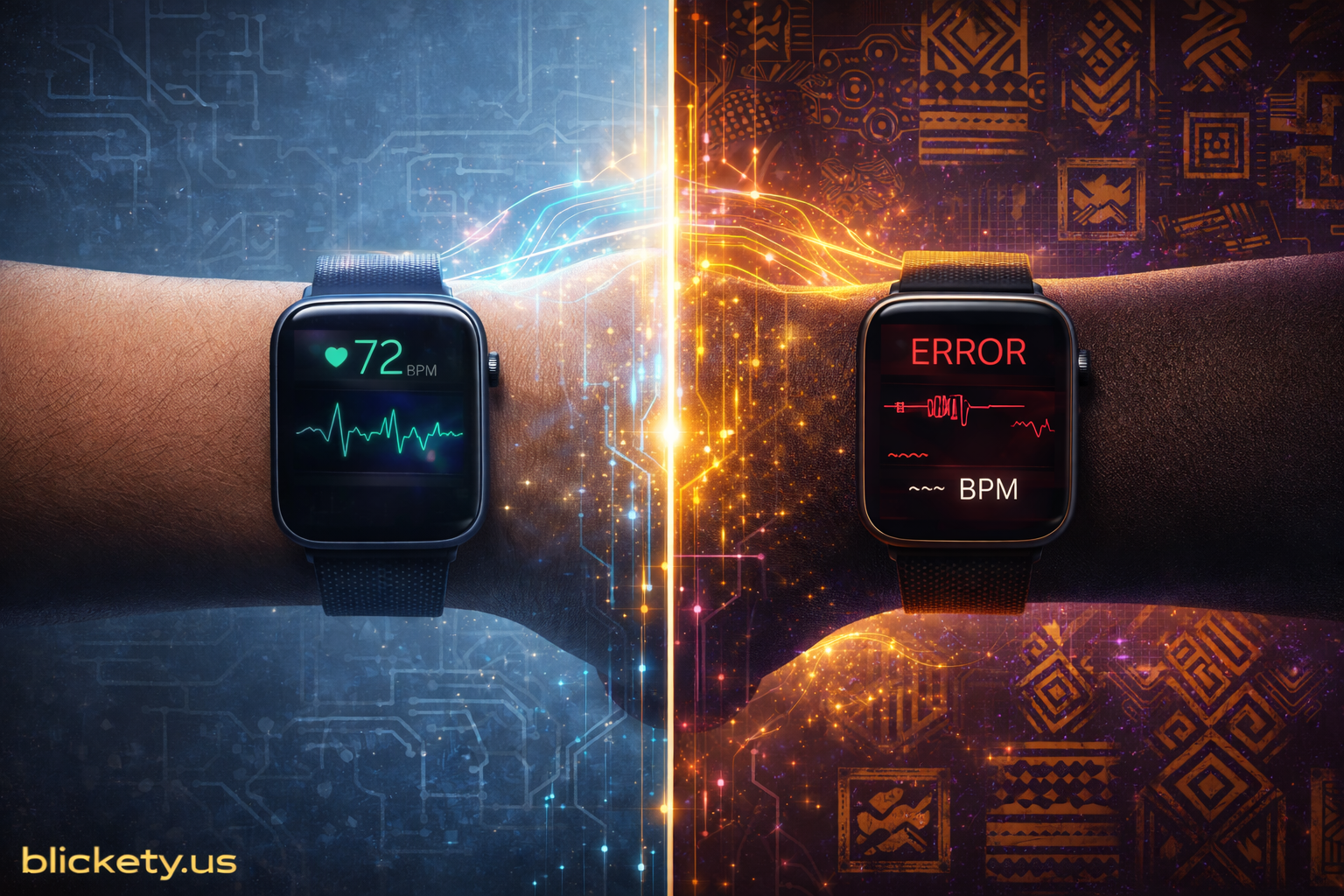
You’re three miles into your morning run, chest heaving, sweat streaming down your face. Suddenly, your smart watch buzzes cheerfully, displaying a heart rate of 72 bpm—a resting pulse. You know something’s wrong. Moreover, you can feel your heart hammering against your ribcage, but the sleek $400 device on your wrist insists you’re perfectly calm.
This isn’t a glitch. It’s not user error. Instead, for millions of Black and brown users worldwide, this represents the daily reality of wearable technology designed without them in mind.
The truth Silicon Valley doesn’t want you to know? Your smart watch was never built to see you.
In 2024, as we stand at the intersection of advanced AI, quantum computing, and biotechnology, the medical devices wrapped around our wrists still can’t accurately measure vital signs on melanin-rich skin. Furthermore, this isn’t just an inconvenience—it’s a design flaw that’s been documented since the 1980s and systematically ignored by an industry more concerned with aesthetics than equity.
Consequently, this is the story of how technology’s blindness to Blackness became embedded in the devices we trust with our health, and how a new generation of Afrofuturist innovators is finally rewriting the code.
The Invisible Problem: When Technology Can’t See Melanin
How Your Fitness Tracker Actually Works
At the core of every fitness tracker and smart watch lies photoplethysmography (PPG). Specifically, this technology measures your pulse by shining light into your skin and detecting changes in blood volume.
Here’s where the bias begins.
Standard PPG sensors use green LED light—a wavelength engineers chose because it’s absorbed well by red blood cells in lighter skin tones. When your heart beats, blood volume increases in your capillaries, and the sensor detects this change in light reflection. Simple, elegant, effective—if you’re white.
Melanin, the pigment that gives darker skin its color, absorbs light across the visible spectrum. Consequently, the more melanin in your skin, the less light penetrates to the blood vessels below, and the weaker the signal the sensor receives. It’s like trying to read a book through increasingly dark sunglasses—eventually, the text becomes invisible.
Why Experts Say Current Wearables Are “Colorblind”
Dr. Valencia Koomson, Associate Professor of Electrical and Computer Engineering at Tufts University, explains it simply: “Current wearables are essentially colorblind. They’re optimized for one skin tone and everyone else gets approximations at best, dangerous misinformation at worst.”
In December 2020, researchers published a bombshell study in the New England Journal of Medicine. Their findings were stark: Black patients experienced occult hypoxemia—dangerously low blood oxygen levels that went undetected—nearly three times more frequently than white patients.
Let that sink in. Medical devices that doctors and patients trusted to alert them to life-threatening oxygen deprivation were missing critical warnings in Black patients 300% more often.
From Hospitals to Your Wrist
The implications rippled far beyond hospital settings. Indeed, these same pulse oximetry technologies form the foundation of consumer wearables—the Apple Watches, Fitbits, Garmin devices, and Samsung Galaxy Watches that tens of millions of people rely on daily to monitor their health.
During the COVID-19 pandemic, when pulse oximeters became essential home monitoring tools, this bias created serious health risks. As a result, Black and brown patients received false reassurance from devices telling them their oxygen levels were safe, potentially delaying critical medical intervention until their conditions became severe.
From the Cotton Fields to Silicon Valley: A Legacy of Medical Racism 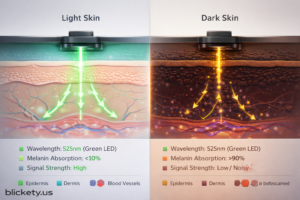
Four Decades of Documented Failure
The failure of pulse oximeters on dark skin isn’t new—researchers have documented it since engineers invented the technology in the 1980s. However, to understand why this bias persists four decades later, we need to trace the roots of medical racism in American technology.
Throughout medical history, the medical establishment has treated Black bodies as inherently different, deficient, or simply invisible. For instance, J. Marion Sims performed experimental gynecological surgeries on enslaved Black women without anesthesia. Similarly, the Tuskegee syphilis experiments denied treatment to Black men for 40 years. These aren’t isolated incidents—instead, they reveal a consistent pattern of devaluing Black lives in medical research and development.
How Silicon Valley Inherited Medical Racism
Modern technology manifests this legacy in insidious ways. Engineers at major tech companies develop new devices and test them on convenience samples—often their own predominantly white, Asian, and male workforce. Unfortunately, diversity in testing populations isn’t a regulatory requirement; it’s an afterthought.
As a result, devices work flawlessly on the people who built them and fail catastrophically on everyone else.
The 2022 Lawsuit That Changed Everything
On December 24, 2022, the legal landscape shifted. Alex Morales and Ángel Luis Durán filed a class-action lawsuit against Apple Inc., alleging that the company knowingly sold Apple Watches with pulse oximeters that “do not work for people with darker skin tones.”
According to the lawsuit, internal Apple research and third-party studies demonstrated the accuracy problems. Nevertheless, Apple continued marketing the devices as medical-grade health monitors while knowing they failed for millions of users.
The Real-World Harm
This wasn’t just about inaccurate step counts or calorie estimates. Instead, users were making health decisions based on false data. Athletes were overtraining or undertraining. Meanwhile, individuals with cardiovascular conditions were receiving incorrect vital signs information.
Apple’s response was telling. Rather than disputing the accuracy issues, the company argued that it intended its oximeter for “general fitness and wellness purposes” and not medical diagnosis—despite marketing materials emphasizing health monitoring capabilities and FDA clearances for certain features.
Caveat emptor: If the technology doesn’t work for you, that’s your problem.
The FDA Finally Wakes Up: January 2025 Guidance
New Rules for Medical Devices
On January 15, 2025, the U.S. Food and Drug Administration issued long-awaited guidance requiring medical device manufacturers to test pulse oximeters and related technologies on diverse populations, including people with dark skin pigmentation.
Now, clinical studies must include representation across the full spectrum of skin tones (Fitzpatrick scale I-VI), minimum sample sizes for each category, performance data stratified by skin tone, and labeling that clearly discloses any accuracy limitations.
Medical device manufacturers face a seismic regulatory shift. For the first time, inclusive design isn’t optional—it’s mandatory.
The Loophole Nobody’s Talking About
However, here’s the catch: this guidance applies to new devices seeking FDA clearance, not the hundreds of millions of wearables already on wrists worldwide. Your current smart watch? Still operating under the old, biased paradigms.
Furthermore, consumer wearables like fitness trackers exist in a regulatory gray area. Most aren’t classified as medical devices requiring FDA approval, meaning manufacturers can continue selling inaccurate devices to dark-skinned users without consequence.
Why Guidance Alone Isn’t Enough
The FDA guidance is a crucial first step, but it’s not enough. Instead, real change requires innovation from the ground up—new technologies designed with equity as a foundational principle, not an afterthought.
The Afrofuturist Solution: Valencia Koomson’s Melanin-Independent Vision 
Building Technology That Actually Sees Us
While legacy tech companies scrambled to retrofit bias out of existing designs, Dr. Valencia Koomson and her team at Tufts University asked a different question: What if we built technology that actually sees melanin, instead of being blinded by it?
Koomson’s approach represents a paradigm shift in biosensor design. Instead of fighting against melanin’s light-absorbing properties, her technology works with them, using multiple wavelengths and advanced signal processing to extract accurate biometric data regardless of skin pigmentation.
A Revolutionary Philosophy
Technical innovation drives this work, but the philosophical approach is revolutionary. Koomson isn’t trying to make Black and brown bodies fit into white-designed technology. Rather, she’s designing technology that recognizes and respects human diversity from the ground up.
This is Afrofuturism in its purest engineering form: taking the knowledge of how existing systems fail Black people and building entirely new systems where Black people are centered, not marginalized.
“We’re not asking for accommodation,” Koomson explains. “We’re demanding technology that works for all humans. That’s not a diversity initiative—it’s basic scientific rigor.”
Heritage → Innovation → Future
Her melanin-independent sensors represent more than a technical fix. Instead, they’re a blueprint for what equitable technology development looks like: diverse teams, inclusive testing, and design frameworks that assume human variation rather than treating it as an edge case.
The Afrofuturist approach to technology isn’t just about building better gadgets. Moreover, it’s about reconnecting with ancestral wisdom about the body, health, and community while leaping forward into radical new possibilities.
Heritage: Traditional African healing practices understood that health isn’t one-size-fits-all. Different bodies require different approaches, different measurements, different understandings. Western medicine dismissed this wisdom as “primitive,” even as that same medicine built technologies that failed to account for human diversity.
Innovation: Researchers like Koomson reclaim that understanding of bodily diversity and translate it into cutting-edge bioengineering. Consequently, the result isn’t “catching up” to white technology—it’s leapfrogging ahead to more sophisticated, more accurate, more equitable solutions.
Future: The endgame isn’t just smart watches that work on dark skin. Instead, it’s a complete reimagining of health technology designed by and for the full spectrum of humanity. AI diagnostic tools will be trained on diverse datasets. Medical algorithms won’t assume whiteness as default. Ultimately, “medical-grade accuracy” will mean accuracy for all bodies.
What You Can Do Right Now: Navigating Biased Technology
Protect Yourself With Smart Watch Awareness 
Until melanin-independent technology becomes mainstream, users with dark skin need to know the limitations of their current devices and how to work around them.
First, don’t trust a single reading. If your device shows an unusually low or high heart rate, verify with manual pulse checks or alternative devices. Additionally, adjust fit tightly—PPG sensors work better with firm skin contact, so wear your watch snug during workouts.
Furthermore, monitor trends, not absolutes. Use your device to track changes over time rather than trusting individual measurements. Finally, know your baseline by establishing your actual resting heart rate through medical-grade equipment so you recognize when readings are wrong.
For Athletes and Fitness Enthusiasts
Use Rate of Perceived Exertion (RPE) and listen to your body instead of relying solely on heart rate zones. Moreover, invest in chest strap monitors—many chest-based HR monitors use different technology and show better accuracy across skin tones.
Additionally, calibrate when possible, as some devices allow manual calibration. Finally, document inaccuracies and report failures to manufacturers and regulatory agencies.
For Medical Monitoring
Never rely on consumer wearables for medical decisions. Instead, discuss appropriate monitoring tools with your healthcare provider. Furthermore, request diverse-tested equipment by asking your doctor about pulse oximeters validated on darker skin tones.
Finally, advocate for better tools and demand that healthcare systems invest in equitable medical technology.
Consumer Power: Vote With Your Wallet
Research devices before purchasing. While no consumer wearable is perfect for dark skin, some perform better than others. First, ask manufacturers directly about testing protocols and accuracy across skin tones. Then, read independent reviews from users with darker skin.
Additionally, support companies that publish transparent diversity testing data. Finally, join advocacy groups pushing for better standards like Black Health Matters and the National Medical Association.
Your purchasing decisions send signals. Specifically, when companies lose sales because of accuracy issues, they notice.
The Broader Pattern: Tech’s Diversity Problem Isn’t Just Optical
When Technology Fails to See Blackness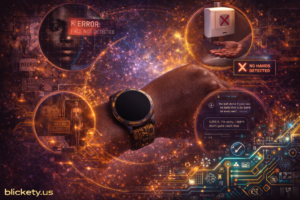
The smart watch bias isn’t an isolated incident—instead, it’s part of a systemic pattern of technology failing non-white users.
For example, facial recognition systems misidentify Black faces at rates up to 100 times higher than white faces. Similarly, automatic soap dispensers in public restrooms don’t detect dark skin and refuse to dispense. Meanwhile, voice recognition software struggles with non-standard English accents. Even automated hand dryers often fail to detect darker hands.
The Root Cause
These aren’t random glitches. Instead, they’re the predictable result of homogeneous development teams building products tested primarily on people who look like them.
The tech industry’s diversity problem has real-world consequences that go far beyond hiring statistics. Specifically, when 83% of tech executives are white and only 3% are Black, the products reflect that imbalance.
The Cost of Exclusion
This bias costs money. The global wearable medical device market is projected to reach $195 billion by 2027. Black Americans alone represent $1.6 trillion in annual buying power. Consequently, companies that ignore this market leave billions on the table.
However, more importantly, this bias perpetuates health disparities. Delayed medical diagnoses, inadequate disease monitoring, and false health data create downstream inequities that compound existing barriers in healthcare access and outcomes.
The Future Is Melanated: What’s Coming Next
Beyond Accommodation: Designing for Diversity First
The next generation of health wearables won’t treat dark skin as a problem to solve—instead, engineers will design it with melanin diversity as a baseline assumption.
Emerging technologies include multi-spectral imaging using infrared and red light wavelengths less affected by melanin, bioimpedance sensors that measure electrical signals rather than optical ones, pressure-based sensors that detect pulse mechanically, and AI-powered signal processing trained on diverse datasets to extract accurate readings from weaker signals.
Innovation Is Already Happening
Companies like Biobeat, Corsano Health, and Kenzen are already developing alternative sensing modalities. Similarly, university research labs worldwide are publishing new approaches. Furthermore, the FDA’s 2025 guidance accelerates this innovation.
Within five years, we’ll likely see a new generation of wearables that make today’s devices look as primitive as flip phones.
The Regulatory Revolution
The FDA guidance is just the beginning. Advocacy groups are pushing for mandatory accuracy labeling stratified by skin tone, post-market surveillance tracking real-world performance disparities, penalties for misrepresentation when manufacturers market devices as “medical-grade” but they fail for significant populations, and insurance coverage only for devices meeting diversity standards.
Meanwhile, the European Union is considering even stronger requirements, potentially banning medical devices that show significant accuracy disparities across demographic groups.
Education and Workforce Development
Long-term change requires diversifying the engineering pipeline. Initiatives like Black Girls Code, Code2040, and /dev/color are building the next generation of Black and brown engineers who will bring lived experience to product development.
Additionally, universities are beginning to teach “equity-centered design” as a core engineering principle, not a specialty elective. Students learn to question assumptions, test on diverse populations, and recognize bias in algorithms and hardware.
This cultural shift takes time, but it’s happening. Engineers entering the workforce today are more aware of diversity issues than any previous generation.
Conclusion: The Revolution Will Be Measured Accurately
The smart watch accuracy crisis isn’t a technical problem—it’s a moral one. For four decades, the technology industry has known that its devices fail on dark skin and chosen profit over equity, convenience over justice.
However, the tide is turning. 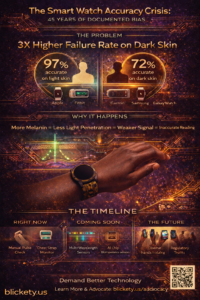
From Valencia Koomson’s labs at Tufts to FDA conference rooms in Silver Spring, Maryland, to class-action lawsuits in California courthouses, the demand for equitable technology is growing louder and more urgent.
What’s Really at Stake
This is about more than wrist-worn gadgets. Instead, it’s about who gets to exist in the future being built by Silicon Valley. It’s about whether technology will amplify existing inequities or become a tool for liberation.
The Afrofuturist vision offers a path forward: technologies that honor our ancestors’ understanding of human diversity, innovate beyond white-default design paradigms, and build a future where all bodies are seen, measured, and valued accurately.
We’re Building the Future Ourselves
Your smart watch doesn’t work on your skin because the people who built it never imagined you wearing it. Nevertheless, the next generation of devices will be different—because we’re building them ourselves.
The revolution will be measured accurately. In multiple wavelengths. On all skin tones.
And this time, we’re writing the code.