Own Your Bag: Apps Black Creators Use to Build Independent Income

You already know the algorithm isn’t your friend.
You’ve watched it happen — the reach drops overnight with no explanation. The video that should’ve gone viral got suppressed before it even had a chance. The content that blew up for somebody else barely made a ripple for you. And if you’ve ever typed the words “Black people” in a caption and watched your engagement fall off a cliff? You already know what time it is.
Black creators face implicit biases built directly into the algorithms — platforms flag content using terms common in Black communities, and the presence of Black images and sounds tends not to perform as well with the broad “overall” audience as more racially mainstream content. The Culture Economy That’s not a conspiracy theory. That’s the operating system.
But here’s what’s shifting. The apps Black creators use to build independent income have fundamentally changed the equation. The smartest Black creators in the game aren’t waiting on platform payouts or begging the algorithm for crumbs. They’re building their own infrastructure — their own tables, their own revenue streams, their own digital institutions.
This is the Maono Tech stack. And it starts with understanding that owning your bag means owning your platform.
Why the Algorithm Was Never Designed to Work for Us
Let’s be real before we get into the tools.
Black creators enter this game already behind — algorithm bias, lack of amplification, and implicit user bias all compound to make the climb steeper before a single piece of content is even published. The Culture Economy The platforms that gave rise to creators in the 2010s? They weren’t building with us in mind. The billboards in Los Angeles and New York promoting their top creators? Notice who wasn’t on them.
And yet — Black creativity shaped the internet anyway. The dances, the sounds, the slang, the aesthetics. We built the culture that drives engagement on every platform. Then watched other people get paid for it.
That ends when you stop depending on their system and start building your own.
According to Patreon’s 2025 State of Create report, over half of the $290 billion creator economy now comes from direct-to-fan revenue — memberships, livestreams, and ticketed content — as creators shift away from algorithm-dependent platforms toward models where they control their audience and earnings. ContentGrip
The exit is already happening. The question is whether you’re on the right side of it.
The Stack: Apps Black Creators Are Using to Build Real Income
Substack — Your Voice, Your Subscribers, Your Money
Substack is where the writers, thinkers, essayists, and cultural analysts live. And for Black creators who have something to say — real talk, not just content — it’s one of the most powerful tools in the stack.
Here’s how it works: you write, you publish, some content is free, some is paid. Substack takes 10% of paid subscriptions. That’s it. No algorithm deciding who sees your work. No suppression. No shadowban. The people who sign up for your newsletter want to hear from you — and they pay you directly for it.
The power isn’t just in the money. It’s in the list. Your subscriber list belongs to you. If Substack disappeared tomorrow, you could export every email address and rebuild somewhere else. Try doing that with your Instagram followers.
For Black thinkers building an audience around culture, politics, tech, finance, spirituality, or any of the intersections — Substack is the digital equivalent of owning your printing press.
Patreon — Community, Tiers, and Recurring Revenue
Patreon is the OG of the creator membership economy. You build tiers — $5/month, $10/month, $25/month — each with different levels of access, exclusive content, behind-the-scenes, early releases, community access, whatever you decide your community is worth.
KevOnStage is a master at this — leveraging his audience online to build a paid membership community on Patreon that generates income independent of platform algorithms. The Culture Economy That’s the model. Build the audience on the free platforms, monetize the relationship on the platforms you control.
Patreon works best for creators who already have a community and want to deepen it. Podcasters, video creators, artists, comedians, educators. The key isn’t the follower count — it’s the trust. A thousand people who genuinely love what you do will outperform a hundred thousand passive followers every single time.
According to creator economy data, creators earning over $10,000 monthly typically use at least three platforms for income — diversification isn’t optional, it’s the strategy. Whop
Patreon is one leg of that stool.
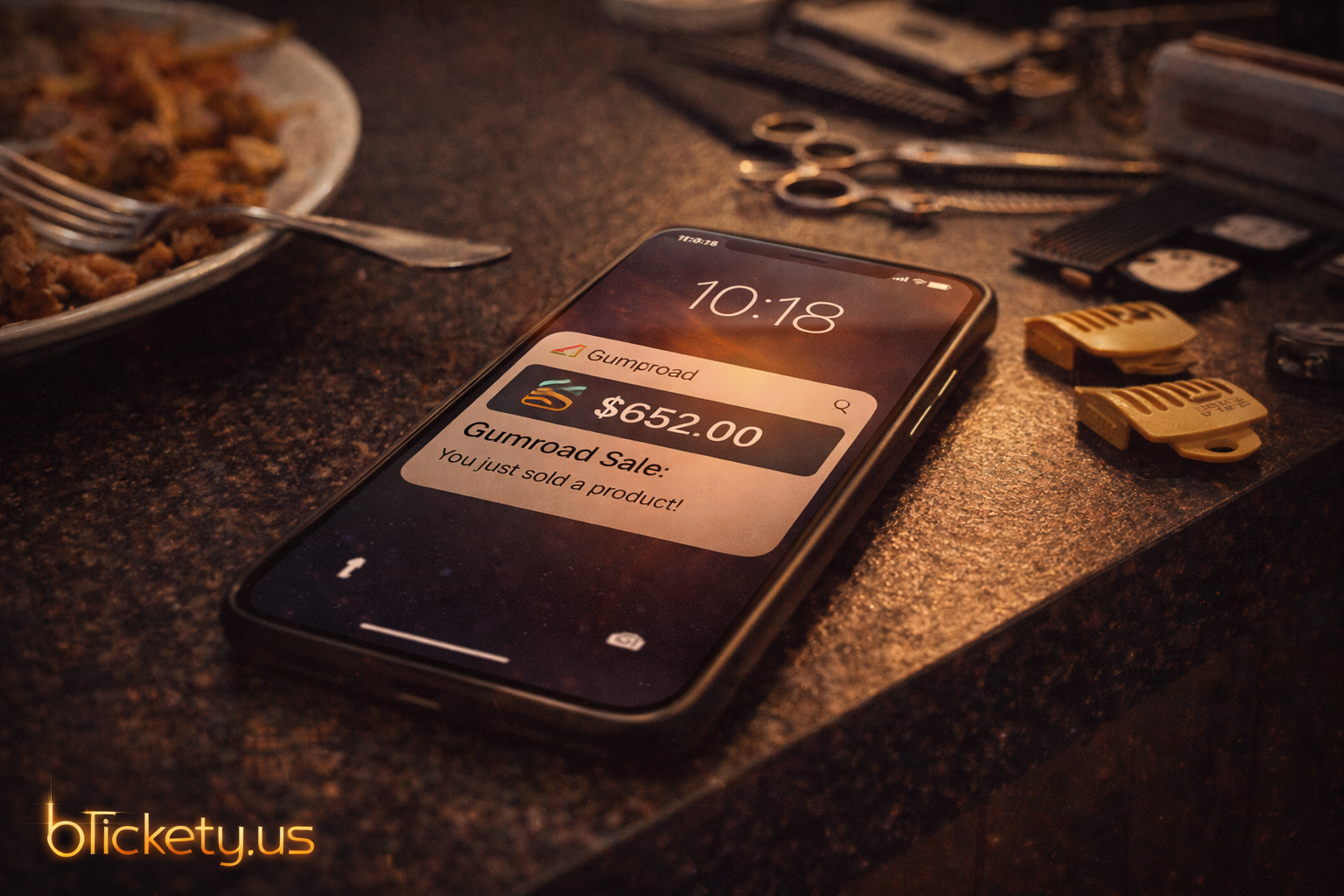
Gumroad — Your Digital Store, Open 24/7
Gumroad is the one that changes how you think about what you’re selling.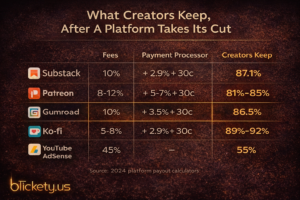
You don’t need a physical product. You don’t need a store. You need something valuable — and there’s an excellent chance you already have it.
An ebook. A template. A course. A beat pack. A photo preset. A digital zine. A swipe file. A research guide. Gumroad simplifies selling digital goods directly to your audience — ebooks, software, music, templates — with fast payouts and a flat 10% transaction fee, making it ideal for creators selling discrete, valuable items. Gumlet
The thing Black creators often underestimate is the depth of their own knowledge. If you know something — about investing, cooking, hair care, entrepreneurship, music production, content strategy, spiritual practice, digital tools — that knowledge is a product. Gumroad lets you package it and sell it while you sleep.
That’s not hustle. That’s infrastructure.
Ko-fi — The Tip Jar That Builds Culture
Ko-fi is the most accessible entry point in the stack. No monthly fees. No minimums. You set up a page, share the link, and your community can support you directly — one-time tips, memberships, digital product sales, commissions.
For Black creators just getting started, or for creators who want a frictionless way for their community to show love, Ko-fi removes every barrier. You don’t need a big audience. You don’t need a polished product. You need people who value what you do and a simple way for them to show it.
It’s not going to replace a full income. But it starts the relationship between your audience and direct support — and that relationship is the foundation everything else gets built on.
YouTube — The Long Game Worth Playing
YouTube is the only major platform that genuinely rewards creators over time. Videos keep earning. Old content keeps finding new audiences. The YouTube Partner Program lets creators earn from ads, memberships, and Super Thanks — and the earnings compound in ways that TikTok and Instagram simply don’t. 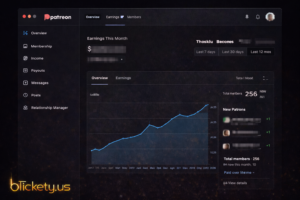
YouTube and TikTok consistently rank as the top two platforms for creator income generation, with YouTube offering the most consistently reliable long-term earnings through multiple revenue pathways. DemandSage
For Black creators building a body of work — not just content, but work — YouTube is the archive and the engine. The channel you build this year will still be working for you in five years. That’s the kind of asset that compounds.
The algorithm bias exists here too. But YouTube’s search function means content can be discovered without algorithmic amplification — someone searching for exactly what you make can find you without a single boost.
The Affiliate Play — Getting Paid for What You Already Recommend
Here’s the one most Black creators sleep on.
You’re already recommending products. You’re already telling your people about the tools you use, the books you read, the services you love. The only difference between doing that for free and doing it for income is a single affiliate link.
LaShonda Brown does a genius job educating people about tech tools and then making affiliate revenue from recommending those same tools to her viewers — and unlike sponsorships or ad revenue share, you don’t have to meet any threshold to start earning. The Culture Economy
Amazon Associates. ShareASale. Impact. PartnerStack for software tools. The affiliate infrastructure already exists — and unlike brand deals, it doesn’t require you to have a massive following before you qualify. You need an audience that trusts you. That’s it.
The Philosophy Behind the Stack: Own What You Build
Here’s the thing though — the tools aren’t the revelation. The philosophy is.
Every platform listed above shares one core feature: it puts the relationship between you and your audience outside the control of a third party. Your Substack list is yours. Your Gumroad store is yours. Your Patreon community is yours. No algorithm can suppress it. No policy change can demonetize it overnight. No shadow ban can hide it.
In 2026, the creator economy is done playing small and waiting for platform payouts — creators are building their own tables, launching brands, owning their IP, and cashing in on what they built from scratch: attention, trust, and community. inBeat Agency
This is the Afro-Futurist tech move. Not chasing what someone else built. Building something that outlasts you.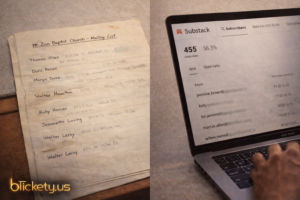
Think about it. Black Wall Street wasn’t just an economic success story — it was an infrastructure story. Banks, schools, theaters, newspapers, medical offices. Black people building systems that served Black people without waiting for permission from the outside world. The digital version of that is being built right now — one Substack, one Gumroad store, one Patreon community at a time.
The tools are different. The mission is the same.
Own your audience. Own your products. Own your income. Own your bag.
Where to Start: The Minimum Viable Creator Stack
You don’t need all of these at once. Start with what matches where you are:
If you’re a writer or thinker: Substack first. Build the list. Monetize when you’re ready.
If you already have an audience: Patreon. Turn passive followers into paying community members.
If you have knowledge to package: Gumroad. Build one digital product. Price it fairly. Watch it sell while you sleep.
If you’re just starting: Ko-fi. Get your first direct support. Let people show up for you.
If you’re playing the long game: YouTube. Build the archive. Let it compound.
Whatever you’re doing: Add affiliate links to what you already recommend. Get paid for the trust you’ve already earned.
The stack doesn’t have to be built overnight. But every piece you add is another brick in something that belongs to you.
And in 2026, when the algorithms keep shifting and the platforms keep changing the rules — the only thing that doesn’t move is what you own.
Start building.
Maono Tech lives inside the-afrofuturist.com — the home for Black innovation, digital liberation, and the tech tools that serve the culture. Explore more at the-afrofuturist.com