### Painting the Hurricane Fence: Why Black Celebrity Philanthropy Won’t Save Us
Author: Altimore Fields
Publication Date: 21 February 2026
Abstract:
Painting the Hurricane Fence argues that Black celebrity philanthropy has become a symbolic performance that obscures the structural forces producing the very crises it claims to address. The article traces how media, corporate partnerships, and algorithmic amplification convert charitable gestures into reputational armor, allowing institutions to celebrate visibility instead of transformation. It situates these performances within a longer history of racialized spectacle, where Black suffering becomes a stage and Black celebrity becomes a buffer that protects existing power rather than redistributing it. By examining recent philanthropic campaigns and their political afterlives, the piece shows how these gestures reinforce the hurricane fence — a barrier that looks protective but does nothing to stop the storm. The article concludes that liberation requires systemic investment, not symbolic rescue, and that celebrity cannot substitute for collective power or structural change.
Download Scholar Edition (PDF)
Painting the Hurricane Fence: Why Black Celebrity Philanthropy Won’t Save Us — And What Will

Let’s be real about what happened in 2025.
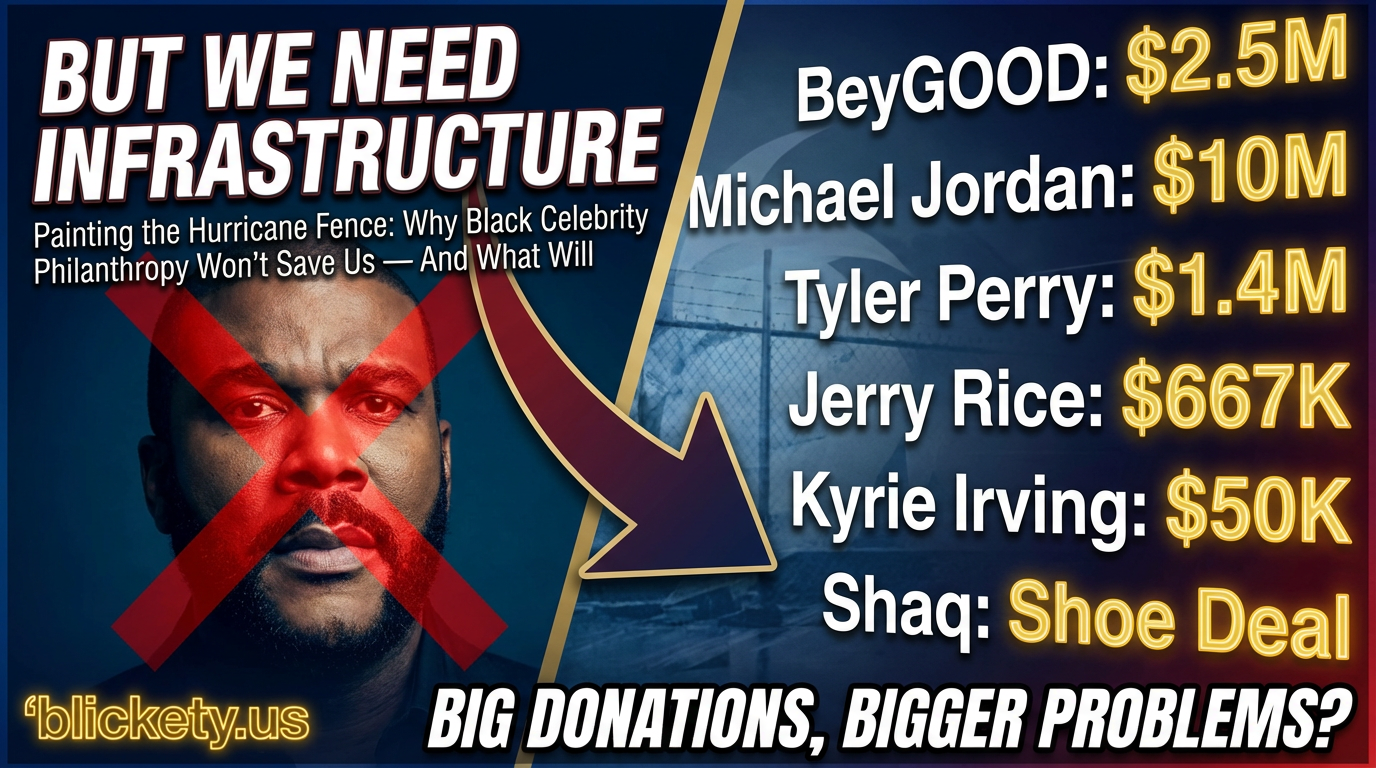
Beyoncé dropped $2.5 million for LA wildfire victims through BeyGOOD. Michael Jordan gave $10 million to rename a neuroscience institute after his mother. Tyler Perry wrote nearly $1.4 million in checks to food banks and school lunch programs right before SNAP benefits got threatened by a government shutdown. Jerry Rice and his wife cleared lunch debt at 103 schools — over $667,000 gone, poof, like it was never there. Kyrie Irving sent $50,000 to the Tamir Rice Foundation on what would have been Tamir’s 23rd birthday. Shaq flew a six-year-old martial arts prodigy named Nalah Barry to New York and gave her a shoe deal.
Good stuff. Real stuff. You can’t look a kid who just got her lunch debt cleared in the eye and call that nothing.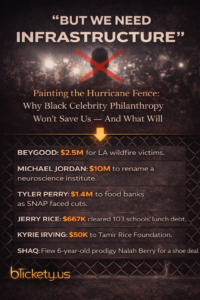
But here’s the question the headlines don’t ask: the morning after the press release drops and the Instagram story fades — what changed structurally? What system got disrupted? What pipeline got redirected? What fence got torn down and replaced with a wall that actually holds?
None of it. The fence just got a fresh coat of paint.
And if you’re operating from an Afro-Futurist mind — if you’re thinking about where Black people are going, not just where we’ve been — you already know that painting a hurricane fence is not a plan. It’s a performance. A beautiful, occasionally tearful performance. But a performance nonetheless.
Black Celebrity Philanthropy Looks Big Until You Do the Math
Black households give 25% more of their income than white households, despite a persistent racial wealth gap. Nearly 67% of Black families donate annually. Givebutter We have always been generous people. That’s not the debate.
The debate is about scale. About structure. About who the giving actually serves long-term.
Beyoncé’s net worth clears $500 million. Jordan is a billionaire. Tyler Perry built a $1 billion studio empire on land he owns outright in Atlanta. When Jordan drops $10 million on a hospital, that is — by his own math — roughly what the average American household earns across two or three generations. For him? That’s what a slow Tuesday looks like on paper.
That’s not shade. That’s arithmetic.
And the arithmetic reveals something ugly: the donations feel transformative because they’re large in absolute numbers, but they’re cosmetic relative to the actual size of the problem. The Greenwood District — Black Wall Street — had a local economy so well-circulated that the average dollar stayed within the community for approximately 19 months before being spent elsewhere. Brookings Nineteen months. Today? A dollar lasts around six hours in Black communities on average. Princeton African American Studies
Six hours versus nineteen months. That’s not a gap. That’s a canyon. And no amount of celebrity check-writing closes a canyon like that.
The Cart Is Still Before the Horse
Here’s what they do: they send Black kids to college.
Oprah has poured over $25 million into Morehouse. Beyoncé cuts checks to HBCUs. Jay-Z’s Shawn Carter Foundation funds students facing socioeconomic hardship. The headline writes itself — “Generous Icon Invests in the Next Generation.”
Look closer though. What happens when that next generation graduates?
Black celebrities are thriving within a kind of Gilded Age that’s at a deep remove from the rest of Black America. Salon The kids they send to school graduate into a job market that is structurally hostile to them. Black unemployment runs nearly double white unemployment. Black college graduates face discrimination in hiring, longer job searches, and routine placement below their credentials — often landing in roles that have nothing to do with what they studied.
A college grad who can’t get a job in their field is theoretically the same as a pair of jeans that went out of style. You paid premium price. You invested time, identity, debt. And now nobody’s buying. The market shifted underneath you before you even got to the register.
So what does the Afro-Futurist mind say about that?
It says: you’re putting the cart before the horse. You’re training pilots before you’ve built an airport. You’re graduating chefs before you’ve opened a restaurant. The infrastructure has to come first — Black-owned businesses, Black-owned financial systems, Black-owned labor markets — and then the degrees make sense as feeders into ecosystems we actually control.
Right now, too much of that scholarship money is essentially training our best people to compete harder in someone else’s game. That’s not liberation. That’s a more sophisticated version of the same dependency.
What Black Wall Street Actually Taught Us
Here is the thing that gets lost every time someone posts an infographic about Tulsa in 1921.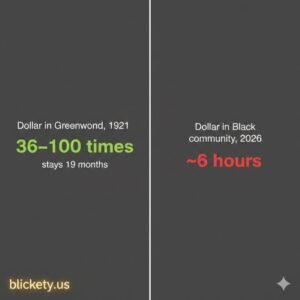
Black Wall Street was not built by generosity. It was built by necessity.
Segregation “forced the development of an insular African American economy to cater to the needs of this walled-off community. With it, an affluent class of African American entrepreneurs developed.” Tulsa Library Black dollars recirculated because there was nowhere else for them to go. Jim Crow didn’t just brutalize Black people — it accidentally created the conditions for one of the most powerful economic ecosystems Black America has ever produced.
By 1921, a dollar spent in Greenwood circulated 36 to 100 times before ever leaving the community. Princeton African American Studies There were 191 businesses. Two newspapers. A hospital. A library. Lawyers. Doctors. Architects of tomorrow living today.
And the wealthy Black people of that era — the O.W. Gurleys, the J.B. Stradfords — they didn’t have an escape hatch. Their plight was tied to the community’s plight. Their wealth could not fully flee into White markets without backlash, violence, or destruction waiting on the other side. So they invested locally. Not out of pure altruism. Out of survival intelligence.
That’s the history lesson celebrity philanthropy keeps skipping. The unity wasn’t idealism. It was infrastructure designed by hostile conditions. And it worked — so well that white Tulsa burned it to the ground in 1921 because they recognized the threat it represented.
Researchers estimate white rioters decimated more than $200 million of Black property in today’s dollars, and they associate the massacre with stifling Black innovation for generations. Harvard Gazette
They didn’t burn it because it was weak. They burned it because it was working.
The Escape Hatch Is the Problem
Post-Civil Rights integration opened a door. A real door. Access to White schools, White businesses, White neighborhoods, White corporate ladders. And some of us walked through. Ran through. And that’s not wrong in itself.
But it cracked something. It gave wealthy Black people an escape hatch from the community’s shared plight. Suddenly you could make it without making the community make it with you. Suddenly the Madam C.J. Walkers of the world — who funded anti-lynching campaigns, built YMCAs, gave $5,000 to the NAACP at a time when that was revolutionary money, who treated philanthropy as inseparable from business — those people became the exception rather than the expectation.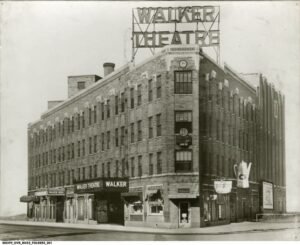
As Black entertainment has accumulated power and clout in recent years, becoming more visible, prolific and profitable, there has arguably been a simultaneous and equal dip in Black celebrity activism. Salon The checks get bigger. The systemic engagement gets quieter. The fence gets a shinier coat of paint.
The wealthy Black person in 2025 does not have to tie their fate to the hood. The system designed it that way on purpose. Individual escape is always on offer. Collective liberation never is.
Black Celebrity Philanthropy and the Charitable Industrial Complex
Real talk: the machine runs on the donations.
When Perry writes a check during a government shutdown, politicians exhale. When Beyoncé funds wildfire relief, FEMA gets to look competent by proxy. When celebrities step in to fill the gap left by defunded public programs, those programs stay defunded. The pressure to fix them dissipates. The narrative becomes “the community took care of itself” — which sounds empowering but functionally means the state off-loaded its responsibility onto rich entertainers’ PR budgets.
That is not a bug in celebrity philanthropy. That is the feature.
Black philanthropy has never been charity. It is survival technology: the offering plate funding freedom schools, the Masonic lodge raising scholarship money, the neighborhood drive repairing what policy neglects. Essence
That’s the tradition. That’s the lineage. But that lineage didn’t stop at charity — it built institutions. It built banks and newspapers and hospitals and schools and mutual aid societies that outlasted the individuals who founded them. The offering plate wasn’t the plan. It was the seed money for something permanent.
What’s the permanent structure behind the 2025 donation cycle? What institution gets built? What pipeline stays open after the press release fades?
Ask that question long enough and the silence becomes its own answer.
The Afro-Futurist Blueprint: DAO Jones and the Sovereign Finance Move
So what does the Afro-Futurist mind actually build instead?
Not charity. Infrastructure. Not individual escape. Collective sovereignty. Not painting the fence. Tearing it down and planting something that grows.
Finance is second to none. Every system runs on it. Land without financing is poetry. Businesses without capital are ideas that die in notebooks. Grads without ecosystems that employ them are expensive losses. Finance is the blood — and right now, too much of it leaks out of Black communities before it can circulate and compound.
The vision is not complicated. It requires will, not genius.
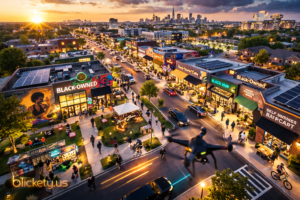
Build Black hamlets. Black townships. Black economic enclaves with Black-owned businesses that pay living wages — not as charity, but as the normal cost of operating in a community that demands accountability from its own. Once the enclave exists, once the businesses are running and the wages are flowing, then the college degree makes sense. Then the grad has somewhere to land that isn’t a White-owned company that hired them for optics.
The finance layer underneath that? It can’t be a traditional bank. Traditional banks have mandates. They answer to regulators, to shareholders, to political winds. They redlined our grandparents. They’ll redline our grandchildren with different paperwork.
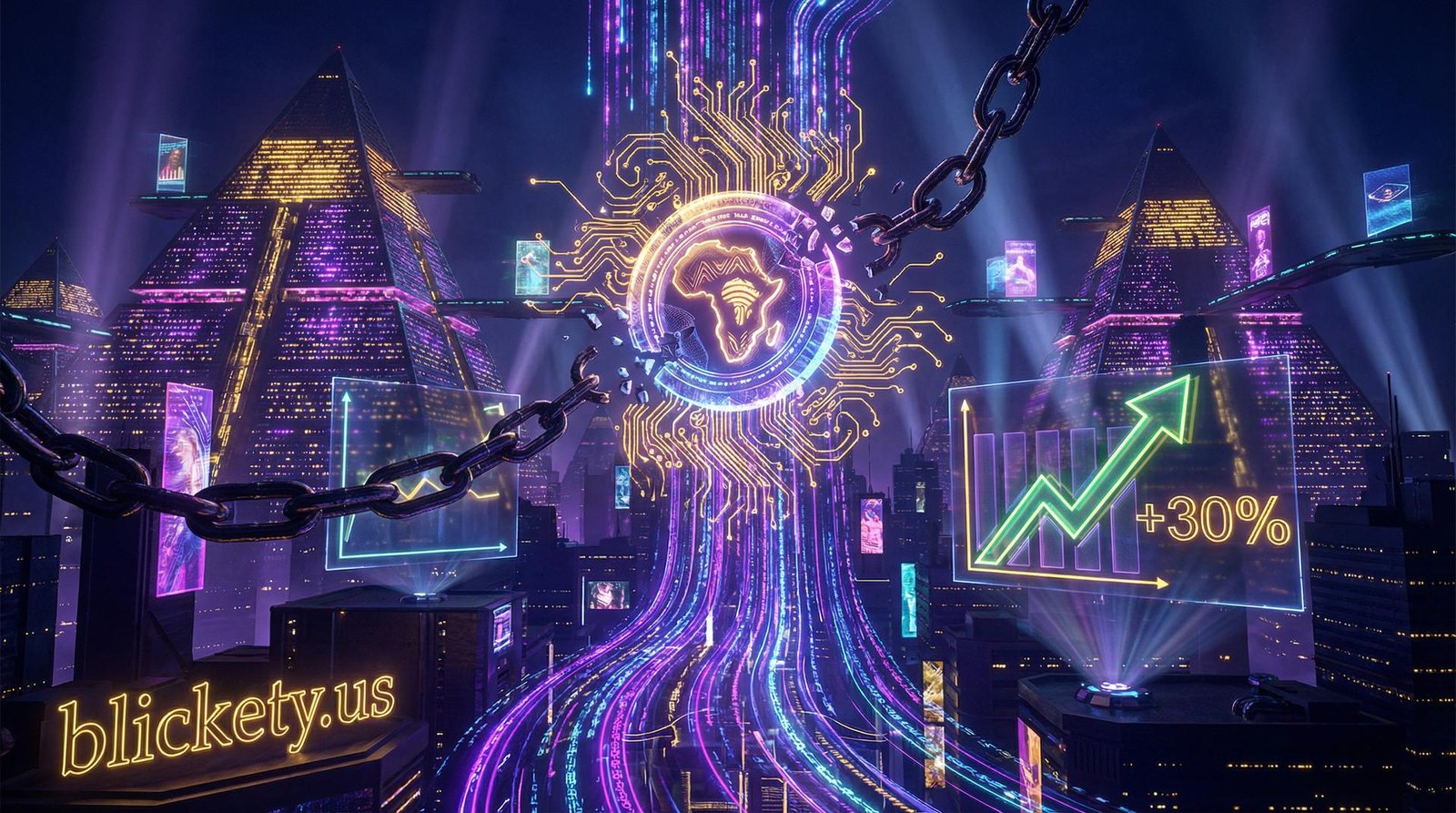
The answer is decentralized. Community-governed. Accountable to token-holders, not executives. A DAO — a Decentralized Autonomous Organization — structured to function like a community bank: pooling capital, lending internally, funding enclave businesses, acquiring land, generating yield that stays inside the ecosystem.
Call it DAO Jones. Flip the Dow Jones on its head. The original Dow tracks 30 corporate blue-chips owned mostly by White billionaires. DAO Jones tracks something else entirely: Black sovereign wealth, Black-owned business growth, community capital in circulation. No central authority freezing accounts. No mandate from the government telling us who qualifies for a loan. Smart contracts enforcing rules transparently, treasury in BTC and stablecoins, governance voted on by the community that built it.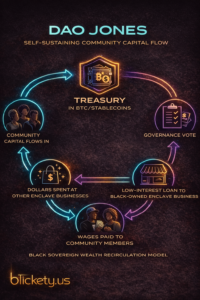
Crypto is still nascent. Volatile. Not wide enough yet for the whole play. That’s why you hedge. BTC as the reserve — digital gold, inflation-resistant, self-custodied. Stablecoins for liquidity and internal lending. DeFi yield strategies that fund the enclave without waiting on a government grant or a celebrity tax write-off. The world is transferring into a new financial system right now. The institutions know it. BlackRock knows it. The right picks, made collectively and governed communally, can push Black sovereign wealth to the top of that transition — not as passengers, but as architects.
That’s not fantasy. That’s Afro-Futurist praxis. It’s Black Wall Street built with 21st-century tools. It’s the Greenwood dollar circulating 36 times again — this time on a blockchain that nobody can burn down overnight.
The Real Smile
Nalah Barry getting a shoe deal from Shaq is a good moment. A genuine one. The tears on that mother’s face in the Jennifer Hudson Show audience when A’ja Wilson surprised her son are real. You can’t manufacture that.
But the Afro-Futurist is not satisfied with moments. We are building timelines.
The real smile is not the one on the face of a kid whose lunch debt got cleared — it’s the one on the face of a kid who grows up in a community where lunch debt doesn’t exist because the enclave’s businesses circulate enough wealth that no child is food insecure. The real smile is the Black woman who spent her childhood playing video games, discovered drone technology, built a company, and found a community that had already built the infrastructure to support her. The real smile is the grad who comes home from Howard or Spelman or Morehouse and finds a DAO-funded tech hub already running, already hiring, already building the next version of what Black excellence has always been — self-sufficient, self-defined, self-determined.
Celebrity philanthropy gives you the paint.
Sovereign infrastructure gives you the wall.
The ancestors didn’t build with handouts. They built with intention, with pooled resources, with the understanding that every brick you lay is a brick your grandchildren don’t have to find somewhere else. That’s not nostalgia. That’s the blueprint.
Time to stop painting and start building.