
Why FBA Reparations Are Necessary — And Why Lineage Is the Only Compass That Works

There is finally a compass.
After generations of symbolic marches, fragile coalitions, and movements that dissolved the moment the cameras left — FBA reparations now have something they have never had before: a documented, lineage-based claim that the law itself is beginning to recognize. Not a vibe. Not a slogan. A legal framework rooted in the most specific and traceable historical injury in American history: chattel slavery on American soil, and everything the American government did — and kept doing — after.
FBA is a lineage-based designation that specifically refers to the over 43 million Black Americans who are direct descendants of the Freedmen — the formerly enslaved Black people who were emancipated in the United States. This lineage represents a unique and unbroken connection to the foundational builders of this nation. Officialfba
That is not poetry. That is a definition. And definitions matter enormously when you are building a legal claim worth trillions.
FBA reparations are not a radical ask. They are the most historically documented, legally grounded, and morally self-evident demand in American political history. The pushback is loud. The confusion is real. But neither the noise nor the confusion changes what the record shows. And the record is unambiguous.
FBA Reparations Have Always Been a Lineage Question — Not a Race Question
Here is where most people get lost, and where clarity becomes the most dangerous thing in the room.
FBA reparations are not a race-based claim. They are a lineage-based claim. That distinction is not semantic — it is the entire foundation. A race-based claim says every Black person in America is owed something. A lineage-based claim says the specific people whose ancestors were held in chattel slavery on American soil, whose labor built the American economy without compensation, whose descendants were then systematically denied the wealth that labor generated — those people are owed a specific, documented, legally traceable debt.
California’s reparations task force voted 5-4 in favor of defining eligibility based on lineage “determined by an individual being an African American descendant of a chattel enslaved person or the descendant of a free Black person living in the US prior to the end of the 19th century.” The task force chairperson said that not going with a lineage-based approach would “aggrieve the victims of slavery.” Governing
Read that again. Aggrieve the victims. Not symbolically — legally. If FBA reparations get diluted into a universal racial claim, the people most harmed become invisible inside the category designed to protect them. That is not justice. That is erasure dressed in the language of inclusion.
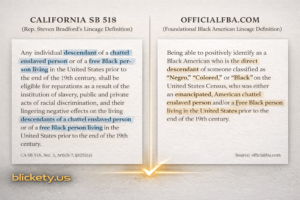
The legal architecture being built right now reflects this. California’s SB 518 defines descendants as individuals who can establish direct lineage to a person who, prior to 1900, was subjected to American chattel slavery — including those emancipated through legal or extralegal means, gradual abolition statutes, military service, or classified as fugitives from bondage. CA
That is a compass. That is a line drawn in law, not in sand. FBA reparations need that line to hold.
The Three Pillars That Make FBA Reparations Unbreakable
Every movement that has tried to secure FBA reparations has failed for the same reason: one of three pillars collapsed before the structure could stand. Lineage without sovereignty is just genealogy. Sovereignty without political clarity is just pride. Political clarity without lineage is just politics. All three have to lock together, or FBA reparations remain symbolic — and symbolism has never paid a debt.
Lineage is the anchor. It answers the “who.” Every potential beneficiary should be able to provide plausible and legitimate documentation about their lineage. Officialfba Without that documentation, the claim dissolves the moment it enters a courtroom. Lineage is not gatekeeping for its own sake — it is the difference between a claim that holds and a claim that gets dismissed.
Sovereignty is the boundary. It answers “what is ours.” FBA culture — the blues, jazz, hip-hop, the civil rights movement, the intellectual tradition from Frederick Douglass to James Baldwin to Octavia Butler — belongs to a specific lineage. That culture has been borrowed, remixed, marketed, and exported globally, often without acknowledgment and certainly without compensation. FBA sovereignty says: this is ours, it has always been ours, and our political claims are rooted in what this lineage built and survived — not in what anyone else chose to claim afterward.
Political clarity is the engine. It answers “what we are owed and why.” The federal HR 40 bill — the Commission to Study and Develop Reparation Proposals — has been reintroduced in Congress for decades. The legislation addresses the institution of slavery, the de jure and de facto discrimination against freed slaves and their descendants from the end of the Civil War to the present, and the lingering negative effects of that institution on living African Americans. Congress.gov That is the scope. That is the argument. FBA reparations are not asking for charity — they are presenting a bill for services rendered under duress across three centuries.
Remove any one of these pillars and the entire claim collapses back into symbolism. That is why FBA reparations require all three. That is why the movement is firmer now than it has ever been.
Pan-Africanism Was a Ship That Was Never Built to Sail
Real talk. Pan-Africanism has always been strongest as a cultural idea and weakest as a political structure. It was never a lineage system. It was never a legal category. It was never a reparations framework. It was a feeling — and feelings, however powerful, cannot stand in a courtroom.
The people who carried pan-Africanism furthest — the Du Boises, the Garveys in their American era, the Stokely Carmichaels, the Malcolm Xs, the entire intellectual and artistic tradition of Black American radicalism — were overwhelmingly FBA. Black Americans were the engine, the megaphone, and the cultural currency of global Black identity for over a century. The sacrifice was disproportionate. The return was not.
Think about what that actually means. Go to Africa as a Black American — as someone tracing a lineage that survived the Middle Passage, Reconstruction, Jim Crow, redlining, mass incarceration — and discover that you are a tourist. Price-gouged. Treated as an outsider. Welcomed for your dollars, not your blood. The Yoruba and Igbo have been in tension for thousands of years. Tribalism did not end in 1960. Shared melanin has never meant shared interests, and pretending otherwise has cost FBA people more than it has ever given them.
Pan-Africanism is a museum ship — magnificent, meaningful, permanently docked. You can honor it. You can learn from it. You can acknowledge it as part of the story. But FBA reparations cannot be built on a vessel that was never meant to sail in legal or political waters. The compass points a different direction now.
Why the Pushback on FBA Reparations Is Actually Proof That the Claim Is Real
Here is something the Afro-Futurist mind notices immediately: the louder the pushback, the more real the claim.
While no federal reparations program exists as of 2025, local and state-level efforts are increasingly shaped by the debate over who qualifies — and why. FBAs aren’t rejecting unity or Black global solidarity. They’re calling for respectful distinction. Cultural preservation and reparative justice require honoring the unique role of those whose ancestors built America from the ground up. Interracial Marriage
The pushback against FBA reparations takes a specific shape. It argues that lineage-based eligibility is divisive, that it “others” immigrants, that it resembles the logic of exclusion. But notice what that argument actually requires: it requires erasing the specific nature of the harm. It requires treating 250 years of American chattel slavery, followed by another century of legal apartheid, as equivalent to any other Black experience anywhere in the world. That is not inclusion. That is the disappearance of the actual victims inside a category broad enough to hold everyone — and therefore accountable to no one.
Black immigrants from Africa and the Caribbean have been strategically elevated — by institutions and political actors — to dilute or redirect reparations efforts. After the 1965 Immigration Act, which FBAs helped push for, a wave of Black immigrants entered the U.S. Interracial Marriage
That is not a conspiracy. That is a documented pattern: whenever a specific Black claim becomes legally viable, the definition of “Black” expands just enough to dilute the claim. FBA reparations cut through that expansion. The lineage is the line. The line is the protection.
Closing the chapter on pan-Africanism as a political identity is not disrespectful. It is not hostile. It is not rejection. It is completion. Every lineage, every nation, every ethnic group eventually arrives at the moment where it says: this is who we are, this is what we are owed, and this is where our political sovereignty begins and ends. FBA reparations represent that moment.
The Law Is Already Moving — The Question Is Whether FBA Identity Is Firm Enough to Receive It
This is the part that should make every FBA person pay close attention. The legal infrastructure for FBA reparations is being built right now — not in theory, but in statute.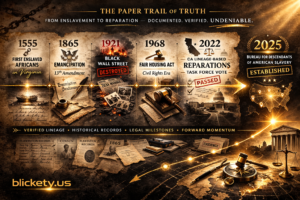
California’s SB 518 establishes a Bureau for Descendants of American Slavery within the state’s Civil Rights Department, with authority to confirm eligibility for descendants of U.S. chattel slavery, coordinate restitution and financial redress, support property reclamation programs, and advance public education, research, and government accountability. CA
A Bureau. For Descendants of American Slavery. With legal authority to confirm eligibility, coordinate restitution, and support property reclamation. That is not symbolism. That is an institution being built with public money to serve a specific lineage.
Washington State funded its own reparations study in 2025. The federal HR 40 bill keeps getting reintroduced. The California task force already voted that lineage — not race — is the eligibility standard. Experts have testified that establishing lineage in a race-neutral fashion is less likely to be struck down by courts. CalMatters The law is learning to say what FBA people have been saying for years: this is a specific claim, rooted in a specific history, owed to a specific group.
The question is no longer whether FBA reparations can be legally grounded. The question is whether FBA identity is firm enough, documented enough, and politically unified enough to receive what the law is beginning to offer. Lineage enforcement is the fragile pillar — not because the claim is weak, but because the emotional work of separating heritage from identity, and identity from pan-African nostalgia, is the hardest part of any sovereignty movement.
Africa is the origin. The Middle Passage is the rupture. FBA identity is the continuation. You can honor the origin without letting it define you. You can acknowledge the rupture without being destroyed by it. You can claim the continuation without apology.
The Afro-Futurist Imperative: Build the Infrastructure Around the Claim
FBA reparations, when they arrive, will not be a finish line. They will be seed capital.
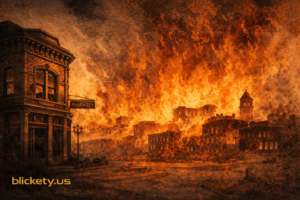
The Afro-Futurist sees what most people miss: the reparations check is the beginning of the build, not the end of the struggle. Think about what Greenwood had before it was destroyed — a dollar spent in Greenwood circulated 36 to 100 times before ever leaving the community. Princeton African American Studies Banks. Newspapers. Hospitals. Lawyers. Real estate. A self-sustaining ecosystem where FBA wealth compounded internally because the enclave was intact.
The infrastructure has to be ready when the resources arrive. Black hamlets and townships with Black-owned businesses paying living wages. Black-governed financial systems — DAO structures, community banks, decentralized lending pools — that keep FBA wealth inside FBA ecosystems instead of immediately leaking into the same extractive economy that created the debt in the first place. Black educational pipelines that feed into Black-owned employers instead of training FBA talent to compete in someone else’s game.
FBA reparations are not a handout. They are a debt payment on the specific, documented, legally traceable injury of American chattel slavery. And like any debt payment, what you do with it after it arrives determines whether it transforms anything or simply disappears into the same hurricane that has always been coming.
The lineage is documented. The sovereignty is defined. The political claim is concrete. The law is moving.
The gauntlet has been slammed. The compass points forward. FBA reparations are not a debate anymore — they are an inevitability. The only question is whether we build the infrastructure to receive them before the moment passes.
Build first. Receive second. Multiply forever.