‘What You Gonna Do?’: Two Black Men Laugh in a Racist’s Face — And Black Joy as Resistance Goes Viral
He had one minute. One minute to land an insult, to wound, to steal something. He brought Jim Crow-era slurs. He brought a phone camera broadcasting his performance live to whoever would watch. He brought manufactured rage and the full arsenal of 400 years of dehumanization language — “coon,” “monkey,” the N-word — aimed at two young Black men who had the audacity to simply exist on a sidewalk on February 21, 2026.
He got nothing. They laughed in his face.
The video shared by X user @Suzierizzo1 on February 22 has been shared at least 700 times, with the internet erupting not in anger but in applause. Not because the racism was funny — it wasn’t — but because what those two men did in response was something ancient, something deliberate, something that Black people have been doing long before anyone had a name for it.
Black joy as resistance. And it just went viral again.
What Happened: The Full Scene
The video is about 60 seconds. An unidentified white man films himself during what appears to be a live stream, slinging slurs at two Black men walking past him on the street. “Dumb coon thinks I’m starting sh-t,” he says into his phone. “I don’t give a f*ck. I can say what I want. I don’t like them.”
One of the Black men responds — his exact words not fully audible in the footage — but whatever he said lit the heckler up further. The white man escalated, deploying what he clearly believed was his heaviest ammunition. “Oh, look at this here. I’m a monkey from the streets. I’m a monkey. It’s what you is.”
Then came the moment that broke the internet. When one of the men asked simply, “What you gonna do?” — the racist deflated. “Not a damn thing, motherf*cker,” he said. Because that was the truth. He had nothing. No power. No punch. No plan beyond the hope that his words would do what centuries of that same language was designed to do: shrink a Black man.
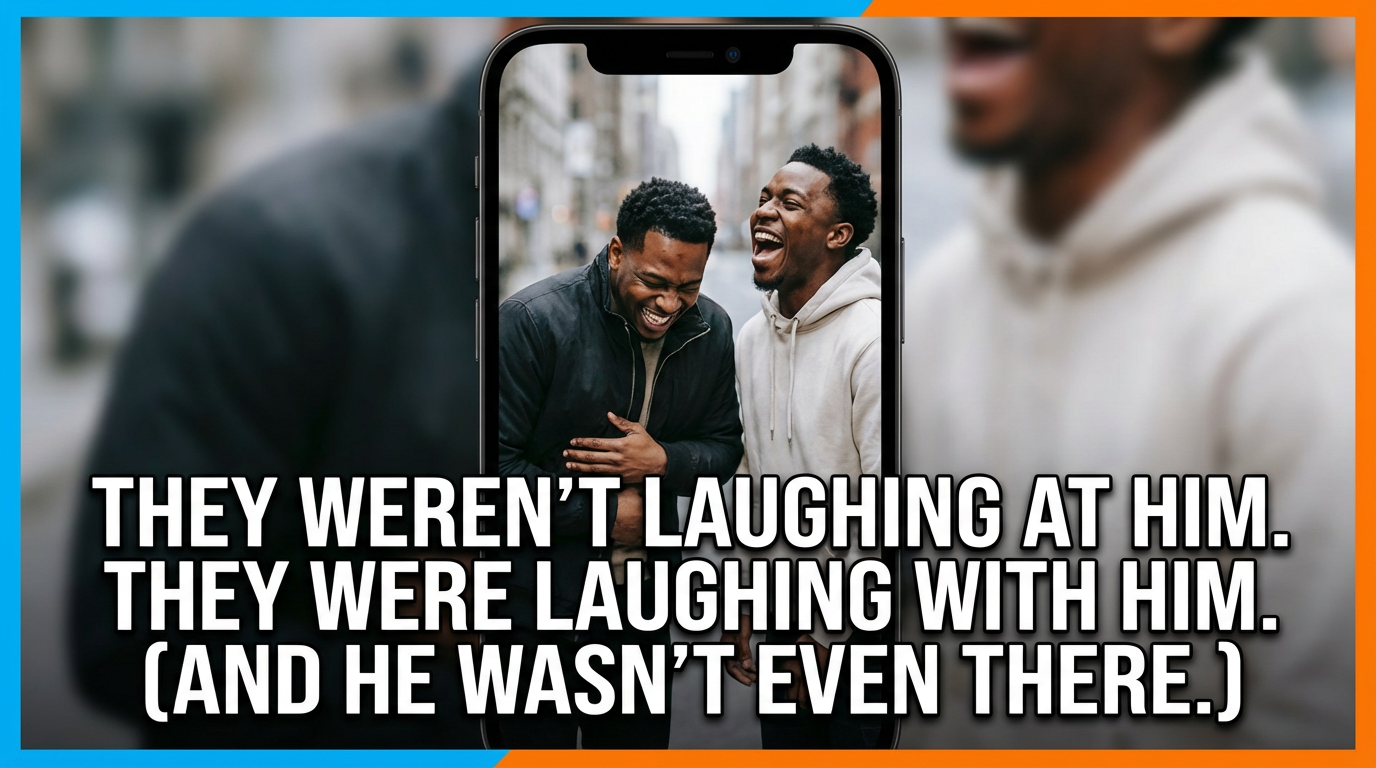
Instead, the two men laughed. Not the laugh of people pretending to be unbothered. The laugh of people who recognized a man swinging at air. The laugh that communicates, clearly and without malice, that you are not a threat to us. You are, in fact, deeply embarrassing.
Commenters on X delivered the verdict: “He went out rage-baiting where he knew he wouldn’t get any real static and got boisterous for clicks. Ultimately, not getting his desired reaction and being laughed at the whole way. Bravo!” Another wrote: “I’m hollering, he got nothing. Shout out to these two Black kings for keeping their composure.”
The internet is also now working to identify the man. Screenshots are circulating. The algorithm is not on his side.
Why the Laughter Was Not Incidental — It Was the Weapon
Here is what the headlines will miss if we let them: that laugh was not a coping mechanism. It was not a nervous reflex. It was not the men “keeping their cool” as if cool is a neutral default. That laugh was Black joy as resistance deployed with surgical precision in real time.
 The Smithsonian’s National Museum of African American History and Culture defines Black joy as an affirmation and an action — one that “demonstrates that internal responses are fully within a person’s control” and that claims power “where we can.” Kleaver Cruz, founder of the Black Joy Project, describes it as an internally driven happiness that someone “consciously chooses… as a way to combat the traumas of racism.” He calls it “an ancestral responsibility.”
Read that last phrase again. Ancestral responsibility. These two men did not just choose a response in a moment. They carried forward a tradition. They were standing in a lineage of Black people who have been choosing joy — weaponizing it, actually — as a form of survival and defiance for as long as the machinery of white supremacy has been trying to strip it away.
Andrea Walls, the multidisciplinary artist behind the Museum of Black Joy, puts it plainly: “The way they’ve arranged the history of Black people in America — it hasn’t centered joy. But we’ve always lived it.”
Always. Not despite the conditions. Within them. Against them. The laugh that white supremacy was never designed to survive.
The Afrofuturist Read: Rage-Baiting Is a Dying Script
To understand what happened on that sidewalk through an Afrofuturist lens, you have to understand what the heckler was actually doing — and why it failed so completely.
He was not having a spontaneous racist outburst. He was performing one. The phone camera was rolling before he even approached the men. He was live-streaming himself delivering hate for an audience — fishing for a reaction that he could monetize, clip, and repost as evidence of some threat he needed to perform against. This is the modern architecture of racist rage-baiting: manufacture a confrontation, provoke a response, frame the response as danger, collect the engagement.
The two Black men identified this in real time. And they opted out of the script entirely.
Afrofuturism, at its core, is about refusing to be written into someone else’s story. It is the intellectual and creative tradition that asks: what happens when Black people step outside the narrative that was built to contain them and author their own? Sun Ra, one of the founding pillars of Afrofuturist thought, said: “I’m not man. I’m a myth.” He was rejecting the category that white supremacy had created for him — not arguing within it, not fighting on its terms, but dissolving it through creative refusal.
Those two men on the sidewalk did something directly in that tradition. They refused to be a character in his story. They did not become the “threat” he needed. They did not become the “victim” either. They became something the script had no room for: two Black men laughing at a man who had nothing.
That is an Afrofuturist act. That is Black joy as resistance in its purest, most immediate form.
Black Joy Has Always Been This Dangerous
This is not new. What happened on February 21, 2026 is the continuation of a tradition that stretches back to the plantation, to Reconstruction, to the Great Migration, to the Civil Rights Movement, to every moment in American history when Black people chose delight over despair and that choice was treated as a threat.
Scholar Bettina Love writes that “joy is crucial for social change” and that finding joy in the midst of pain and trauma “is the fight to be fully human.” Not the fight to fight back. The fight to be fully human. Because the entire project of white supremacy depends on Black people being denied that humanity — on Black men being legible only as danger, as spectacle, as something to be managed or feared or pitied.
When those two men laughed, they were refusing all three categories. They were not dangerous. They were not pathetic. They were not in need of anyone’s sympathy. They were two human beings encountering something ridiculous and responding accordingly.
The NAACP Legal Defense Fund frames Black joy as living and laughing “when we weren’t meant to laugh and dreaming when we weren’t meant to dream.” That framing is essential. Because what angers racists most deeply is not Black anger — they have centuries of systems built to manage and punish that. What destabilizes white supremacy most profoundly is Black indifference. Black amusement. Black joy that does not ask permission and cannot be controlled.
The man on that sidewalk had no plan for being laughed at. He had never considered it as a possible outcome. His entire performance was built on the assumption that his words would land with weight. When they didn’t — when the two men he targeted treated his most poisonous ammunition like mild inconvenience — his whole architecture collapsed.
“I’m hollering, he got nothing,” said one commenter. That is the summary of the last four centuries.
The Viral Mirror: What the Internet Did With This Video
The way the video traveled on X is itself an Afrofuturist story. Over 700 shares in less than 24 hours. Commenters from across demographics arriving not with outrage but with laughter — mirroring the men in the video, extending the joy outward, turning a moment of targeted hate into collective celebration. 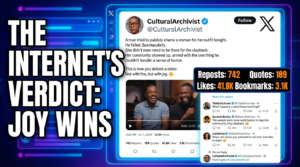
“Ridicule the desperate pleas for attention,” one person wrote. Another: “Shout out to these two Black kings for keeping their composure.”
And then the community moved into action. Screenshots of the heckler’s face are circulating. People are working to identify him. The algorithm that he tried to use as a weapon is being redirected against him. The live stream he built to gain an audience is now building a case.
This is what Afrofuturist resistance looks like in the digital age. It does not require a march. It does not require confrontation. It requires two men who refuse to perform for a racist, a phone camera pointed at the real story, and the collective intelligence of a community that has been practicing this particular form of joyful refusal for generations.
The internet gave them the last laugh. But they had already gotten it on the sidewalk.
What This Moment Reveals About 2026
It would be easy to file this story under “viral feel-good content” and move on. That would be a mistake.
These viral sidewalk moments are appearing with increasing frequency in 2026 — partly because phones are everywhere, partly because rage-baiting as a content strategy has become so common that it is now a recognized cultural phenomenon, and partly because the current political climate has given certain people the impression that open racism is not only acceptable but audience-building.
What the response to this video reveals is that Black people — and specifically Black men — are increasingly refusing to provide the content that racist performativity needs to survive. The rage-bait fails when the target doesn’t rage. The provocation deflates when the provoked are genuinely unbothered. The live stream becomes evidence against its own creator when the intended victim laughs and walks away.
As one commenter noted precisely: “He went out rage-baiting where he knew he wouldn’t get any real static.” Translation: he found a situation he thought was low-risk for him and high-yield for engagement. He miscalculated, because he did not account for Black joy as resistance as a strategy with centuries of refinement behind it.
He brought a live stream. They brought an ancestral practice. It was not a fair fight.
The Afrofuturist Takeaway: Joy Is Infrastructure
Afrofuturism asks us to look at the present moment through the lens of the future we are building. And what are these two men building, in the 60 seconds that the internet has been watching on repeat?
They are building a demonstration. A proof of concept. A real-time argument that the weapons that white supremacy has relied upon for four centuries — dehumanization, animalistic comparisons, the reduction of Black men to slurs — have lost their structural power when met with the right response. 
Joy, in this frame, is not a feeling. It is infrastructure. Kleaver Cruz calls it “an ancestral responsibility” because our ancestors understood something that gets re-demonstrated in videos like this every generation: that the laugh is a fortress. That the man who refuses to be wounded by a weapon that was built to wound him has dismantled something at its foundation.
The Afrofuturist tradition — from Sun Ra’s cosmic refusal of human categorization, to Janelle Monáe’s android mythology, to Missy Elliott’s deliberate refusal to perform desirability, to these two men laughing on a sidewalk in 2026 — is one continuous argument. The argument that Black people are not characters in anyone else’s story. That we choose our own categories. That we author our own responses. That we do not owe our suffering to anyone’s script.
“What you gonna do?” one of the men asked. The answer was: laugh. Walk away. Let 700 people share it. Watch the internet do the rest.
FAQ: Black Joy as Resistance
What is Black joy as resistance? Black joy as resistance is the practice — rooted in centuries of Black American and diaspora culture — of consciously choosing happiness, laughter, and celebration in the face of racism and oppression as a form of defiance and survival. It rejects the narrative that Black people must always respond to racism with visible pain or anger.
How is Black joy related to Afrofuturism? Afrofuturism centers the idea that Black people author their own stories, identities, and futures rather than living within narratives built by oppressive systems. Black joy as resistance is Afrofuturism in everyday practice — refusing to perform suffering for a system that depends on that suffering to maintain its power.
What happened in the February 2026 viral video? On February 21, 2026, an unidentified white man live-streamed himself directing racist slurs at two Black men on a sidewalk. The men responded with laughter and calm composure rather than anger, deflating the heckler completely. The video went viral on X with over 700 shares, with commenters widely celebrating the men’s response.
Why did the racist’s attempt fail so completely? His performance was built on the assumption that his words carried enough historical weight to provoke a reaction. When they didn’t — when the men met his slurs with laughter — the entire architecture of his rage-bait collapsed. As one X commenter observed, he got “not his desired reaction and was laughed at the whole way.”
What is rage-baiting and why does it fail against Black joy? Rage-baiting is the practice of deliberately provoking a reaction — particularly online — to generate engagement. It depends on the target responding with visible distress or anger. Black joy as resistance short-circuits rage-baiting because it removes the emotional reaction that the bait was designed to produce. Joy is, structurally, the one response that racist provocation has no counter-move for.
Published on The Afrofuturist | Culture | Resistance | Black Joy