Why Black Americans Could Never Buy Essence: Who All Going?
https://the-afrofuturist.com/wp-content/uploads/2026/03/essence-fest-2026-the-sacred-festival-at-a-cultural-crossroads-hallelujah.pdf
“Who all going?”
Pay attention to when Black folks ask that question. It ain’t always casual. Sometimes — especially after a rupture, after a betrayal, after something communal got cracked open and exposed — “Who all going?” is really asking something deeper. It’s asking: Are we still together on this? Do we still trust this? Is this still ours?
That’s what “Who all going to Essence Fest 2026?” really means right now. After what happened in 2025 — the sparse crowds, the scheduling chaos, the identity confusion, the cultural drift, and the financial mess none of us were supposed to find out about — asking “who all going” has become a referendum. And what makes Essence Fest 2026 a 32nd anniversary and not just another July 4th weekend in New Orleans is the weight of that question pressing down on every ticket purchase, every hotel booking, every conversation happening right now in group chats across Black America.
This piece is about all of it. The 2025 rupture. The FBA foundation that made Essence what it is. The impossible ownership story — why Black Americans could never have simply “bought” Essence even if they wanted to. The complicated legacy of the man who did buy it. And what 2026 has to prove before the aunties, the millennials, the Gen Z contingent, and the culturally serious can answer that roll call with a full-throated “I’m in.”
The Roll Call as Warning Signal — “Who All Going?” Is Not Small Talk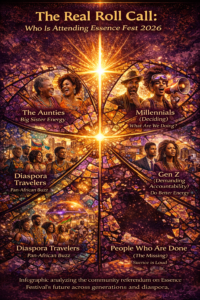
There’s a vernacular tradition that doesn’t get enough credit in cultural analysis: the Black roll call. It sounds like logistics. It is actually surveillance.
When something beloved has been disrupted — a cookout location changed, a church shook by controversy, a neighborhood spot that started letting in the wrong energy — the roll call is how the community takes its temperature. “Who all going?” is how we determine whether the thing is still the thing.
The Essence Festival of Culture has been “the thing” for over three decades. Born in 1995 as a one-time event to celebrate Essence magazine’s 25th anniversary, it grew into the largest annual gathering of Black culture in the United States — a pilgrimage, a homecoming, a party with a purpose. Hundreds of thousands of people descend on New Orleans every Fourth of July weekend. The Caesars Superdome becomes a cathedral. The convention center becomes a marketplace of Black-owned businesses, empowerment seminars, and conversations that don’t happen anywhere else.
For people who’ve been going for decades, it isn’t just a festival. It’s a reunion. It’s the aunties in their outfits. It’s the couples who got engaged there. It’s the business connections and the after-parties and the smell of the city and the feel of being surrounded, fully surrounded, by Black excellence. The Lens in New Orleans described the early Essence Festival as “more than just an event — it was a movement. It centered Black women in all their power.”
And then 2025 happened.
The 2025 Fiasco — The Year Essence Lost the Plot
Let’s be real about what 2025 was. Not performatively critical. Not piling on. But honest in the way that you have to be when something you care about goes sideways.
The physical evidence was damning. The Caesars Superdome’s top terrace level — which accounts for roughly 60 percent of available seating — sat barely a quarter full across all three nights. That hadn’t happened before, not in anyone’s recent memory. You could feel it. Empty seats in a space that’s supposed to vibrate with collective energy don’t just look bad. They feel like absence. Like something’s been subtracted.
The production failures compounded it. Lauryn Hill didn’t hit the stage until 2:35 AM — not because of her, but because of scheduling collapse on the organizers’ end. Essence publicly took responsibility. But the damage was already done in real time, on social media, in the exhausted and angry posts of people who’d traveled across the country and stood in a loud, chaotic building until nearly sunrise. Stephanie Mills was so underwhelmed by the professionalism of the event that she wrote an open letter publicly decrying the organizers. That’s not a minor thing. That’s a Black cultural legend saying, in print, that what she experienced did not meet the standard.
But all of that might have been survivable. Production mishaps happen. Scheduling disasters happen. What rattled people at a deeper level was the identity rupture.
The 2025 programming pushed a Pan-African pivot that many longtime attendees — particularly Black Americans who are descendants of slaves, the FBA community — experienced not as expansion, but as erasure. TikTok creator @deja.zhane captured what thousands felt: “Instead, it’s become a space that uplifts everyone else aside from Black American heritage. That shift is starting to feel really intentional.” That video didn’t go viral because it was extreme. It went viral because it named something real.
And then, months later, came the financial story that none of them planned on us knowing. Public records revealed that Sundial Media Group — Essence’s parent company — had an outstanding balance of $456,000 at the Ernest N. Morial Convention Center from the 2025 event, representing more than 60 percent of its hosting charges. A separate source alleged that over a million dollars was owed to a local production company. NOLA.com reported that $50,000 was paid only after the balance became public, bringing the outstanding amount down to roughly $406,000.
The festival that pours hundreds of millions of dollars into the local New Orleans economy owed its own vendors. The festival that built its brand on community was leaving community partners holding the bag.
When the smoke cleared — and when the performative posts stopped — what remained was a serious question. Not “Was 2025 fun for someone?” It definitely was, for some people. The question was: Does Essence still know what it is? And if it doesn’t, can we afford to give it our attendance, our dollars, and our trust again?
The FBA Foundation — The Cultural Motherboard That Powers Everything
Here’s what gets lost when this conversation devolves into FBA vs. diaspora, or American vs. African: the argument isn’t about exclusion. It’s about anchor.
Essence Festival — all of it, its grammar, its humor, its fashion codes, its politics, its spiritual energy, its relationship with New Orleans — was built on a specific foundation. Black American culture. Southern Black culture. The culture of people whose ancestors survived the Middle Passage, Jim Crow, redlining, and systematic exclusion, and who still had enough surplus joy and creative genius to build something like this from the ground up.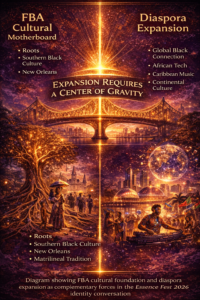
That’s not a boundary claim. It’s an architecture claim. You can’t expand a building by ignoring the foundation. You can’t build a global diaspora festival by treating the root system like a constraint.
The Essence Festival was launched in 1995 specifically as an extension of Essence magazine — a magazine that, from its founding in 1970, was created by and for Black American women. As Ebony reported in its 2025 coverage of the controversy, the festival has always been “a praise break wrapped in a protest. It’s a love letter to a people who endured the Middle Passage, survived Jim Crow.” That’s not a description of global Blackness in the abstract. That’s a description of a very specific, very rooted cultural inheritance.
Pan-Africanism is real. Diaspora unity is necessary. Dr. W.E.B. Du Bois, Marcus Garvey, and Stokely Carmichael all spoke to the necessity of African and Black American solidarity. But — and this is critical — unity cannot be built by sidelining the people whose cultural labor created the platform in the first place. You don’t build cross-diaspora community by performing a hostile takeover of the spaces that FBA folks built. You build it by honoring that foundation and expanding from it intentionally, with cultural literacy, with care, with a long-term strategy that doesn’t make the original community feel like strangers in their own home.
That’s what 2025 failed to do. Not because the intentions were wrong — perhaps they weren’t. But because the execution was untethered. The expansion happened without grounding.
The Ball We Dropped — What Essence Fest Could Have Been
Here’s the Afro-Futurist grief underneath all of this: Essence Festival had the potential to be something historically unprecedented. Ground zero for a coordinated, cross-diaspora Black economic ecosystem. A space where FBA entrepreneurs connected with African tech builders, Caribbean designers, and European-based Black investors. A cultural parliament where the global Black family didn’t just party together — but built together.
The global African diaspora is more economically and digitally connected than at any point in human history. African fintech is rewriting the global financial system. Afro-Caribbean music dominates streaming charts. Black American cultural exports shape global aesthetics from Seoul to São Paulo. A coordinated diaspora — properly resourced and strategically aligned — represents a potential geopolitical and economic force that has no historical precedent.
Essence Fest could have been the annual convening of that force. The Davos of the Black world. Not just a concert. An institution.
But here’s what 2025 showed: expansion without grounding produces drift. When you try to be everything for everyone without starting from a coherent center, you end up being something hollow for everyone. The ungrounded Pan-African pivot of 2025 didn’t serve FBA attendees OR diaspora visitors particularly well. It served the idea of global Blackness rather than its living, breathing reality.
Burn the whole blueprint and start from soil. That’s what Afro-Futurism actually means. Not a rejection of the past — a radical commitment to building from its deepest roots. The FBA foundation isn’t a limit. It’s the launchpad. Miss that, and you drift. Get it right, and you build something that outlasts everyone in that building.
Why Black Americans Could Never Simply “Buy” Essence
The Myth vs. The Mechanics 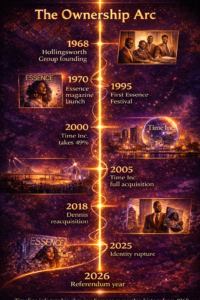
“Why didn’t Black Americans just buy it?”
This question gets asked, and it’s worth taking seriously — not to dismiss it, but to understand what it actually requires to answer it.
The short answer: corporate media assets are not sold on the open market. They’re sold in closed rooms, between institutional players, through processes that most people — regardless of race — have no access to or awareness of.
Essence Communications Inc. was founded in 1968, originally as the Hollingsworth Group, by Edward Lewis, Clarence Smith, Cecil Hollingsworth, and Jonathan Blount. It launched Essence magazine in 1970, during the era of Black capitalism — a moment when the building of Black-owned institutions was understood as an act of resistance and self-determination. For thirty years, Essence was one of the most significant Black-owned media companies in the country.
In 2000, facing the financial pressures that have consistently undercapitalized Black media, founders Ed Lewis and Clarence Smith sold a 49 percent stake to Time Inc. Five years later, in 2005, Time Inc. purchased the remaining 51 percent — placing Essence wholly under corporate white ownership for the first time in its 34-year history. The New York Times documented how this transaction occurred — a quiet, internal deal between institutional parties.
There was no announcement inviting Black community stakeholders to participate. There was no public process. There were no community ownership structures, no cooperative buy-in mechanisms, no crowdfunding apparatus. There was a transaction between a struggling Black media company and a white media conglomerate with the capital to acquire it. That’s how corporate media works. That’s how it has always worked.
For Black Americans to have purchased Essence in 2005, several things would have had to be true simultaneously. First — they would have needed to know the sale was happening, in advance, with sufficient lead time to organize. They didn’t. Second — they would have needed access to the tens of millions of dollars in acquisition capital required.
Black institutions are historically undercapitalized; this is a documented, structural consequence of redlining, discriminatory lending, and systemic exclusion from generational wealth transfer. Third — they would have needed a corporate vehicle capable of executing a media acquisition. Black private equity and venture capital infrastructure, while growing, was not in 2005 positioned to execute this kind of deal. Fourth — they would have needed to be invited into the process. They weren’t.
So when people ask “Why didn’t Black Americans just buy it?” — the answer is: the same reason Black Americans couldn’t just buy Black Wall Street back after the 1921 Tulsa massacre. Not because of lack of desire. Because of structural exclusion from the mechanisms of capital accumulation and institutional transaction.
There was no secret sale. There was simply no access.
Richelieu Dennis — Builder, Broker, and the Limits of Black Capital
The 2018 reacquisition is the part of the story that reads like a victory — and it is, partly. Richelieu Dennis, a Liberian-born entrepreneur who co-founded Sundial Brands (SheaMoisture and Nubian Heritage) with his mother and college roommate, sold Sundial to Unilever in 2017 in a landmark $1.6 billion deal — the largest consumer products transaction ever completed by a majority Black-owned company.
Rather than cash out and disappear, Dennis used the proceeds to establish the New Voices Fund, a $200 million investment vehicle aimed at empowering women entrepreneurs of color, and to acquire Essence from Time Inc., returning it to Black ownership for the first time since 2000. AfroTech’s coverage of Dennis’ media empire notes that under Sundial Media Group, he also acquired Refinery29, Afropunk, and Beautycon, building a constellation of culturally adjacent brands.
That’s a legitimate legacy. Black ownership of Black cultural institutions matters. The mechanics of how it happened — a man who built wealth in Black beauty and used it to acquire a Black cultural anchor — is exactly the kind of institution-building that Afro-Futurist thinking is supposed to celebrate.
But.
The complications are real, and ignoring them doesn’t serve the community. Dennis’s tenure has included serious governance turbulence. In 2020, a group of anonymous Essence employees published allegations of workplace mistreatment and sexual harassment under Dennis’s leadership — allegations that triggered an internal investigation. In 2024, Dennis left the board of Group Black, a media collective he co-founded, amid internal disagreements that escalated into mutual litigation. Essence Communications sued Group Black alleging $7 million in unpaid bills.
Most recently, as Complex reported in its coverage of the ongoing financial situation, Sundial Media Group’s outstanding balance to the New Orleans Convention Center from the 2025 festival raised serious accountability questions — especially given that the festival simultaneously needs increased public funding from Louisiana lawmakers to survive.
NBCUniversal sued Group Black in February 2026 for $35.8 million in allegedly unpaid Peacock advertising revenue — further illustrating the financial turbulence surrounding enterprises connected to Dennis.
This is the paradox of Black capital operating at scale inside a system designed to undermine it. Dennis represents both the possibility of Black institutional ownership and its limitations when operating inside corporate frameworks without sufficient resources, accountability structures, and community governance. The man who returned Essence to Black ownership is also the man whose organization owes vendors for the festival that’s supposed to celebrate those same communities.
That’s not a reason to dismiss him. It’s a reason to hold complexity without collapsing into either hagiography or cancellation. Truth be told; the availability of FBA capital. We have the second largest group of millionaires in this country. Tens of millions of dollars? There are mid level NBA players sitting on the bench making that kind of money. Not one FBA was considered? Makes you wonder!
The Identity Crisis — FBA, Diaspora, and the Corporate Multicultural Drift
Let’s talk about what actually happened culturally in 2025, because the discourse around it got messy fast.
There were legitimate critiques: FBA attendees feeling displaced in a space rooted in their culture. Real frustration about a Pan-African programming pivot that didn’t include the literacy, the care, or the consultation that such a pivot required.
And then there were things that veered into xenophobia — blaming Caroline Wanga, Essence’s President and CEO and a first-generation Kenyan immigrant, for a programming overhaul she reportedly wasn’t even involved in executing. That’s misplaced outrage, and it’s important to name it as such. The impulse to scapegoat a Black woman for systemic corporate failures is not cultural protection. It’s misdirection.
As TANTV’s analysis of the controversy pointed out, the deeper wound is this: Black institutions like Essence are caught between corporate dependency and community accountability — lacking the capital, the governance structures, and the political cover to navigate both simultaneously. When sponsors dried up — multiple sources note that corporate DEI funding collapsed significantly in 2025, exacerbated by the anti-DEI climate of the Trump era — Essence had to make compromises. Some of those compromises cost them the culture.
The identity crisis isn’t simply about who shows up. It’s about who makes decisions. A festival built by and for Black American women, now operating under a Black Liberian-owned corporate entity, with a Kenyan-born CEO, programming for a global diaspora audience while attempting to maintain FBA cultural specificity — and doing all of it while short on corporate sponsors and trying to keep vendors paid — is a complicated thing. Calling it a “crisis” is not hyperbole. It’s accurate description.
The question underneath all the noise: When a cultural institution loses its original community’s trust, what does it owe them in the work of repair?
Essence Fest 2026 — What the 32nd Anniversary Has to Prove
The 2026 festival carries an enormous amount of symbolism. The official language from Essence — “home of Black joy, artistry, and resilience” — signals a deliberate return to roots. The tagline “It’s Our Turn” and the framing around cultural community and commerce suggest that someone in the building heard the 2025 feedback.
Essence’s own language for 2026, per their official festival page, emphasizes community and a return to the festival’s core values. The 32nd year doesn’t carry the round-number anniversary pressure of a 30th, but it carries something more urgent: the weight of repair.
What does repair actually look like? It means Black-owned vendors and local New Orleans businesses in the marketplace — not as a token gesture, but as the structural backbone of the festival economy. It means outstanding bills paid before the next event begins. It means a programming strategy that honors the FBA root system while building diaspora bridges intentionally — not by swapping one out for the other, but by understanding that expansion requires a center of gravity.
It means Essence demonstrating, in practice and not just in language, that it understands who built this thing, who keeps showing up for it, and what they’re owed in terms of respect, representation, and cultural recognition.
Here’s the uncomfortable truth that Essence’s leadership has to sit with: trust, once broken, is not repaired by a good lineup. You can announce Janet Jackson and Usher and Frankie Beverly and Maze and the aunties will still be having a conversation that goes: “But remember 2025…” You rebuild trust with consistent action over time. The 2026 festival is not the end of that process. It’s the beginning.
The Real Roll Call — Essence Fest 2026 Attendance as Cultural Referendum
So. Who all going?
The aunties — the cultural backbone, the ones who haven’t missed a year since 2003 — are going. They’re going because New Orleans is in their bones and because even a hurt Essence is still home. But they’re watching. They’re rating. They’re talking to each other in real time.
The millennials who’ve been going since their twenties are split. Some bought tickets early, because the muscle memory of this festival is strong. Others are waiting to see the lineup, waiting to feel the energy, waiting to hear what the aunties report back. They remember 2025, and memory is a powerful thing.
Gen Z is a different conversation. They don’t have the same inherited loyalty. They came of age in an era where cultural accountability is expected, not requested. They’ll go if the programming earns their presence. They’ll stay home if the vibe is off — and they’ll document both choices on TikTok in ways that shape the narrative for people who aren’t even there.
Diaspora travelers — people who came specifically because of the 2025 framing — may actually have had a better time in 2025 than FBA attendees did. Whether they return depends on whether 2026 offers them a reason to, without making that reason feel like it comes at someone else’s expense.
Influencers, brands, and corporate partners are watching attendance as a market signal. Sponsorship may be recovering somewhat from the 2025 DEI collapse, but the question of whether Essence can attract the caliber of corporate investment it needs is directly tied to whether its audience shows up.
And then there are the people who are simply done. Who said “this ain’t Essence anymore” and meant it, and are spending that money on a beach somewhere. Their absence is also part of the referendum — and Essence would be wise not to dismiss it.
The Stakes — What Essence Reveals About Black Cultural Futures
Here’s what Essence Fest is, underneath the lineup and the parties and the business expos: it’s a sensor array for Black cultural direction. It registers where Black America is, what it values, who it trusts, and what it’s willing to invest its time, money, and energy in.
The 2025 rupture exposed something that those of us watching Black institutions have been tracking for a while: the tension between the cultural authenticity that makes Black institutions matter and the corporate scale required to keep them financially viable. This tension is not unique to Essence. It’s the tension that destroyed Black Wall Street when white violence and institutional abandonment removed the protective insulation. It’s the tension that BET navigated badly when Viacom took over. It’s the tension that Black media institutions face every time a corporate sponsor’s priorities diverge from community values.
Afro-Futurism — real Afro-Futurism, not the aesthetic — is about building systems resilient enough to hold that tension without collapsing under it. It’s about creating cultural institutions that don’t have to choose between survival and authenticity because they’ve built the ownership structures, the financial infrastructure, and the community governance that makes that choice unnecessary.
Essence Fest hasn’t built those structures yet. The outstanding vendor bills, the corporate sponsor dependency, the governance turbulence — these are symptoms of an institution that is still, thirty-plus years in, operating with insufficient structural support.
That’s the real conversation that needs to happen in New Orleans in July 2026. Not just about headliners. About infrastructure. About what it actually takes to build a Black cultural institution that outlasts its founders, its controversies, and the hostility of the economic environment it operates in.
Because the ancestors who built Essence — the four men who founded it with nothing but vision and commitment in 1968, the Susan Taylors who made it a sacred space for Black women — they weren’t building a festival. They were building a legacy. And legacies require structures that hold.
The Final Frame — “Who All Going?” Is the Wrong Question
Here’s where we land.
“Who all going to Essence Fest 2026?” is the roll call. But it’s not actually the question that matters.
The question that matters is: Is Essence Fest still ours?
And the answer to that question is not in the attendance numbers. It’s not in the lineup. It’s not in how clean the production is or how late the headliner hits the stage.
It’s in whether the community that built this thing — that poured thirty years of loyalty and dollars and cultural labor into making it what it is — sees itself reflected in the decisions being made, the vendors being paid, the stories being centered, and the direction being charted.
Real talk: Essence Festival can expand its diaspora lens AND honor its FBA foundation. Those are not mutually exclusive. The Afro-Futurist vision demands both — rootedness and reach, heritage and horizon. But that vision requires leadership with the cultural literacy to execute it, the accountability structures to support it, and the community trust to sustain it.
2026 is not the end of the conversation. It’s the opening argument.
The aunties are watching. The millennials are watching. Gen Z is recording. And somewhere, the ancestors who launched this thing in 1970 with nothing but a vision for what Black women deserved to see in print — they’re watching too.
Give them something worth watching.
FAQ — Voice Search & Featured Snippet Optimization
When is Essence Fest 2026? The ESSENCE Festival of Culture 2026 is scheduled for July 4–7, 2026, in New Orleans, Louisiana, at the Caesars Superdome and Ernest N. Morial Convention Center.
Why did Essence Fest 2025 lose attendance? The 2025 Essence Festival faced a combination of production failures, a controversial Pan-African programming pivot that alienated longtime FBA attendees, corporate sponsor losses driven by the anti-DEI climate, and visible logistical breakdowns including extremely late performances. The top terrace of the Superdome sat barely a quarter full across all three nights.
Who owns Essence Festival? Essence Festival is owned by Sundial Media & Technology Group (SMTG), led by executive chairman Richelieu Dennis, who acquired Essence Communications from Time Inc. in January 2018, returning it to Black ownership for the first time since 2000.
Why couldn’t Black Americans buy Essence when it was sold to Time Inc.? Corporate media acquisitions occur through private institutional processes. Black Americans had no advance knowledge of the sale, lacked access to the tens of millions in acquisition capital required, and were not invited into the transaction process. This reflects structural exclusion from capital accumulation mechanisms — not lack of interest or desire.
What is the FBA cultural foundation of Essence Fest? Essence Festival’s cultural grammar, aesthetics, humor, politics, and spiritual energy are rooted in Black American culture — specifically Southern Black culture and the traditions of descendants of enslaved people in the American South. This FBA foundation is the root system that has powered the festival’s cultural authority for over three decades.
Is Essence Fest 2026 worth attending after the 2025 controversy? Essence Fest 2026 carries the weight of rebuilding community trust after the 2025 rupture. Attendance this year is as much a cultural referendum as a personal choice — a statement about whether the community believes Essence can re-earn its original mandate. The festival has signaled a return to its roots, but proof will be in the execution.
Originally published at the-afrofuturist.com Internal link: See also — Black Wall Street to Blockchain: Building the Next Digital Economy — on the-afrofuturist.com © the-afrofuturist.com | Altimore Fields