“I’m Working on Me” — Is This the New “It’s Not You, It’s Me”?
 You already know what’s happening the moment she says it. When she says she’s working on herself, something in you goes quiet — not because you’re moved by the depth of it, but because you recognize the script. The soft delivery. Maybe a hand on your arm if she’s feeling generous. You’ve heard it before. Probably more than once. And every time, something in your gut says: that’s not quite the full story.
So let’s actually talk about it. What does it mean when a woman says she’s working on herself in a dating context — and why does it feel so hollow in 2026 when you hear it? Because it is hollow. These women are all over the place. Some of them are actually dating ai.
The Original Script and Its Upgrade
“It’s not you, it’s me” used to do one job. Clean and simple — absorb the blame, soften the blow, exit without a fight. Transparent as glass. Everybody knew what it meant. The line became so recognizable it stopped working, and dating culture has been cycling through replacements ever since.
“I’m working on me” is the upgrade. More sophisticated. Much harder to argue with. The original line was a statement; this one is a whole narrative. It doesn’t just exit the situation — it reframes the entire story. You’re not being rejected. You’re being released, gently, by someone who’s on a journey.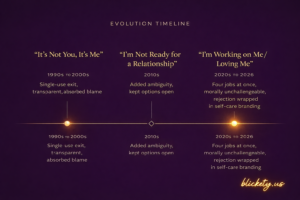
Count the jobs this phrase does, because it’s doing a lot. It functions as a soft rejection — a way to say “I don’t want you” without having to say anything so stark or honest. It protects the ego of the person saying it, because the story now is that they left dating by choice, not because options dried up or the last situation ended badly. It maintains narrative control, framing the speaker as the empowered protagonist rather than someone who got curved. And it keeps the door cracked open with deliberate ambiguity — “maybe later” always implied, nothing ever fully closed.
“It’s not you, it’s me” was a one-trick pony. This new version is a Swiss Army knife.
When She Says She’s Working on Herself — Which Version Are You Dealing With?
Not everyone who uses this line is running the same game. There are three distinct versions of the person behind the phrase, and they require different reads.
The first is the one most people are describing when they complain about it: the Cop-Out Version. This is the person who’s between situations, didn’t get what they wanted out of the last one, maybe got played or ghosted or simply ran out of options — and has no interest in saying any of that out loud. “Working on me” is cleaner. It sounds intentional. Nobody asks follow-up questions when you frame a quiet period as a spiritual commitment to yourself.
The second is less cynical but still a dodge: the Avoidance Version. Dating burnout is real. More than half of young adults report that dating has gotten harder, with dishonesty and lack of seriousness consistently cited as main reasons. Some people genuinely hit a wall — not because they’re in growth mode, but because they’re exhausted. Tired of talking stages that dissolve into nothing. Tired of situationships that perform like relationships but refuse the label. “Working on me” covers the burnout without requiring explanation.
The third version is the one everyone claims and almost nobody is actually doing: the Real Work Version. Therapy. Actual pattern interruption. Sitting with the uncomfortable truth that you might be the common denominator in a series of similar endings. Building discipline, not a better Instagram presence. This version exists. It’s just rare enough that when you hear the phrase, statistical probability says you’re not talking to this person.
The Claim vs. The Reality
Here’s where the dishonesty lives, and it’s worth being precise.
When someone says they’re working on themselves, the words carry specific implications: introspection, behavior change, accountability, pattern correction, measurable discipline. The kind of growth that shows up in how you move, how you communicate, what you tolerate, what you walk away from. Something another person could observe and verify over time.
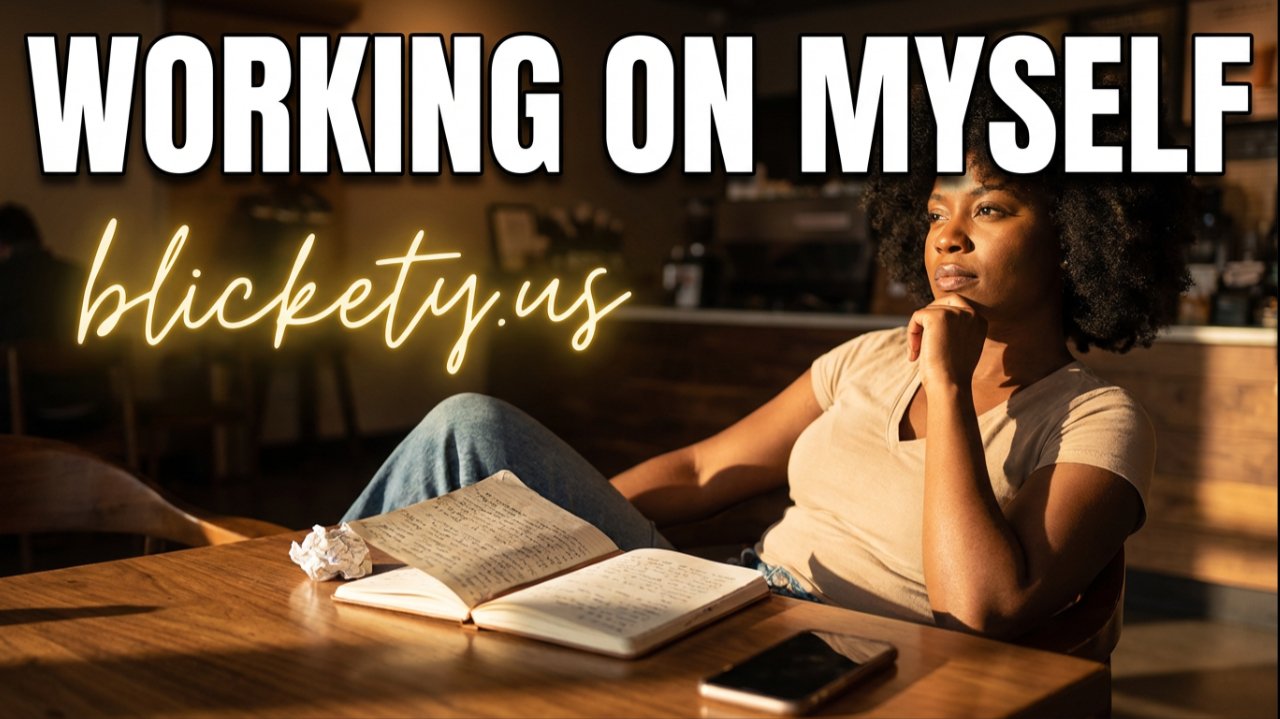
What most people are actually doing during a “working on me” era: posting better content. Vibe curation — managing how the self appears from the outside while the interior stays exactly the same. The aesthetic of self-improvement without the friction of it. Going to yoga twice and telling everyone about it. Buying the journal but not writing in it. Curating a persona that says “healing” while texting the same person you said you were done with at 11:47 PM on a Tuesday.
This matters because the mismatch between the claim and the reality is what actually bothers people when they hear the phrase. It’s the false advertising. If someone said “I need a break from dating and I’m not ready to explain why,” that would be honest — most people could respect that. What they can’t respect is the performance of depth that doesn’t actually exist. Self-love has become a brand, a consumer category, an identity construction rather than anything resembling a practice. The branding and the substance stopped being the same thing a long time ago.
The Rejection Script Nobody Talks About
There’s a function of this phrase that gets less attention than it deserves, and it might be the most important one: it’s an extraordinarily effective way to reject someone without doing the emotional labor of rejection.
Think about how it works from the inside. You’ve been talking to someone. Maybe you went on a date. Maybe you’ve been in each other’s orbit for a few weeks. They’re interested; you’re not. The honest options are: “I’m not attracted to you,” “you’re not my type,” “I don’t see this going anywhere.” All of those require directness. All of them give the other person something real to process, which creates the possibility of pushback or questions or just a visible truth sitting between you.
“I’m working on me” gives them nothing to push back on. You cannot argue with someone loving themselves — the phrase comes pre-equipped with a moral shield. Challenging it makes you look like you’re against their healing, their journey, their growth. The rejection lands, the door closes, and the person delivering it walks away feeling empowered rather than like they just let someone down.
Safety is a real factor here, particularly for women navigating situations where a direct “no” can produce unpredictable responses. A soft rejection that deflects rather than declines has genuine protective value in some contexts. That doesn’t make the script more honest — but it does explain why it became so normalized so fast.
Ambiguity does the rest. “Maybe later” hovers somewhere in the implication. Options stay open. Nothing is admitted. The other person is left in a fog that feels vaguely hopeful and isn’t. Rejection without clarity is, in the long run, often harder to move on from than a clean no.
Why Modern Dating Made This Inevitable
Here’s the context that actually explains why this became the default script, and it starts with the nature of dating itself in 2026.
Situationships dominate the landscape — arrangements with emotional and sometimes physical intimacy but without labels, commitment, or any clear future. A 2023 YouGov survey found 62% of Millennials and Gen Z reported being in at least one. The architecture of modern dating is deliberately low-investment: texting instead of calling, linking instead of dating, unlinking with a ghost instead of a conversation. People don’t merge lives the way previous generations did. The emotional bandwidth required to navigate a typical 2026 situationship is genuinely not that high.
Which is exactly why “I need time to work on myself” lands so hollow. A sabbatical requires a significant prior investment. Taking a sabbatical from a job you barely showed up to doesn’t track. When the relationship was a few months of sporadic texting, some occasional plans, and a talking stage that never resolved — the idea that it consumed enough of you to require a full recovery period and personal development program is a stretch.
What modern relationships are missing isn’t intensity that burns people out. It’s depth. Research from Baylor University found that situationships mirror relationships in affection, sexual behavior, and communication patterns — but they lack commitment, clarity, and any discussed future. People get the emotional entanglement without building anything real. Then the entanglement dissolves and someone announces they’re working on themselves. For what? From what? The situation they left never asked enough of them to necessitate recovery.
The Accountability Problem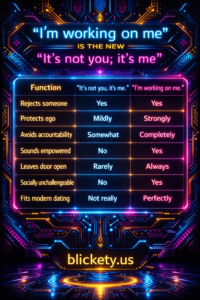
The deeper irritation — and this one tends to be harder to articulate — is about accountability.
“Working on me” is a beautifully constructed escape hatch from examining your own patterns. You don’t have to admit the last three situations ended the same way because of something you keep doing. You don’t have to say you got played, that you played someone else, that you kept someone around as emotional insurance while waiting for someone better. The phrase hovers above all of that. It implies awareness without requiring any. It sounds like introspection while bypassing the actual discomfort of it.
There’s a specific thing that happens when someone is the common denominator in a series of similar relationship failures. The healthiest response is to actually look at that — to ask what role they played, what patterns they’re running, what they keep choosing and why. That’s uncomfortable enough that most people will do almost anything to avoid it. “Working on me” is the perfect avoidance mechanism because it sounds like you’re doing exactly that work while letting you skip the hardest part of it entirely.
Ego gets protected. Narrative gets controlled. Pattern continues unchanged.
What It Reveals
None of this is malicious. Most people using this script aren’t running a calculated manipulation — they’re reaching for a socially available tool that does several jobs at once with minimal friction. The phrase exists because it works. Non-specific enough to be unchallengeable. Morally coded in a direction everyone agrees is positive. Ambiguous enough to preserve options. Protective of everyone’s feelings in the moment.
But it keeps people stuck. The person using it avoids the mirror. The person receiving it gets unclear closure that’s harder to move past than a direct answer. Experts tracking 2025 and 2026 dating trends are noting genuine fatigue with this architecture — people reporting they want more intentionality, earlier directness, and less ambiguity. The situationship era may actually be cresting. A generation burned by indefiniteness is starting to say what it wants out loud and walk when it doesn’t get that.
Which means the “working on me” script might be running out of runway. When everyone knows the code, the code stops working.
When She Says She’s Working on Herself — A Translation Guide
Context matters, but here’s a working read for the most common situations.
From someone you’ve shown interest in who you barely know: probably a soft rejection. File it, respect it, move on. Don’t wait for the door to reopen.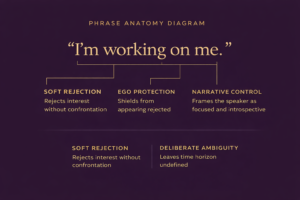
From someone exiting a situationship or something that went sideways: ego protection combined with narrative control. Something ended in a way they don’t want to explain. You probably weren’t going to get the real story regardless.
From someone who can speak specifically about what they’re working on — the therapy, the pattern, the specific behavior they’re trying to change: this person exists. Rare but real. Specificity is the tell. Real growth has detail. Vibe curation has aesthetics.
When “I’m working on me” comes with a highlight reel of healing content and no other evidence that anything is actually different — you have your answer. When it comes with “I’ve been in therapy since March, I’m learning X about myself, and I need time to practice Y before I bring someone else into it” — that’s a different conversation entirely.
Most people are doing the first. A few are doing the second. The phrase sounds identical either way. That’s the whole problem — and the whole point.
FAQ
What does it mean when she says she’s working on herself in dating? It depends on context, but the phrase most commonly serves one of three functions: a soft rejection delivered without the emotional labor of a direct no, an ego-protection mechanism after a situation ended badly, or genuine self-work — which is the rarest version. The tell is specificity. Real work has detail — therapy, named patterns, measurable changes. Vibe curation has aesthetics and general language about growth with nothing concrete underneath it.
Is “I’m working on me” the new “It’s not you, it’s me”? Functionally, yes — but it’s a more sophisticated evolution. “It’s not you, it’s me” did one job: soften a rejection by absorbing the blame. “I’m working on me” does four jobs simultaneously: soft rejection, ego protection, narrative control, and deliberate ambiguity that keeps options open. It replaced the older line because it’s harder to challenge and comes pre-equipped with a moral shield. Questioning someone’s self-love journey makes you look like the problem.
Why does “I’m working on me” feel dishonest in modern dating? Because the phrase implies specific things — introspection, pattern correction, behavioral discipline, accountability — that most people using it aren’t actually doing. The mismatch between the claim and the observable reality is what reads as false advertising. In an era where self-love has become a brand and a consumer identity rather than a practice, the language of growth got decoupled from the actual work of it. The words stopped requiring receipts.
What’s vibe curation and how does it relate to this? Vibe curation is managing how your life appears externally — better content, surface-level habits, aesthetic choices that signal improvement — without doing the interior work that would actually change anything. It’s the highlights reel of growth without the footage. Buying the journal but not writing in it. Posting about therapy without changing any of the patterns therapy is supposed to address. Most “working on me” eras in modern dating are vibe curation periods, not growth periods.
How do you respond when someone says they’re working on themselves? Take it at face value and adjust your behavior accordingly — meaning don’t wait. The most expensive thing you can do in modern dating is treat a functionally closed door as open because the ambiguity technically leaves room. If the real version of the work happens and they come back with specific evidence, evaluate it then. Until that point, the most honest interpretation of “I’m working on me” in a dating context is: this chapter is over.
Why do women use this phrase more than men in dating? The phrase shows up more visibly among women partly because self-love marketing has been directed at women as a consumer category far more aggressively, and partly because women navigating dating situations have real social and sometimes safety incentives to use soft rejections over direct ones. Men run equivalent scripts — “I’m not in a good place right now,” “I’m focused on my career,” “I’m not looking for anything serious” — that do identical work with different phrasing. The mechanism is the same. The language just lands differently by gender.