NAACP Image Awards: Godfrey Was Right — 7 Truths About Black Entertainment Sovereignty
London. February 22, 2026. Royal Festival Hall. Michael B. Jordan and Delroy Lindo walk out under the BAFTA lights — two Black kings at the center of the most culturally vital film of the decade — and before they finish a full sentence, a racial slur splits the air.
Six days later. Pasadena Civic Auditorium. Sinners wins 13 awards. The room rises for Jordan and Lindo like a congregation that knows exactly what it witnessed. Viola Davis tells everybody their crowns are already bought and paid for. Samuel L. Jackson, draped in tradition, leads a tribute to Jesse Jackson and tells the room to keep hope alive.
Same two men. Two completely different rooms. Two completely different experiences of what it means to stand in front of your peers and be seen.
That contrast is the whole conversation. And comedian Godfrey — watching all of it from across his Instagram feed — put it as plainly as it’s been put in a long time: Black people need to stop seeking NAACP Image Awards Black entertainment sovereignty isn’t just a phrase. It’s a directive. It’s a blueprint. And after what the 57th NAACP Image Awards just demonstrated, the evidence has never been clearer.
Here are 7 truths the culture needs to sit with.
Truth #1: The BAFTA Incident Wasn’t an Accident — It Was a Structural Failure
Let’s handle the nuance first so we can get to the argument. John Davidson has Tourette syndrome. His vocal tics are involuntary. He is not the villain of this story, and he never was.
The institution is.
BAFTA and the BBC apologized to Jordan and Lindo after the racial slur made it into the broadcast despite a two-hour tape delay — a window during which the audio could have been edited, but wasn’t. Gold Derby That same tape delay was used to cut a “free Palestine” statement from an acceptance speech. The scissors existed. The institutional will to protect Black dignity in the moment did not.
Delroy Lindo said afterward that neither he nor Jordan were contacted by anyone from BAFTA after the incident happened onstage. Variety No one came backstage. No one checked in. Two of the most celebrated Black actors in the world stood in front of their professional peers, absorbed a racial slur mid-sentence, kept their composure for the room, and then — nothing. The institution moved on.
Production designer Hannah Beachler, who in 2019 became the first Black person to win an Oscar for her work on Black Panther, wrote on social media that the incident happened to her three times that night — including once directed at her personally on the way to dinner after the show. CNN Three times. In one night. At what is supposed to represent the highest tier of cinematic celebration.
That’s not an isolated incident. That’s an institution telling you, in its behavior rather than its statements, exactly what kind of space it is and who it was built to protect. The ancestors understood something our generation keeps having to relearn: you cannot find safety in a house that was not built with your protection in mind.
NAACP Image Awards Black entertainment sovereignty begins with being honest about what these mainstream spaces actually are — and refusing to let that honesty be called cynicism.
Truth #2: Godfrey Said What Black Hollywood Has Been Whispering for Decades
Look — Godfrey didn’t break new ground philosophically. What he did was say out loud, in a five-minute Instagram video, what a lot of people in Black Hollywood have been passing around in private conversations for years.
He wrote in his video caption: “Black people, it’s time we stop going to these award shows and other platforms looking for validation and create our own stuff. We have enough millionaires and billionaires to do it. We have enough creators, we have enough stars, we’ve proven that we can sell tickets at the box office.” TheGrio
He pointed to Black Panther. He pointed to Sinners. He pointed out that Wesley Snipes essentially held Marvel together before Marvel became the global juggernaut it is now, and that Black artists have never received the structural credit — or the structural ownership — that their creative and commercial contributions actually earned.
Then he went somewhere most commentators haven’t: the food industry. He called out Tatiana, a celebrated Nigerian restaurant in New York, as an example of Black excellence being systematically ignored by the Michelin star system BET — extending the argument beyond entertainment into the whole architecture of who gets to define excellence in America, and who benefits financially when that definition is enforced.
His core position was not isolationism — it was investment. He proposed naming new awards after icons like Sidney Poitier or James Earl Jones, honoring legacy while building the kind of infrastructure that protects Black dignity and centers Black taste rather than outsourcing both to white gatekeepers. BET
That’s not radical. That’s just how every other community that has built lasting cultural institutions has operated. You build your own standard. You invest in your own infrastructure. You stop waiting for someone else’s validation to confirm what you already know is excellent.
The Afro-Futurist tradition — from Sun Ra building his own cosmological framework to Octavia Butler constructing worlds where Black people are not afterthoughts but architects — has always understood that sovereignty isn’t granted. It’s built.
Truth #3: Sinners Is the Proof-of-Concept for Black Entertainment Sovereignty
If you want to understand what NAACP Image Awards Black entertainment sovereignty looks like as a living practice rather than a theoretical position, watch what Ryan Coogler did with Sinners — and watch what happened when he brought it home.
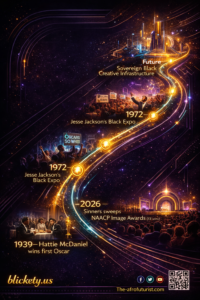
Sinners dominated the 57th NAACP Image Awards, winning 13 awards after entering with a leading 18 nominations — including Outstanding Motion Picture. Michael B. Jordan took home Entertainer of the Year. The film also secured a record-breaking 16 Oscar nominations. The Hollywood Reporter
Sit with that for a moment. A Black-directed, Black-centered, historically grounded period vampire film — rooted in the blues, the Delta, the specific spiritual and cultural geography of Black Southern life — not only dominated Hollywood’s mainstream awards season but swept the ceremony built specifically to honor Black excellence. Both. At the same time. That’s not a compromise. That’s a demonstration.
Coogler has now directed three films that won Outstanding Motion Picture at the Image Awards — more than any other director in the ceremony’s history. Variety Black Panther. Black Panther: Wakanda Forever. Sinners. Three films that didn’t just perform in mainstream spaces — they redefined what mainstream Black storytelling could look like when given the resources and the freedom to be fully itself.
Accepting his directing award, Coogler used the moment to reflect on representation, truth, and what it means to tell stories in spaces that see you fully. Essence That framing matters. Because Sinners wasn’t produced through the kind of studio compromise that usually flattens Black stories into something more palatable for a predominantly white awards-season audience. Coogler built it through Proximity Media — his own production company — which means the creative sovereignty was structural, not just stylistic.
That’s the blueprint. And the NAACP Image Awards Black entertainment sovereignty framework is exactly what allows that blueprint to be recognized and celebrated on its own terms.
Truth #4: The NAACP Image Awards Is Infrastructure, Not a Consolation Prize
This needs to be said clearly because the discourse around Black award shows keeps making the same error: treating the NAACP Image Awards as a fallback, a safe space, a nice-but-lesser alternative to the real awards. That framing is exactly the problem Godfrey is calling out. And it needs to end.
When presenter Regina Hall asked the audience to take a moment for “the two kings in this audience,” gesturing toward Jordan and Lindo, the entire room rose to its feet. Variety That standing ovation — spontaneous, communal, unanimous — cannot be manufactured. You can’t pay for that in a production meeting. It emerged because the room was filled with people who share a history, who understand the weight of what Jordan and Lindo carried at the BAFTAs, and who chose collectively to transform that weight into something else.
Ryan Coogler said it plainly from the stage: “There’s something powerful about standing in this room — a room where we don’t have to explain ourselves, or our stories aren’t footnotes.” Variety
That is not a consolation. That is the whole point.
The 57th ceremony honored Viola Davis with the Chairman’s Award, Colman Domingo with the President’s Award, inducted Salt-N-Pepa and DJ Spinderella into the NAACP Image Awards Hall of Fame, and included a tribute to the late Rev. Jesse Jackson led by Samuel L. Jackson. The TV Cave That’s not a lesser event. That’s an institution honoring its lineage, recognizing its present, and pointing toward its future — all in a single night.
What it needs isn’t legitimacy. It already has that. What it needs is investment — financial, promotional, cultural — that matches the gravity of what it actually represents. The difference between the Oscars and the NAACP Image Awards is not quality. It’s infrastructure, marketing spend, and the collective decision about whose stamp of approval we’ve been trained to treat as the final word.
That is a changeable decision. Changing it is NAACP Image Awards Black entertainment sovereignty in practice.
Truth #5: The History of Exclusion Makes the Case for Ownership
You want to understand why Godfrey is right? Start in 1939.
Hattie McDaniel became the first Black person to win an Academy Award — and was forced to sit at a segregated table at the back of the room, separated from her white castmates at the ceremony. Wearehordes That wasn’t a mistake. That was the institution, functioning exactly as designed.
In the nearly century-long history of the Academy Awards, only six percent of all nominations across all categories have gone to underrepresented racial or ethnic groups. Sankofa Impact One hundred years. Six percent. That is not an accident of omission. That is a structure performing its function.
The #OscarsSoWhite movement erupted in 2015 after not one of 20 acting nominees was a person of color — and then it happened again in 2016, forcing the Academy into a public reckoning with its own exclusions. #MoveMe The response was membership diversification, new representation standards, incremental reform. Real, in some ways. Sufficient? Ask any Black filmmaker navigating that system right now.
Here’s the structural truth that the “fix Hollywood from within” argument keeps colliding with: you can change the demographics of an institution’s membership without changing the cultural logic that determines what it rewards. The architecture was built to serve a particular vision of what excellence looks like, who gets to define it, and who benefits when that definition is enforced.
Rev. Jesse Jackson understood this decades ago, which is why as far back as 1972 he built the Black Expo in Chicago through his Operation PUSH organization — an event that drew over a million attendees and specifically employed Black cameramen at a time when Black people could barely get into the industry unions. WBEZ Chicago He wasn’t waiting for Hollywood to let him in. He was building something that didn’t need Hollywood’s permission to exist.
That is the ancestral logic. From the builders of Great Zimbabwe to the architects of Black Wall Street to the founders of every HBCU that produced the artists, directors, and storytellers who fill the NAACP Image Awards stage — the tradition has always been to build systems that outlast the people who doubted their necessity.
Truth #6: NAACP Image Awards Black Entertainment Sovereignty Already Exists — It Just Needs Investment
Here is something the conversation keeps missing in its urgency to declare what should exist: a significant portion of the infrastructure for Black entertainment sovereignty already exists. Right now. Today. The question isn’t whether to build it from scratch. The question is whether we’re treating what we already have with the gravity it deserves.
Beyond the NAACP Image Awards, Black creativity is celebrated at the American Black Film Festival, ABFF Honors, the Essence Black Women in Hollywood Awards luncheon, the AAFCA Awards, and Black Music Honors. Yahoo! These are not small operations. They represent decades of relationship-building, institutional knowledge, and community investment that cannot simply be replicated by writing a check.
The fracture in this infrastructure is also real and needs to be named. The Soul Train Awards — once a cornerstone of Black entertainment recognition — went on indefinite pause after BET, owned by Paramount, made that decision. Yahoo! Paramount. Not us. That’s what happens when the platforms that carry our cultural institutions belong to someone else — their priorities become our losses.
Tyler Perry built a studio on 330 acres of a former Confederate army base in Atlanta. That is not a metaphor. That is land, infrastructure, and generational equity with an ancestral echo loud enough to rattle the windows. Issa Rae built Hoorae Media as a full creative production ecosystem, not just a vanity production company. Ryan Coogler built Proximity Media and used it to make one of the highest-grossing Black-directed films in history. We have a helluva squad. Ryan Coogler isn’t alone. Nia Dacosta broke highest gross for female director.
The American Black Film Festival has been building the creative pipeline for Black filmmakers for nearly three decades. The Annenberg Inclusion Initiative at USC has been producing the data on industry inequality since before most people were paying attention. The NAACP itself, founded in 1909, has over a century of institutional authority behind every award it presents.
This is not a world where nothing exists. This is a world where what exists is chronically underfunded, undermarketed, and undersupported relative to its actual cultural weight. NAACP Image Awards Black entertainment sovereignty is not a future project. It is a present-tense obligation — to invest in what we already have with the same energy we spend petitioning spaces that were never designed for us.
Truth #7: The Blueprint Is Ancestral. The Building Starts Now.
Every single piece of this conversation — Godfrey’s video, the BAFTA incident, the 13-trophy sweep, the standing ovation for Jordan and Lindo, Viola Davis reminding the room that crowns are already bought and paid for — every piece of it points to the same conclusion.
We are not starting from zero. We are returning to something.
The people who built the pyramids were not waiting for Roman architectural critics to validate their engineering. The griots who carried entire civilizations in their memory were not checking to see if European scholars had acknowledged their contribution. Madam C.J. Walker did not ask anyone’s permission to become the first self-made female millionaire in American history. The architects of the Harlem Renaissance were not curating their work for spaces that called them subhuman.
Black excellence has never required external validation to be real. What it has required — what it has always required — is the willingness to build infrastructure that reflects and protects its own value.
Michael B. Jordan, accepting his Outstanding Actor award, dedicated it to Chadwick Boseman — his brother, his Black Panther co-star — and reflected on how short our time on this planet is, and what we choose to build while we’re here. Variety
That’s the frame. Not just awards. Not just validation cycles. But what we build. What we leave. What we construct that outlasts us and tells the next generation — the ones who will fill the stages and write the films and run the festivals — that they were expected. That they belong. That the room was built for them.
NAACP Image Awards Black entertainment sovereignty is not a political position. It is an architectural decision. It means funding the institutions we have. It means naming our awards after our giants and meaning it. It means treating the Image Awards, the ABFF, the Essence honors, and the Black Music Honors not as alternatives to mainstream prestige but as the actual standard — the one that has always known what our excellence looks like because it was built by people who share it. 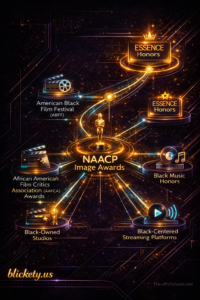
Godfrey was right. The 57th NAACP Image Awards proved it. Sinners proved it. Delroy Lindo standing in Pasadena and saying “it’s a classic case of something very negative becoming very positive” proved it.
We have enough. We always did. The ancestors built empires with less. The only question that remains — the one the culture needs to answer with its money, its platforms, its attention, and its institutional investment — is whether we’re ready to build like we know it.
FAQ
What did Godfrey say about the NAACP Image Awards and white validation? Following the 2026 BAFTA incident where a racial slur was shouted while Michael B. Jordan and Delroy Lindo were onstage, Godfrey posted a five-minute Instagram video arguing that Black entertainers should stop seeking validation from mainstream white award shows and instead invest in building and elevating Black-owned entertainment institutions like the NAACP Image Awards.
How many awards did Sinners win at the 2026 NAACP Image Awards? Sinners, directed by Ryan Coogler, won 13 awards at the 57th NAACP Image Awards — the most of any project — including Outstanding Motion Picture, Outstanding Actor for Michael B. Jordan, Entertainer of the Year for Jordan, and Outstanding Directing and Writing for Coogler.
What is Black entertainment sovereignty? Black entertainment sovereignty refers to the principle that Black creative excellence should be defined, celebrated, and financially supported through Black-centered institutions rather than depending on validation from predominantly white award systems that have historically excluded Black artists.
Why does the NAACP Image Awards matter for Black entertainment sovereignty? The NAACP Image Awards represents 57 years of continuous institution-building dedicated to centering Black excellence in film, television, music, and literature. Rather than a consolation prize, it is functioning infrastructure for Black cultural self-determination — and one of the most important existing nodes in the broader ecosystem of Black entertainment sovereignty.
What happened to Michael B. Jordan and Delroy Lindo at the 2026 BAFTAs? During the 79th BAFTA Film Awards in February 2026, a racial slur was audibly shouted by a Tourette syndrome attendee while Jordan and Lindo were onstage presenting an award. Despite a two-hour tape delay, neither BAFTA nor the BBC edited the slur from the broadcast. Both institutions later issued apologies, but neither contacted Jordan or Lindo directly after the incident.
What Black entertainment award shows and institutions currently exist? Active Black entertainment institutions include the NAACP Image Awards, the American Black Film Festival (ABFF), ABFF Honors, the Essence Black Women in Hollywood Awards, the AAFCA Awards, and Black Music Honors. The Soul Train Awards went on indefinite pause after Paramount — which owns BET — made that decision unilaterally, illustrating the risk of Black cultural institutions operating inside non-Black corporate ownership structures.
For more Afro-Futurist analysis on culture, technology, liberation, and the architecture of Black excellence, explore the-afrofuturist.com.