Jesse Jackson Jr Checks Three Presidents and Kamala Harris at His Father’s Homegoing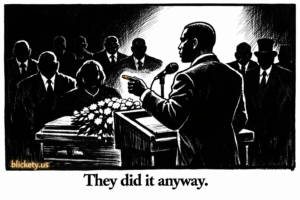
Jesse Jackson Jr made one request. One. He made it publicly, clearly, and early — before the motorcades arrived, before Jennifer Hudson took the stage, before the former presidents found their seats at House of Hope on Chicago’s South Side.
“Do not bring your politics out of respect to Reverend Jesse Jackson and the life that he lived to these homegoing services. Come respectful, and come to say thank you.” RealClearPolitics
Democrat, Republican, liberal, conservative — all welcome, he said. His father’s life was broad enough. Just leave the campaign at the door. Come to bear witness. Come because you knew the man.
They came. And they did it anyway.
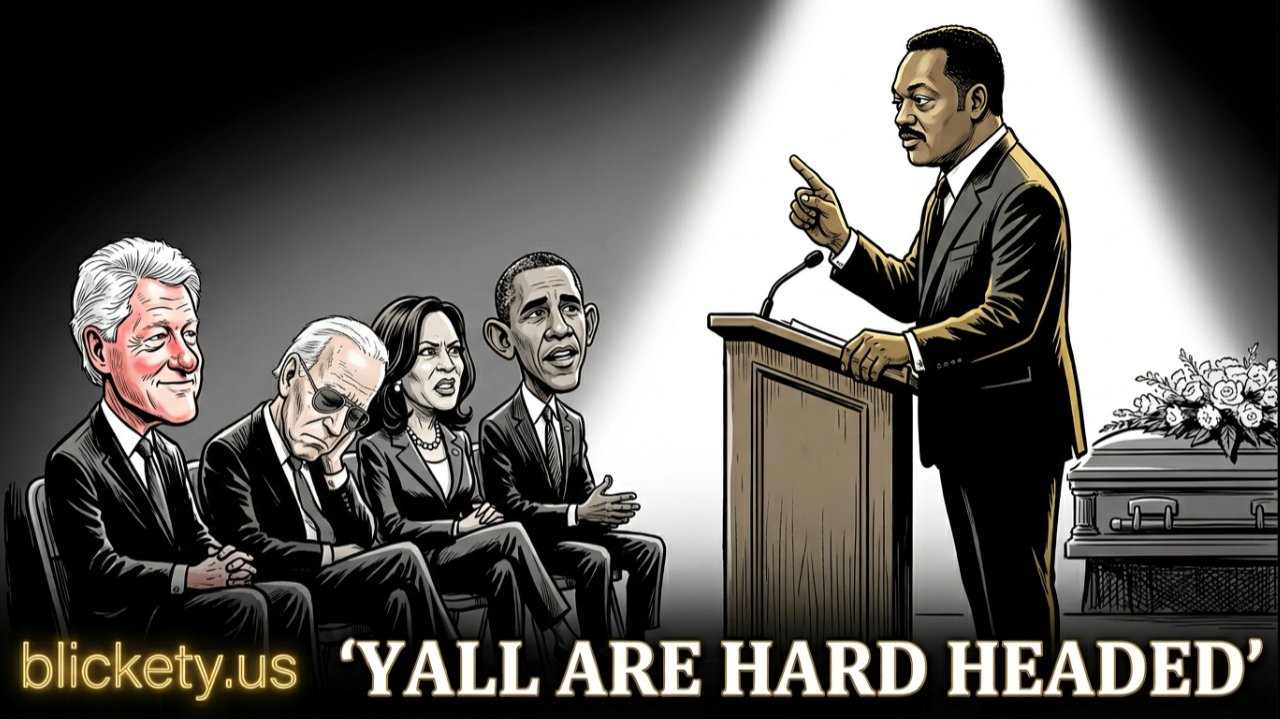
At the end of his nearly 30-minute eulogy, Obama offered a pointed critique of the current administration, saying Americans are living through “some new assault on our democratic institutions” every day. Chicago Sun-Times Clinton recalled their decades-long relationship, including conversations during his own impeachment — which is a remarkable thing to center at someone else’s funeral. Biden told the crowd he was “a hell of a lot smarter than most of you.” Harris said she predicted how Trump’s second term would go, adding: “I’m not into saying ‘I told you so,’ but we did see it coming.” NPR
Jesse Jr. sat in the front row and absorbed all of it.
Then on Saturday, at the final private homegoing at Rainbow PUSH headquarters, he stepped to the mic and delivered his verdict.
“I listened for several hours to three United States presidents who do not know Jesse Jackson.” Newsweek
Not three presidents who got the politics wrong. Not three presidents with bad intentions. Three presidents who simply — did not know him.
That precision matters. Because this piece isn’t about partisan politics. It isn’t about Democrats versus Republicans or left versus right. It’s about something much older, much deeper, and far more uncomfortable than any of that.
Frederick Douglass already wrote this piece. In 1865. To the people who loved him.
What “Do Nothing With Us” Actually Means — and Who Was in That Room
Here’s what gets lost every time this gets quoted, stripped for parts, and recycled into someone’s argument about government dependency or self-reliance:
In April of 1865, Frederick Douglass stood before the Annual Meeting of the Massachusetts Anti-Slavery Society. History News Network Think about who that was. These weren’t the KKK. These weren’t slaveholders or segregationists or open enemies. These were abolitionists. White liberals who had dedicated their lives, their platforms, their reputations to ending slavery. People who genuinely loved Douglass. People who interrupted his speeches with applause and laughter and shouts of approval. His allies. His supporters. His friends.
And he looked them in the face and said this:
“What shall we do with the Negro? I have had but one answer from the beginning. Do nothing with us! Your doing with us has already played the mischief with us. Do nothing with us!” Power Line
Four words. Not a rejection of the people in the room. A diagnosis of them. He observed that “the American people are disposed to be more generous than just” History News Network — and in that single sentence he identified the exact pathology that Jesse Jr. was naming 160 years later at his father’s funeral. Generosity without justice. Presence without permission. Love that cannot stop performing itself long enough to simply be quiet.
Douglass wasn’t angry at enemies that day. He was talking to allies who could not subordinate themselves — not even in that moment, not even after everything — to the actual needs of the people they claimed to serve.
That is the through-line. That is what recolors everything.
Jesse Jackson Jr and the Pathology of Allied Love
The uncomfortable truth at the center of this moment isn’t that Obama, Biden, Clinton, and Harris are bad people. It isn’t that they didn’t love Jesse Jackson or honor his legacy in their own way. The uncomfortable truth is that even genuine love, when it cannot subordinate itself to someone else’s grief, becomes a form of control.
The abolitionist in 1865 who genuinely hated slavery couldn’t stop managing the freed man’s future. The president in 2026 who genuinely admired Jesse Jackson couldn’t stop making the funeral useful. Same structure. Same incapacity. 160 years of the same thing wearing different clothes.
Jesse Jr. said his father “maintained a tense relationship with the political order, not because the presidents were white or Black, but because the demands of speaking for the least of these — the disinherited, the damned, the dispossessed — demanded a consistent, prophetic voice that at no point in time sold us out as a people.” Newsweek
That prophetic voice was never owned by the Democratic Party. It was never owned by any party. And the moment these men took that mic and made the homegoing about the current administration, about their own political urgency, about whatever they needed the moment to mean — they demonstrated exactly what Jesse Sr. spent his whole career navigating around.
To the political class, Jesse Jr. said, his father was “a stranger awaiting a return phone call, reminding the political class of the urgency of the hour.” CBS News
A stranger. In rooms where he was supposedly a partner. Invited in when useful. Kept waiting when not. And now, at his homegoing, still being used — one final time, one last extraction — by the very people who claimed to honor him most.
Jesse Jr. named it. Calmly. Precisely. Without performance.
The Ancestral Frequency Jesse Jackson Sr. Operated On
To understand why Jesse Jr.’s rebuke lands the way it does, you have to understand what his father actually built — and what it was not.
Jesse Jr. was clear: his father’s greatest contribution was not political. It was psychological. CBS News “I am somebody” isn’t a campaign slogan. It’s rewiring. It’s ancestral repair work done in real time, in arenas, in the bodies of people who had been told their entire lives that they didn’t count. That’s a different frequency than electoral politics entirely. That’s a man operating from a place the three presidents in the front row were never quite tuned to receive.
Yusef Jackson said his father “lived a revolutionary Christian faith rooted in justice, nonviolence and the moral righteousness” and that “it’s not about the left wing or the right wing — it takes two wings to fly. For him, the goal was always the moral center.” PBS
The moral center. Not the progressive center. Not the Democratic center. The moral center — which sometimes aligns with a party platform and sometimes stands in direct opposition to it, depending on whether that platform is actually serving the least of these or just saying it is.
Jesse Sr. knew the difference. He spent 60 years knowing the difference, navigating it, pressing against it, refusing to let it collapse into comfortable allegiance. And his son sat in the front row on March 6th, 2026, and watched three presidents and a former vice president collapse it anyway — in real time, at the funeral, over the casket.
“Every single person in here has a Jesse Jackson story,” CBS News Jesse Jr. said. The time he prayed for you. The time he showed up at the hospital. The time he held you up when nobody else did. That man — the one who redeemed the hope of strangers whose names he didn’t always know — is the man his family came to bury.
Not a symbol. Not a coalition anchor. Not a platform. A father.
Do Nothing With Us — The Charge Douglass Left and Jesse Jr. Just Renewed
Here is what makes this a specifically Afro-Futurist moment, underneath the grief and the politics and the cable news cycle that will forget all of it by Thursday: 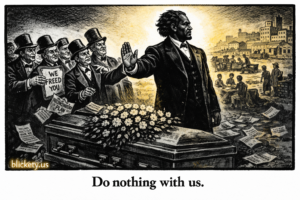
Narrative is infrastructure. Who controls the story of Black people controls the conditions Black people live in. Not as metaphor. As operational fact. The stories told about us shape the policies written about us, the resources directed toward us, the futures imagined with us or without us. And so every time a homegoing becomes someone else’s rally — every time Black grief becomes someone else’s galvanizing moment — it isn’t just rude. It is a structural move. Conscious or not.
Douglass saw this in 1865 sitting in a room full of people who loved him. The abolitionists needed the cause. They needed Black suffering to remain legible, visible, present — because without it, their own moral identity had nothing to organize around. A freed Black man building his own life, telling his own story, governing his own future, is a man who no longer needs abolitionists. And that, quietly, is the threat.
The welfare state inherited this logic from Reconstruction. Different mechanism, same architecture. Managed dependency instead of terror. Comfort instead of chains. But the outcome — Black communities unable to build, transfer wealth, and govern themselves on their own terms — remained remarkably consistent. Douglass saw the first wave coming and named it before it crested. “Do nothing with us, for us, or by us as a particular class. What you have done with us thus far has only worked to our disadvantage. We now simply ask to be allowed to do for ourselves.” Manifoldapp
Jesse Jr. stood at his father’s casket and renewed that charge in 2026. He wasn’t performing outrage. He was being precise. He was doing what the Douglass tradition has always done — looking the allies in the room directly in the eye and saying: you still don’t know how to leave us alone.
What Comes After the Check
Jesse Jackson Jr checking three presidents and Kamala Harris at his father’s homegoing will be remembered as a footnote in most of the coverage. The news cycle moved fast. Obama’s speech got the headlines. The political commentary focused on whether the eulogies were appropriate given the current climate. Annnnnd why didnt he endorse Jasmine Crockett? All the chastising of Black men not long ago only to be endorsing a non black candidate. Not even a stir from Michelle Obama.
Anyways, that misses what actually happened.
What actually happened is a son protected his father’s narrative at the moment it was most vulnerable. What actually happened is a 160-year-old charge got renewed on a Saturday afternoon in Chicago, delivered not to enemies but to allies — which is the only place it has ever really needed to be delivered.
Douglass asked the abolitionists to do nothing with him. Not because he didn’t need justice. Because he understood that the kind of help being offered wasn’t justice — it was management. It was the perpetual positioning of Black people as recipients rather than architects. As causes rather than builders. As the moral occasion for someone else’s better story about themselves.
Jesse Jackson Sr. spent his entire life refusing that positioning. Building Rainbow PUSH. Running for president not to win the White House but to expand who could imagine themselves in it. Showing up for the stranger. Pressing the political class that needed him more than he needed them — and knowing it, always knowing it.
His son knows it too. That’s what the check was. That’s what it has always been.
The ancestors built this tradition of sovereign voice from nothing, in conditions designed to silence them. They built it so precisely that it still lands 160 years later, still names the same pathology, still demands the same thing.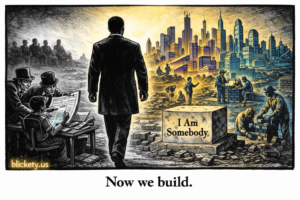
Do nothing with us.
Leave us alone.
Let us bury our dead in peace.