Black Tech Futurists: Culture, Innovation & Black Success
https://the-afrofuturist.com/wp-content/uploads/2026/03/black-tech-futurists-culture-innovation-future-of-black-success.pdf
Introduction: Why Black Tech Futurists Matter Now
Black tech futurists are not a trend. They are not a conference theme, a diversity initiative, or a hashtag that peaks in February and disappears by March. They are architects — methodical, visionary, building with intention in a digital landscape where the stakes are generational and the window is open right now.
But let’s back up. What does it actually mean to be a black tech futurist? Not the romanticized version, not the TED Talk version — the real one. It means you are someone operating at the intersection of cultural identity, technological innovation, and long-range thinking. It means you understand that the tools of this era — AI, blockchain, digital media, fintech infrastructure — are the same thing that cotton gins and railroads were in prior centuries: whoever owns them shapes the world that everyone else lives in. Black tech futurists understand that clearly, without flinching.
Google is paying attention to this niche right now for a reason. Search behavior is shifting. People — Black professionals, founders, creators, students — are looking for a frame that connects their technological ambitions to something deeper than a salary or a Series A. They want to understand where they fit in the larger arc of Black excellence, and they want language for why this moment feels different. Black tech futurists provides that frame. This article is the cornerstone of that conversation — grounded in data, rooted in lineage, and pointed squarely at what’s being built right now.
Futurism, in this context, is not escapism. It is clarity. It is agency. It is the strategic decision to look forward with as much rigor as you look at what’s been done to you, and to build anyway — actually, to build because of it.
Cultural Lineage: The Roots of Black Futurism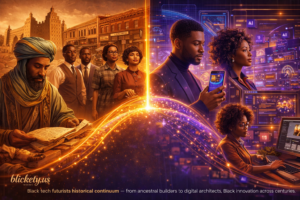
Here’s something the standard tech narrative almost always skips: black tech futurists didn’t begin with smartphones. They didn’t begin with the internet. They didn’t even begin with the PC. The lineage goes back further than any Silicon Valley origin myth wants to acknowledge, and understanding that lineage is not a preamble — it is the actual point.
Afrofuturism is a literary and cultural genre in which the Black experience is explored through speculative fiction, grounded in diversity and avoiding science fiction’s usual racial pitfalls. Notable Afrofuturists include musicians like Sun Ra and Janelle Monáe, as well as science fiction writers like Octavia Butler and Nnedi Okafor — their work combining science fiction tropes with non-Western and minority ethnic aesthetics to produce new, more complex visions of the future. openDemocracy These weren’t people daydreaming about the future. They were architecting survival. They were giving communities a language for imagining beyond the conditions imposed on them, which is — if you think about it clearly — exactly what the best technology does.
Futurism has always been Black survival infrastructure. The coded quilts of the Underground Railroad were information technology. The jazz of Sun Ra was speculative cosmology. The Harlem Renaissance was a cultural operating system running on collective genius and deliberate institution-building. Each of those moments shared a common architecture: a community that refused to accept the world as it was and used creativity, intelligence, and collective will to prototype something better.
Afrofuturism has the potential to envision and shape a more inclusive and equitable future by challenging traditional narratives and offering alternative visions of society. By embracing technology, Afrofuturist artists and thinkers can reimagine systems, institutions, and technologies that center and uplift Black experiences. General Assembly What’s new is that the tools are digital. What’s ancient is the impulse to use whatever tools exist to build forward.
That impulse didn’t skip a generation. It evolved. The kids who grew up on Octavia Butler’s Parable of the Sower and Black Panther’s Wakanda are now the engineers, the founders, the architects. The cultural imagination and the technical capacity have merged. That merger is what black tech futurists represent, and it is why this moment is genuinely different from the diversity initiatives and inclusion panels of the past decade.
The New Class of Black Tech Founders
The shift that defines this generation of black tech futurists is not representation. It’s sovereignty. Those are not the same thing, and conflating them has cost the community real time and real money.
In 2025, the broader conversation about Black entrepreneurship has gained traction, but within the tech world — the industry shaping the future of work, money, and communication — representation remains painfully thin. These founders aren’t lacking talent or ideas. What they’re lacking is access to capital, networks, and equitable opportunity in an ecosystem still built on exclusion. Huffity That’s the structural reality. But underneath it, something is moving.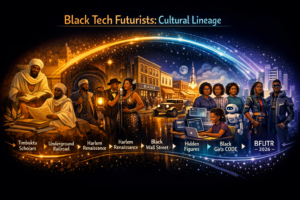
Real momentum is happening where Black founders are building infrastructure — fintech, healthcare, AI. There’s a shift from being invited into rooms to owning the rooms. More repeat founders, more technical depth, more enterprise ambition. Tech:NYC Blog That’s not marketing language. That’s pattern recognition from people inside the ecosystem watching the shift in real time.
That’s one end of the spectrum. On the other end — and this is where the ancestral-to-digital continuum becomes visible — you have early-stage founders solving culturally specific problems with serious technical depth. Eight Black entrepreneurs are leading the charge in using AI to disrupt industries, pushing the innovation frontier forward UrbanGeekz — from AI-powered hair care platforms analyzing hair DNA to cybersecurity companies using machine learning to stop phishing attacks before they land, to energy management platforms designed to serve school systems and commercial buildings. Culture and code working together. Not as a slogan. As an actual business model.
Black tech futurists, as a class, are defined less by a single industry than by a shared orientation: they build for communities that legacy systems have abandoned, they use the most advanced tools available to do it, and they understand that building for Black communities means building for the most complex, most underserved, most data-rich market in the country.
Innovation as Cultural Survival and Strategy
Innovation, for Black communities, has never been optional. That’s worth saying plainly because the mainstream tech narrative treats innovation as a choice — a preference of curious, well-funded people in comfortable environments. Black history says otherwise.
Every generation of Black excellence was built under conditions that were designed to make it impossible. The architects of Timbuktu. The entrepreneurs of Black Wall Street. The scientists of the Hidden Figures era. The coders, founders, and builders of today. Each generation adapted whatever tools existed — legal, cultural, technological — to create forward motion under pressure. That is not resilience as a personality trait. That is innovation as survival technology.
Black founders are building, scaling, and transforming entire industries through artificial intelligence, showing the world that culture and code can work together as tools for both profit and social change. The power shift is clear — you can see it in the funding rounds, the conference panels, and most importantly in the solutions that real people use every day. Primal Mogul The innovation isn’t happening despite the cultural context. It’s happening because of it. Founders who have lived inside broken systems are uniquely positioned to architect better ones.
Digital tools amplify that cultural agency in ways that have no historical precedent. With Artificial Intelligence reshaping how we work, build businesses, grow careers, and live our daily lives, the question is what this new reality means — and how to stay competitive in it. Blackistechconference Black tech futurists are not asking that question defensively. They are answering it offensively — building the platforms, the models, the infrastructure that will define how AI serves communities that previous waves of technology left behind or actively harmed.
Renowned Black tech inventors and innovators such as Dr. Mark Dean, who co-invented the personal computer, and Kimberly Bryant, founder of Black Girls CODE, serve as powerful examples of how Black individuals have made significant contributions to the field. General Assembly These aren’t footnotes. They are a through-line — from the architects of ancient infrastructure to the engineers of digital infrastructure — and the through-line is continuous, deliberate, and generative. Black tech futurists are not starting something new. They are continuing something ancient with better tools.
Economic Futures: Ownership, Crypto, and Sovereignty
Here’s where it gets complicated. And real.
The crypto conversation in Black spaces has been, to put it charitably, a mess. Loud. Occasionally predatory. Full of people who learned the vocabulary of liberation and used it to move money upward. That deserves acknowledgment. The Black community has been burned by financial promises before — Freedman’s Savings Bank, predatory mortgage lending, payday loan infrastructure that parks itself specifically in Black neighborhoods. Healthy skepticism is not paranoia. It is historically earned.
But here’s what doesn’t deserve to be dismissed with the hype: the underlying architecture.
Black consumers are more likely than white consumers to own cryptocurrencies — 18% of Black adults had invested in, traded, or used cryptocurrency compared with 13% of white adults, according to a 2021 Pew Research Center survey. The transparency and accessibility of blockchain may appeal to Black consumers distrustful of traditional financial institutions and of participating in a system that may not work in their best interests. Federal Reserve Bank of Kansas City That adoption rate isn’t impulsive. It reflects a rational assessment by communities who have watched traditional financial systems systematically exclude them.
As of the third quarter of 2024, Black Americans held $5.39 trillion, just 3.4% of the country’s total wealth, while white Americans controlled $134.58 trillion, or 84.2%. The Washington Informer That gap is structural. No single financial tool closes it. But ownership of financial infrastructure — the platforms, the protocols, the payment rails — changes who benefits from transactions flowing through them. That is the sovereignty argument, and it is distinct from the investment argument.
Black tech futurists who are thinking clearly about economic futures understand the difference between using crypto and building crypto infrastructure. Between riding fintech platforms and owning them. The focus is shifting from simple consumption of financial products to the ownership of the infrastructure itself — and HBCU alumni are building their own investment channels, creating a circular economy where alumni invest in startups founded by their peers. HBCU Buzz That’s a generational shift in posture. From participation to architecture.
The ancestors who built Black Wall Street didn’t just work in Greenwood. They owned the banks, the newspapers, the law offices, the hospitals. They built the whole stack. Black tech futurists are doing the same thing — just with servers instead of storefronts, and with blockchains instead of brick-and-mortar. The mission is identical. The tools are just faster.
Strong Foundations: The Data Behind Black Success
This section requires some intellectual honesty, because the data is complicated and the culture war around it is loud. Let’s cut through both.
The research on family structure and Black outcomes is real, and it deserves engagement without weaponization. Black and white children from intact homes are significantly more likely to be flourishing economically, educationally, and socially — on outcomes including child poverty, education, and incarceration rates. At the same time, a stable two-parent family is no panacea for African-American children — Black children in stable, two-parent families are more likely to experience poverty and incarceration, and less likely to graduate from college, compared to their white peers from stable, two-parent families. Institute for Family Studies
Read that carefully. The data says stable family structure correlates with better outcomes and that structural racism means those outcomes are still unequal even when family structure is the same. Both things are true simultaneously. Anyone using this data to argue for or against Black families without holding both realities is either sloppy or dishonest.
Research evidence shows that “family structure is no silver bullet for Black children” because it simply does not overcome the disadvantages produced by generations of socially structured oppression. Wiley Online Library That’s not an argument against stable families. It’s an argument that structural problems require structural solutions — and that family strength is necessary but not sufficient. It has to be part of a larger architecture: community investment, economic infrastructure, educational access, and yes, the kind of technological sovereignty that black tech futurists are actively building.
What Thomas Sowell-style analysis gets right is the cultural infrastructure point: communities with strong internal institutions — families, civic organizations, economic networks, educational systems — produce better outcomes than communities without them. What it sometimes misses is that those institutions were systematically dismantled by external force, not dissolved by internal failure. The two-parent family didn’t decline in Black America because of moral weakness. It declined in the context of mass incarceration, deindustrialization, predatory lending, and policy failures that specifically targeted Black economic stability.
Black tech futurists understand this clearly. The goal isn’t to relitigate those debates endlessly. The goal is to build the infrastructure — digital, economic, educational, communal — that makes strong outcomes the default rather than the exception. The pyramid builders didn’t just build for their generation. They built for 45 centuries. That’s the frame.
The Next Decade: Predictions for Black Tech and Culture
Let’s be specific about what’s coming — not because prediction is certain, but because black tech futurists who are paying attention can see the shape of what’s forming.
AI is going to restructure the economy. AI captured close to 50% of all global venture funding in 2025, up from 34% in 2024, with $202.3 billion invested in the AI sector — more than 75% year-over-year growth. Crunchbase News That capital is concentrating. The founders, engineers, and architects who build the tools will accumulate wealth at a scale this generation hasn’t seen. Black tech futurists who are positioned inside AI infrastructure — not just as users, but as builders and owners — will be the ones who benefit from that concentration rather than being displaced by it.
Digital identity is going to become a sovereign resource. Web3 is moving toward a world where ownership, identity, and data control become core digital rights — not niche ideas. ELITEX Black communities generate culturally specific, economically valuable data constantly. The question is who governs it. Black tech futurists who build data governance frameworks and community-owned identity infrastructure will determine whether that data generates community wealth or flows outward to platforms that extract without reciprocity.
Black tech hubs are already forming and will accelerate. Cities like Atlanta, Austin, and Detroit have emerged as mini-tech hubs for Black innovation, while accelerators and community organizations are building the connective tissue between talent, capital, and community. Huffity These aren’t satellite offices of Silicon Valley. They are parallel ecosystems with their own capital networks, their own cultural logic, and their own definition of what innovation is for.
BFUTR — the largest gathering of Black tech professionals in the world — brings together leaders, innovators, and professionals for learning, networking, and cultural celebration, with AI taking a central role in programming that’s shaping the future of tech, business, and leadership. Obsidi These gatherings matter not because conferences change the world, but because they are where the connective tissue gets built — where a founder meets an investor who actually understands the market they’re building for, where a developer realizes the problem they’re solving isn’t niche, it’s massive.
The next decade will determine whether black tech futurists build infrastructure that outlasts them, or build impressive careers inside infrastructure owned by someone else. The ancestral record strongly favors building to last.
Conclusion: The Afrofuturist Path Forward
Black tech futurists are not waiting for permission. That’s the thing that competitors miss, that mainstream coverage flattens, that diversity metrics completely fail to capture. This is not a community asking to be included. It is a community in the process of building something — deliberately, strategically, with full awareness of the historical continuity they’re operating within.
The Afrofuturist path forward for black tech futurists is the same path it has always been: use the most advanced tools available, build infrastructure that serves the community and outlasts the builder, and understand that cultural identity and technological ambition are not in tension — they are the same thing, expressed through different materials.
Black tech futurists are the descendants of pyramid architects, of Timbuktu scholars, of Harlem Renaissance institution-builders, of Black Wall Street entrepreneurs. The servers are different. The servers are a detail. The architecture — the impulse to build permanent, to build for the collective, to build forward across generations — that is unbroken lineage.
The future of Black success is not somewhere ahead of us, waiting to be discovered. It is being built, right now, by the founders and engineers and creators and community architects who understand that the tools of this era are just the latest version of an ancient technology: the deliberate construction of a world worth living in.
That is what black tech futurists are doing. It has always been what they were doing. The only new thing is the scale of what’s now possible.
Read about Steffanie Rivers who opened a drone company in Texas and teaching kids the value of ownership and tech.
This piece is part of a growing body of work on the-afrofuturist.com exploring Black tech sovereignty, digital infrastructure, and the economic architectures Black communities are building in real time. The conversation runs deeper from here — into who owns the platforms, who governs the data, who controls the AI systems that will define the next half-century. Black digital sovereignty isn’t coming. It’s already being built. Stay locked in.