How 60 Years of Black Political Power Without Economic Power Built Careers, Managed Poverty, and Leaving the Community Spiraling
https://the-afrofuturist.com/wp-content/uploads/2026/03/the-seat-was-there-the-power-wasnt.pdf
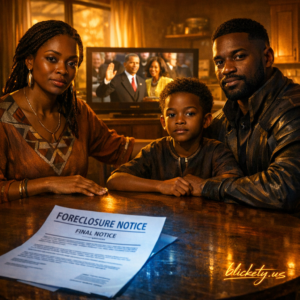
There is a specific kind of grief that doesn’t have a name yet. It’s the feeling of watching something historic happen on a screen while something devastating happens on your kitchen table. Black political power without economic power produces exactly that grief — the simultaneous experience of symbolic ascent and material collapse, happening in the same room, at the same time, to the same people.
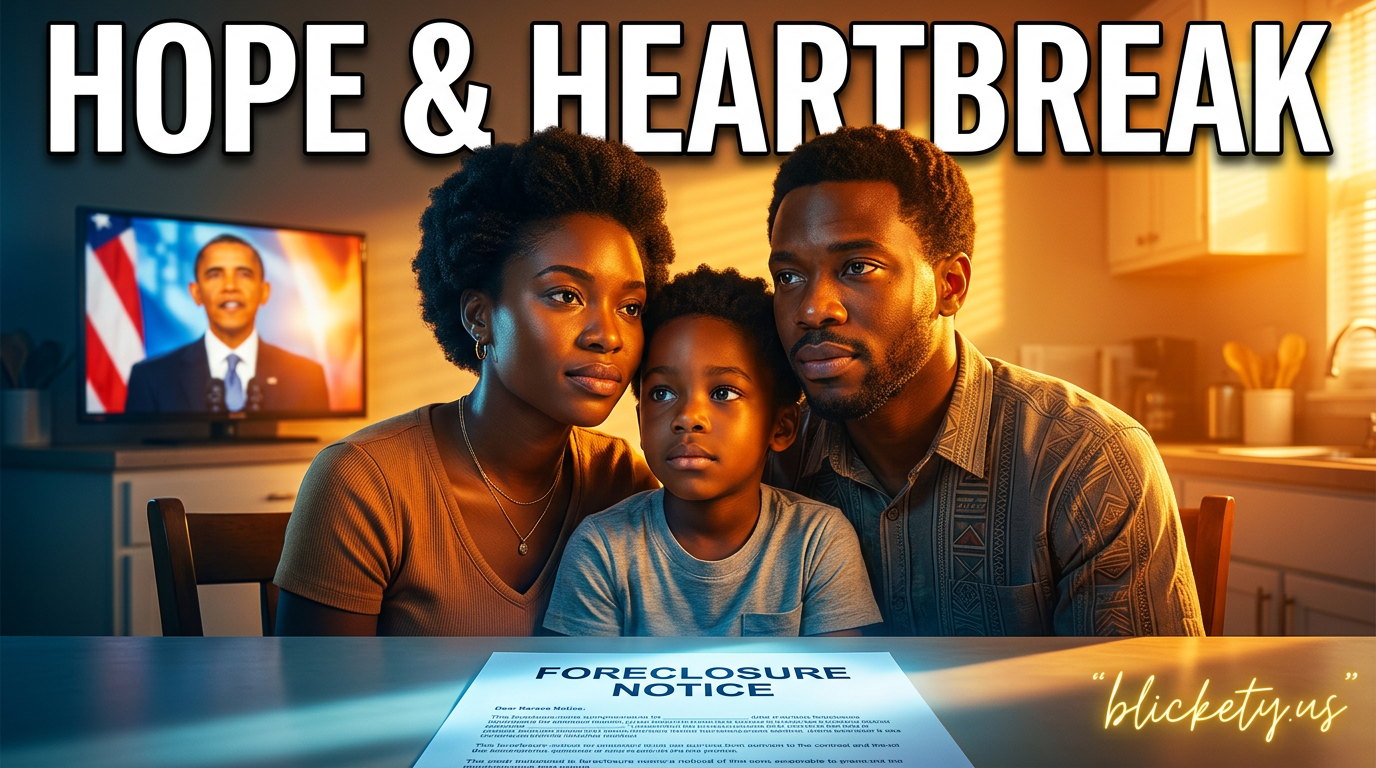
In November 2008, millions of Black families watched a Black man walk toward the presidency of the United States. That moment was real. The pride was real. The tears were real. And on kitchen tables across south Los Angeles, across Detroit, across Baltimore and Memphis and the south side of Chicago, foreclosure notices were real too. The most significant symbolic achievement in the history of Black political representation arrived in the same season as the most catastrophic destruction of Black wealth in modern American history.
That is not a coincidence. That is the story.
Black political power without economic power has been the defining condition of Black political life since the Civil Rights Movement handed a generation of leaders a seat at the table and called it victory. What followed — sixty years of representation, caucuses, chairmanships, historic firsts, and managed poverty — is what this piece is actually about. Not the symbols. The structure underneath them. And what the generation coming up right now is building to replace it.
Table of Contents
- The Symbol and the Storm — 2008
- The Crisis Already in Motion: How the Housing Bubble Was Built on Black Backs
- The Seat at the Table: What a Black President Actually Inherited
- The Bailout Decision: When the Machinery Chose the Banks
- Black Political Power Without Economic Power: The CBC and 54 Years of Evidence
- The Poverty Industrial Complex: Who Gets Paid When We Stay Poor
- The Nearest Green Principle: What Ownership Actually Looks Like
- The Generation That Stopped Asking Permission
The Symbol and the Storm — 2008
Picture it the way it actually happened. Not the cleaned-up version. Not the commemorative magazine cover.
A family in Inglewood, California — south of the 405, west of Compton, inside Maxine Waters’ congressional district — gathered around a television on the night of November 4, 2008. Thirty-five years their congresswoman had been fighting for them. Now a Black man was about to become president. The moment felt like arrival. Like something the ancestors had been moving toward across centuries of forced labor, legal apartheid, and systematic exclusion from every wealth-building mechanism America offered its white citizens.
The foreclosure notice on the kitchen table didn’t care about any of that.
It had arrived quietly, the way those things do. A letter. Official language. A timeline. The house that represented everything the family had built — the down payment scraped together over years, the equity that was supposed to become a college fund, the physical proof that the bootstrap strategy actually worked — was being taken back by a financial system that had sold them a predatory loan in the first place, extracted what it needed, and was now moving on.
Black political power without economic power looks like that kitchen table. The television and the notice. Both real. Happening simultaneously. The political system producing one. The economic system producing the other. And the people who built both systems sitting in entirely different zip codes, watching neither.
The Crisis Already in Motion: How the Housing Bubble Was Built on Black Backs
The housing bubble wasn’t an accident that happened to hit Black communities particularly hard. It was a targeted extraction operation with a marketing strategy.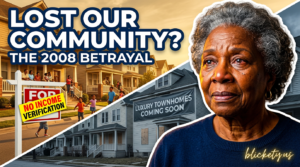
Financial institutions identified Black and Latino neighborhoods as fertile ground for subprime mortgage products specifically because those communities had been systematically excluded from conventional lending for decades. Redlining had blocked Black families from building home equity in appreciating neighborhoods. The Community Reinvestment Act of 1977 had tried to correct that. And predatory lenders used the opening to sell products designed to fail — adjustable rate mortgages with balloon payments, no-documentation loans, interest-only structures that looked like affordability and functioned like debt traps.
The people selling these products knew what they were selling. The institutions packaging them into securities knew what they contained. The rating agencies blessing them with AAA designations knew the math didn’t work. It was a machine. And the communities with the least access to legal protection, the least financial literacy infrastructure, and the longest history of being told to trust institutions that were robbing them — those communities were the machine’s primary fuel source.
By the time the bubble burst in 2008, Black homeowners had lost more wealth more rapidly than at any point since Reconstruction. According to Federal Reserve data, the foreclosure crisis wiped out roughly half of Black family wealth accumulated between 1983 and 2007. Not a setback. Not a dip. Half. Gone. In communities where home equity was often the only significant wealth asset a family possessed, that wasn’t a financial crisis. It was generational erasure.
The community organizer who saw it coming couldn’t stop it. The local pastor who counseled families through it couldn’t stop it. The housing advocates who filed complaints couldn’t stop it. The machinery of American finance doesn’t respond to moral argument. It responds to structural power — ownership of the institutions, control of the regulatory framework, leverage over the people making the decisions.
Which is exactly what Black communities didn’t have. And what sixty years of Black political power without economic power had failed to build.
The Seat at the Table: What a Black President Actually Inherited
Barack Obama walked into the White House on January 20, 2009, carrying the weight of every Black person who had ever been told no. The symbolism was total and real and deserved to be celebrated. Nothing diminishes what that moment meant or what it cost to achieve.
But a president inherits a government. Not a blank canvas.
The government Barack Obama inherited included a Treasury Department staffed by people who had spent their careers inside the financial institutions that caused the crisis. It included an economic advisory team whose intellectual framework was built on the idea that healthy banks were the precondition for a healthy economy — not the other way around. It included a Federal Reserve whose mandate centered on price stability and employment, not wealth distribution. It included a Congress where the votes needed to pass anything required coalition-building with members whose donors were the same institutions now asking for help.
Black political power without economic power means that even when your person reaches the highest seat in the world, the machinery of that seat was built by and for other interests. The levers don’t automatically redirect. The institutions don’t automatically realign. The advisors don’t automatically prioritize the communities that provided the margin of victory.
Obama received 96% of the Black vote in 2008. That is not a coalition. That is a guarantee — and guarantees don’t generate leverage. They generate gratitude and management.
What the administration did next revealed the architecture of the system more clearly than any political science textbook ever could.
The Bailout Decision: When the Machinery Chose the Banks
The Troubled Asset Relief Program. TARP. Seven hundred billion dollars authorized to stabilize the financial system. The argument was clear and it wasn’t wrong on its own terms — if the major financial institutions collapsed, the economic damage to everyone, including Black communities, would be catastrophic. The banks had to be saved to save the system.
What never got the same urgent energy was saving the people the system had already destroyed.
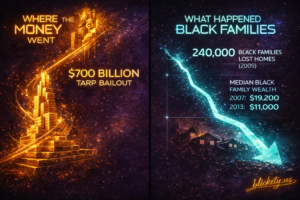
The Home Affordable Modification Program — HAMP — was supposed to help struggling homeowners renegotiate their mortgages and stay in their houses. It was designed for three to four million modifications. It delivered roughly 900,000 permanent ones. The gap between promise and delivery wasn’t a policy failure. It was an architecture failure. The program was designed in a way that gave servicers — the same financial institutions that created the crisis — enormous discretion over who qualified and who didn’t. Predictably, the modifications went where they were most profitable, not where they were most needed.
Meanwhile, the community organizer who had been working south Los Angeles for fifteen years — filing fair lending complaints, running first-time homebuyer workshops, building the kind of institutional knowledge that doesn’t show up on a resume — hit bureaucratic walls at every turn. The hotline numbers led to hold music. The loan modification applications disappeared into servicer systems with no transparency and no accountability. The legal aid organizations were overwhelmed within weeks.
Black political power without economic power means that even with a Black president, a Black attorney general, and a Congressional Black Caucus at its most numerically powerful, the architecture of the response to the greatest destruction of Black wealth in modern history was designed by people who answered to Wall Street first.
That’s not a character indictment of Barack Obama. It’s a structural analysis of what Black political power without economic power actually produces at the moment of maximum crisis. Visibility. Presence. Symbolic authority. And the machinery still running on its original programming.
The families lost the houses. The banks kept the bailout. The neighborhood started the long process of hollowing out. And the investors who would eventually buy those foreclosed properties for pennies on the dollar — turning Black family equity into rental income streams and eventually luxury development — were already circling.
Black Political Power Without Economic Power: The CBC and 54 Years of Evidence
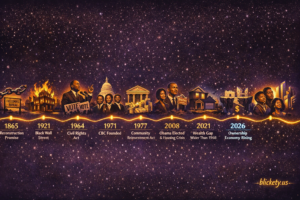
The Congressional Black Caucus was founded in 1971 by thirteen legislators who called themselves the conscience of Congress. Shirley Chisholm said they were unbought and unbossed. They presented President Nixon with a 32-page document demanding the eradication of racism. They boycotted the State of the Union when Nixon refused to meet with them. The founding energy was real and radical and necessary.
Fifty-four years later the CBC has 62 members — the largest in its history. And Black households hold 4% of American wealth while white households hold 84%. That number has not moved meaningfully in the entire lifespan of the caucus.
Black political power without economic power, institutionalized and operating at full capacity for over half a century, has produced the most diverse Congress in American history and a racial wealth gap that would have been familiar to someone living in 1968.
The criticism of the CBC isn’t that its members don’t care or don’t work. Some of them have fought genuinely hard inside an impossible structure. The criticism is structural — and scholars who study the caucus, not its enemies, have named it directly. The CBC writes an alternative budget every year that receives almost no attention on Capitol Hill. Its annual legislative conference is as famous for its social gatherings as for its policy outcomes. The work is largely symbolic.
The corporate money problem runs deeper than the symbolic work. Several CBC members backed efforts to protect derivatives — the exact financial instruments that helped produce the Great Recession — while representing majority-Black districts. A Black newspaper noted at the time that the reason their colleagues stopped short of calling them out publicly was money. Corporate donors. The same ecosystem that funds the institutions extracting wealth from Black communities also funds the political careers of the people claiming to protect those communities.
The CBC is almost entirely a Democratic institution. And that structural dependency is where the leverage disappears. You cannot hold your landlord accountable when your landlord is also your only source of political survival. The Democratic Party has known for sixty years that Black voters have nowhere else to go. That certainty removes every incentive to actually deliver. Unconditional loyalty in politics is just another name for being taken for granted — and the CBC’s unconditional alignment with Democratic Party interests has made it, at the institutional level, a very well-dressed management tool rather than a liberation instrument.
Compare that to how groups with actual leverage operate. They fund both parties. They make their support conditional on performance. They are willing to walk away — or at minimum, credibly threaten to. The CBC has never been willing to walk away from the Democratic Party. And the Democratic Party has never had to fear losing the CBC. That asymmetry is sixty years old and still producing the same results.
The Poverty Industrial Complex: Who Gets Paid When We Stay Poor
This is the part nobody says out loud. Not at the CBC conference. Not at the NAACP gala. Not in the policy papers. Not in the congressional hearings. So we’re going to say it here.
Poverty in Black communities is not just a problem. It is an industry.
A fully operational economic ecosystem with its own revenue streams, its own career tracks, its own conference circuits, its own credential hierarchies, and its own deep institutional incentive to never actually solve the problem it exists to address.
Think carefully about who gets paid when Black communities stay poor.
Nonprofit directors pulling six-figure salaries to distribute scarcity. Federal agencies with hundreds of employees administering programs that haven’t moved the poverty needle in forty years. Consulting firms receiving government contracts to study the racial wealth gap — to study it, not close it. Politicians whose entire identity, fundraising infrastructure, and career longevity depend on the continuation of Black need. Academic departments. Think tanks publishing reports that get cited and filed and cited again. The conference circuit where the same faces appear year after year to discuss the same crisis with the same urgency and the same absence of resolution.
All of these entities have a financial relationship with Black poverty that ends the moment Black poverty ends.
That is not a conspiracy. That is an incentive structure. And incentive structures, left unexamined, produce exactly the outcomes you’d predict — management of the condition rather than elimination of it. Keep the patients sick enough to need the hospital. Not so sick that the hospital gets shut down. Find the sustainable level of suffering that maintains the institution.
Maxine Waters has represented south Los Angeles for thirty-five years. She chairs the committee that oversees the banks, the housing agencies, the financial regulatory apparatus. Her district has a 43% poverty rate. Homelessness in her district has exploded. The wealth never built. And she is running for her nineteenth term, positioning herself to chair the same committee again at 88 years old, inside a political structure that has every reason to keep her there and no mechanism for asking whether her continued presence is producing anything her constituents can actually spend.
That’s not cruelty. That’s just the Poverty Industrial Complex operating as designed. The seat generates a career. The career generates a platform. The platform generates fundraising. The fundraising generates incumbency. And the community — whose continued struggle is the entire justification for the seat — remains the backdrop against which the career continues to be built.
Tim Scott tried to interrupt this logic with Opportunity Zones. The concept was genuinely sound — bring capital to the zip code instead of making poor people travel to opportunity. The intention appears real. But the execution was captured by wealthy investors before it ever reached the communities it was supposed to serve.
The median Opportunity Zone investor had a household income over $740,000. 63% of eligible census tracts received zero investment. 78% of all investment flowed to just 5% of zones. Luxury apartments. Self-storage facilities. Hotels. The architecture was right. The enforcement mechanism that would have kept wealthy investors from redirecting it toward their own benefit was absent. And without that mechanism, the Poverty Industrial Complex simply absorbed another tool and kept it operational.
This isn’t a Republican problem or a Democratic problem. It is a structural problem. And it has a name now.
The Nearest Green Principle: What Ownership Actually Looks Like
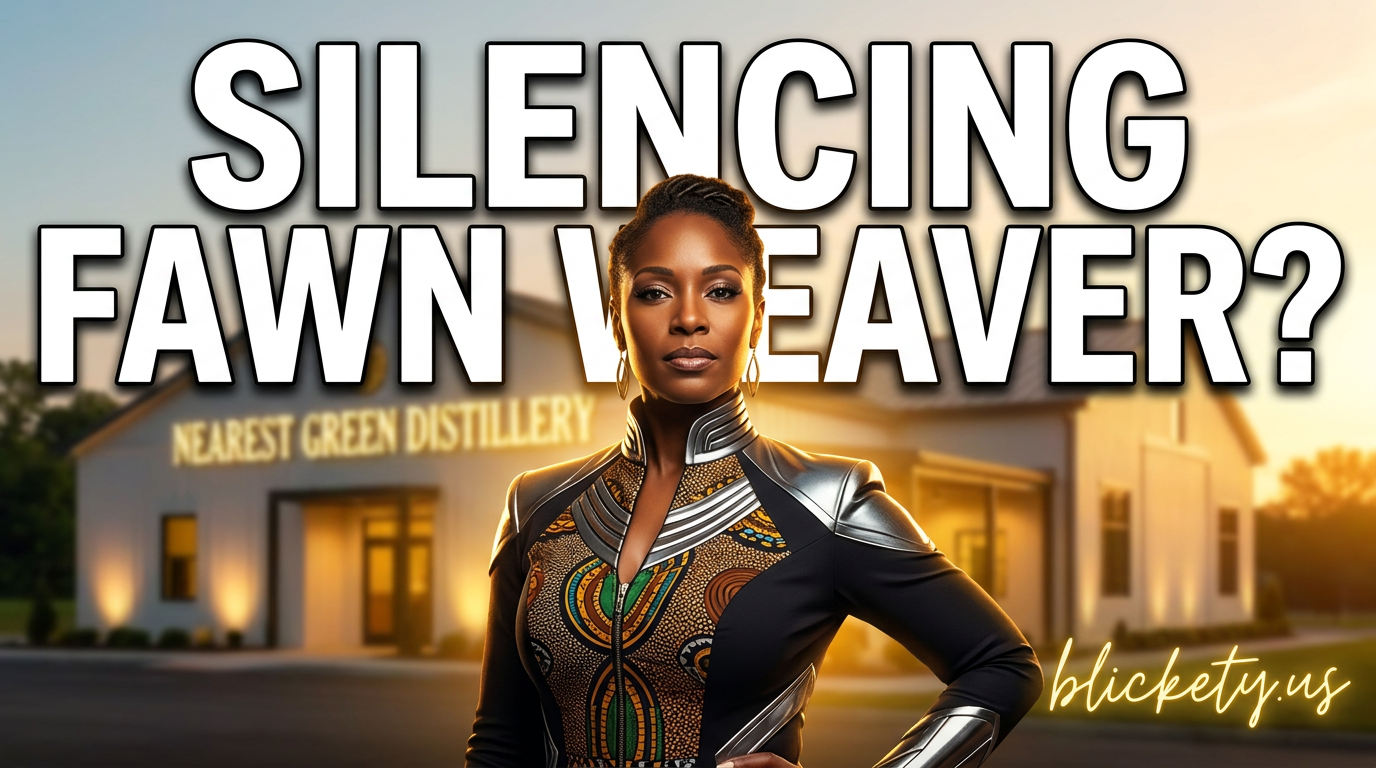
Uncle Nearest Premium Whiskey exists because Fawn Weaver read an article about a man whose name had been erased from history and refused to accept that erasure.
Nearest Green was an enslaved man who taught Jack Daniel the art of whiskey distilling. He is now recognized as the first known African American master distiller in United States history. His name was on none of the bottles his craft produced for over a century. His legacy generated wealth for an institution that owned him and then forgot him.
Weaver built a company on the foundation of that recovery. She raised capital, constructed a state-of-the-art distillery in Shelbyville, Tennessee, won industry awards, and put a Black man’s name on bottles in liquor stores across America. She built ownership. Not advocacy. Not representation. Ownership of the brand, the building, the intellectual property, the distribution relationship, the cultural narrative.
That is the Afro-Futurist principle this piece has been building toward. Black political power without economic power is visibility without leverage. But Black economic power — actual ownership of institutions, infrastructure, and the systems that generate and circulate wealth — is the thing that makes political power mean something. The ancestors who built Black Wall Street weren’t waiting for a seat at the table. They built their own table. Then they built the building the table was in. Then they built the bank that financed the building.
That is the model. Not subsistence. Not managed poverty. Not symbolic representation. Infrastructure that compounds. Ownership that transfers across generations. Systems that don’t require anyone else’s permission to operate.
The Nearest Green principle is simple: you cannot recover what you do not own, and you cannot build what you keep outsourcing to people who benefit from your dependency.

The Generation That Stopped Asking Permission
Here is what is happening right now that most political commentary is missing entirely.
There is a generation of Black Americans — born after Maxine Waters was already in Congress, born after the CBC was already institutionalized, born after the Democratic Party had already absorbed Black political energy and returned symbolic representation — that has decided, largely without making a formal announcement about it, to build outside the system.
Not to abandon politics. Not to stop voting. But to stop treating political representation as the primary strategy for Black liberation and start treating economic ownership as the infrastructure that makes everything else possible.
They are building companies from phones. Circulating dollars through Black-owned platforms. Creating content that generates income streams politics never offered. Stacking ownership in cryptocurrency, in real estate purchased collectively, in intellectual property that compounds. They watched their parents lose houses in 2008 while the banks got bailed out. They watched the CBC issue statements. They watched a Black president manage a crisis that destroyed Black wealth with a team of advisors who answered to Wall Street. They drew conclusions.
Black political power without economic power, they have decided, is the problem — not the solution that needs more time. And they are right.
The Afro-Futurist arc from Nearest Green to Black Wall Street to this moment is not a metaphor. It is a living strategic tradition. Every generation of Black people that has produced lasting community wealth has done it through ownership, institution-building, and the circulation of resources inside the community rather than the extraction of resources upward. The pyramids were built by people who understood that legacy requires infrastructure. So was Black Wall Street. So is every Black church that has operated as a community bank for a hundred years while the actual banks were redlining the neighborhood.
The next chapter is not about finding a better politician. It is about building systems so self-sufficient that whoever is in power has to negotiate with Black communities rather than manage them. When you own something they need — land, capital, technology, media, distribution infrastructure — the conversation changes completely. You stop being a constituency to be appealed to and start being a power to be reckoned with.
Black political power without economic power is just visibility. And visibility, after sixty years, has produced a 43% poverty rate in Maxine Waters’ district, a racial wealth gap that hasn’t closed, and a Congressional Black Caucus that writes alternative budgets nobody reads.
The seat was there. The whole time.
The power was always somewhere else.
Building it — owning it, circulating it, compounding it across generations — that is the work that politics was never designed to do for us. And the generation that understands that is already building.
The ancestors would recognize what they’re doing. They’ve seen it before. Every time Black people built something real, they built it themselves — from soil, from skill, from the ancestral understanding that no system designed to manage your poverty will ever accidentally eliminate it.
You have to build the thing that makes the system irrelevant.
That’s not pessimism. That’s the oldest Afro-Futurist instruction in the archive.
Build. Own. Compound. Transfer.
The rest is just noise.
📖 Suggested Reading: When the Numbers Shift: Black Futures in a New Minority-Majority America