

He Is Up There Right Now
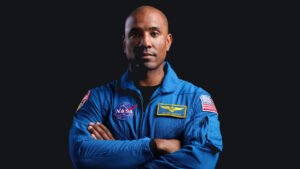
The Victor Glover astronaut moon mission launched April 1, 2026 — and Victor Glover is in space right now, as you read this, piloting the Orion spacecraft — named Integrity by his crew — on humanity’s first journey toward the Moon in more than fifty years. He lifted off from Kennedy Space Center on April 1, 2026, at 6:35 p.m. EDT. On the mission’s first day, Glover became the first person of color to travel beyond low Earth orbit — the first in human history. Wikipedia
The Victor Glover astronaut moon mission CNN is what the Afro-Futurist tradition has always known was coming. Our ancestors mapped the stars from the banks of the Nile before Europe had a written language. They built structures aligned with celestial bodies with a precision that still confounds modern engineers. The cosmos was never unfamiliar to us — only the gate to it was closed. This is what it looks like when that gate swings open.
He will reach the Moon’s vicinity on April 6. He will splash down in the Pacific on April 10. Every moment between now and then is history being written in real time.
Victor Glover Astronaut Moon: Who He Is Before the History
Before the headline, before the launch, before the orange spacesuit and the cheering crowds — there is the man. And the man’s biography reads like the Afro-Futurist template for what Black excellence looks like when it compounds across decades.
Victor Jerome Glover Jr. was born on April 30, 1976, in Pomona, California to African American parents. He graduated from Ontario High School in 1994, where he was a quarterback and running back for the school’s football team. Wikipedia He went to Cal Poly. Played football and wrestled. Earned a degree in general engineering. Joined the Navy. Earned his wings as a naval aviator in 2001. During his career, Glover accumulated 3,000 flight hours in more than 40 aircraft, completed over 400 carrier arrested landings and 24 combat missions. His callsign is “Ike,” standing for “I know everything.” Wikipedia
From 2007 to 2010 he earned three master’s degrees simultaneously — flight test engineering, systems engineering, military operational art and science — from three different institutions while continuing to fly. He was selected as a NASA astronaut in 2013. In 2020, as the pilot of SpaceX Crew-1, he became the first African American to live on the International Space Station for an extended mission — 168 days, four spacewalks. He did not visit. He lived there. 
Now he is piloting the ship that is taking humanity back to the Moon.
This is not symbolic. The Victor Glover astronaut moon mission exists because a man spent thirty years building the kind of résumé that makes him genuinely the right person for the job. The history is real. So is the qualification.
The Grandfather Who Couldn’t Fly
Here is the detail that every mainstream outlet is running past in their rush to the launch statistics. The Victor Glover astronaut moon mission carries a weight that the numbers cannot capture. Glover was heavily inspired by his grandfather, who enlisted in the Air Force during the Korean War but was tragically told he could not fly simply because he was Black. Theqgentleman
Sit with that. A man who wanted to fly. Who had the desire, presumably the capability, the willingness to serve a country that was simultaneously denying him the right to sit at a lunch counter. And he was told: not for you. The sky is not for you.
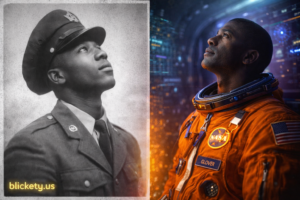 That man’s grandson is now piloting humanity’s return to the Moon.
The Afro-Futurist arc is not always a clean line. Sometimes it runs through generations of deferred dreams. Sometimes the people who built the foundation never got to stand on what they built. The grandfather did not get to fly. But something in that family — something in the telling of that story, in the grief of it, in the refusal to let the grief be the final word — carried forward into a boy from Pomona who decided that the sky was absolutely for him. Who kept compounding that decision through every degree, every carrier landing, every spacewalk, until he was sitting in the pilot’s seat of a spacecraft pointed at the Moon.
That is not inspiration content. That is the mechanism of how Black futures actually get built — through people who refused to accept their grandfather’s ceiling as their own.
The Line From Hidden Figures to Orion Integrity
The crew named the Orion spacecraft Integrity. Not Courage. Not Pioneer. Not Discovery. Integrity — which means wholeness, the state of being undivided, what you are when no external force has been able to split you from yourself.
For a Black man piloting humanity’s first crewed lunar mission in fifty years, a spacecraft named Integrity is not an accident. It is a statement.
The line from Katherine Johnson to the Victor Glover astronaut moon mission runs through fifty years of Black people doing the mathematics, doing the engineering, doing the flying, that made this moment possible — often without credit, often without recognition, always with the understanding that the work itself was the inheritance being built for those who would come after. Pioneers like Guion Bluford, Mae Jemison, Bernard Harris, Ronald McNair, Frederick Gregory, Charles Bolden, and others helped crack open the door that once seemed sealed shut. Glover now carries that lineage forward, not just as another astronaut, but as someone pushing Black representation into an even rarer frontier: the Moon. Black America Web
Guion Bluford was the first Black American in space — 1983. Mae Jemison was the first Black woman — 1992. Bernard Harris was the first Black man to walk in space — 1995. Ed Dwight was supposed to be the first Black astronaut in the 1960s and was passed over. Each one extended the arc one step further. Each one made the next step possible.
Victor Glover astronaut moon mission is what step fifty years in the making looks like. And the spacecraft is named Integrity.
What He Said From Space
The day after launch, during a live public affairs event from aboard Orion, Victor Glover spoke to Earth. What he said from 46,000 miles away matters more in the Afro-Futurist frame than any of the technical statistics.
“The first thing I would say is, trust us, you look amazing. You look beautiful,” Glover said. “And from up here, you also look like one thing. Homo sapiens is all of us, no matter where you’re from or what you look like. We’re all one people.” CNN
A man whose grandfather was told he could not fly because of what he looked like is now looking at the entire Earth from 46,000 miles away and saying: from here, you look like one thing.
That is not a press release. That is the specific gravity of a moment that only makes sense if you know the full arc. The distance the Victor Glover astronaut moon mission has traveled — generationally, historically, literally — is what gives those words their weight.
Glover reflected: “We call amazing things that humans do moonshots for a reason, because this brought us together and showed us what we can do, not just putting our differences aside, but when we bring our differences together and use all the strengths to accomplish something great.” CNN
Bring our differences together. Use all the strengths. That is the Afro-Futurist thesis in one sentence, spoken from a spacecraft on the way to the Moon by a man who knows in his bones what it cost to get there.
Victor Glover Astronaut Moon Mission: The Five Generations of Deferred Dreams
Generation 1 — The Grandfather. He wanted to fly. He was told the sky was not for him. His dream did not die. It went underground and became inheritance.
Generation 2 — The Parents. They raised Victor Glover in Pomona, California, in the shadow of that deferred dream, in a country still deciding whether Black children deserved to dream at all. They raised a boy who became a quarterback, a wrestler, an engineer.
Generation 3 — Victor Glover Himself. The man who took the deferred dream, added thirty years of relentless qualification, and turned it into a seat on humanity’s most significant mission in half a century. He is at the controls of the Victor Glover astronaut moon mission right now. He did not inherit the dream passively. He built the machine that could carry it.
Generation 4 — The Fourteen Who Flew Before Him. Bluford, Jemison, Harris, McNair, Gregory, Bolden, and the others. Each one cracked the door wider. NASA has so far sent only 14 Black Americans to space out of a total of more than 300 NASA astronauts. Wikipedia Fourteen people carrying the weight of a lineage. Glover is the fifteenth.
Generation 5 — The Children Watching. Every Black child who watched that rocket lift off on April 1, 2026, saw a Black man in the pilot’s seat of humanity’s most ambitious mission. What that does to a child’s sense of what is possible cannot be measured. But the Afro-Futurist tradition knows exactly what it does. It builds the next generation. It is the whole point.
What Comes Next — and What We Owe It
The Victor Glover astronaut moon mission splashes down on April 10. He will come back as the farthest-traveled Black man in human history, the pilot who proved Orion works, the grandfather’s grandson who flew.
Artemis III is targeting 2027 — the actual Moon landing. Artemis IV is planned for 2028 with a base at the lunar south pole. BET The Moon is the proving ground for Mars. The generation being built right now — the children watching the launch, the young engineers studying Glover’s trajectory, the Black girls who will grow up knowing that Christina Koch was the first woman to fly around the Moon and that a Black man piloted the ship — that generation will take humanity to Mars.
The pyramid builders looked at the stars and built structures aligned with them because they understood the cosmos was part of their inheritance, not foreign territory. Katherine Johnson calculated the orbital mechanics that put men on the Moon from a segregated office in Virginia. Victor Glover is piloting the spacecraft that is taking humanity back.

The arc is not straight. It runs through deferred dreams and Jim Crow and fourteen Black astronauts in sixty years and a grandfather who was told the sky was not for him. But it bends. It bends toward the Moon. It bends toward what Glover said from 46,000 miles out: from up here, you look like one thing. Before reading the next segment, lets look back by going forward and read the story about the first black female pilot in space. And its not Mae Jamison
The next question this series is asking: who comes after Victor Glover? The pipeline of Black astronauts, the schools producing them, the mentorship structures sustaining them, and what NASA’s commitment to Artemis means for whether the next generation of pilots looks different from the last sixty years of fourteen. That piece is being built now, the same way Artemis III is being built — on the proof that the last mission gave us.