Kenya’s Emerging Role in the Global Reorder — and the Sovereign Debt It’s Running Up

Kenya foreign policy 2026 is not a policy debate. It is a reckoning. The world that Kenya became independent into — the world where big powers competed, but still maintained the theater of rules, institutions, and multilateral fiction — is gone. Canada's Prime Minister Mark Carney said so plainly at Davos in January: "a rupture in the world order, the end of a pleasant fiction and the beginning of a harsh reality." He was speaking to middle powers. He was, whether he intended it or not, speaking directly to Nairobi. The question is not whether the old order has ended. It has. The question is what Kenya does next — and whether it does it for itself, or for whoever is paying. KENYA FOREIGN POLICY 2026 AND THE PRICE OF BORROWED LOYALTY
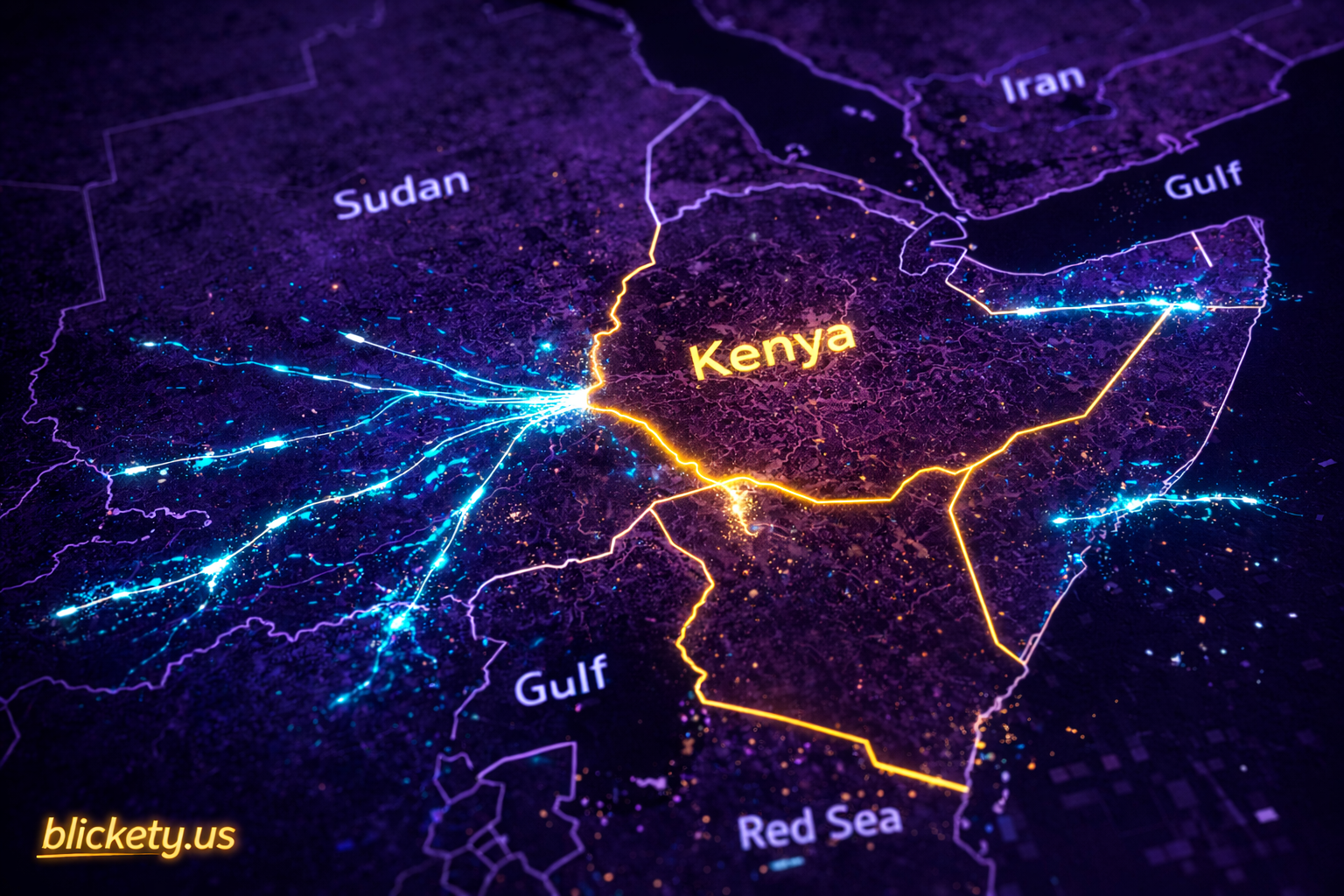
The evidence of the cost is not abstract. It shows up in balance sheets and broken supply chains. Sasini, one of Kenya's listed agriprocessors, sold its avocado processing plant in 2025. The reason was not mismanagement or market failure. It was Yemen's civil war, which disrupted Red Sea shipping routes and made transportation too expensive and too unpredictable for the company to absorb. That plant represented Kenyan agricultural infrastructure, Kenyan jobs, Kenyan productive capacity — and it is gone because a conflict Nairobi had no hand in starting has now restructured the economics of getting Kenyan goods to market. That is the bill arriving from a world order Kenya did not build and cannot control. But some of what Kenya is paying today, it chose to pay. Kenya's tea is banned in Sudan. The decision came after Nairobi hosted the Rapid Support Forces — the paramilitary group accused of genocide and ethnic cleansing — to announce a parallel government from a Kenyan government-owned facility in February 2025. Khartoum recalled its ambassador, branded Kenya a "rogue state," and imposed a sweeping suspension of all Kenyan imports. Sudan is not a small market. The relationship took decades to build. It ended in a press conference. Kenya's tea is also no longer moving through Iranian supply chains, though for a different reason — a single exporter, Cup of Joe Ltd., shipped substandard product and had its license revoked. Iran suspended all Kenyan tea imports in response. In 2024, Kenya exported approximately 13 million kilograms of tea to Iran valued at KSh 4.26 billion. That market did not disappear because of war or sanctions. It disappeared because quality control failed and no one caught it in time. Two of Kenya's top tea markets. Gone. In the same season. THE NEUTRAL GROUND KENYA BUILT AND WHAT IT WAS WORTH To understand what Kenya foreign policy 2026 has abandoned, there is a history worth naming before it disappears entirely into revisionism. Kenya became something rare in the post-colonial African landscape: neutral ground. Not neutral in the sense of indifference — neutral in the sense of trusted. Nairobi hosted the United Nations' only headquarters in the Global South. It contributed to nearly as many peacekeeping missions as have existed on the continent. It ceded complex regional disputes, including the Western Sahara question, to the African Union rather than inserting itself as arbiter. When Somalia needed a peace process, Nairobi was the venue. When Sudan's factions needed a table, Nairobi provided it. This was not charity. It was strategy — sophisticated, long-horizon, sovereign strategy.
The value of that neutrality was not just diplomatic goodwill. It was the ability to sit across from all parties in any conflict and have each of them believe, with reason, that Kenya was not working against them. That is a form of power most nations never achieve. Kenya had it. It was earned across decades of careful, sometimes frustrating, deliberate restraint. A lot of that is gone now. KENYA FOREIGN POLICY 2026 AFTER ABU DHABI'S CASH ARRIVED
The primary reason Kenya broke from its own diplomatic history is not complicated, even if the consequences are. The United Arab Emirates and other Gulf states, flush with petrodollar wealth and Washington's sustained interest, have spent the last several years purchasing influence across East Africa. The competition runs from Yemen to Khartoum to Mogadishu. It is economic, political, and military. And it has found willing partners in Nairobi. Kenya's decision to align with the RSF in Sudan's civil war did not happen in a vacuum. It happened in the context of Abu Dhabi's deep financial relationships with Nairobi and its documented support for the RSF across the region. Kenya allowed RSF leaders to use its territory as a logistical hub, hosted Hemedti and his delegations, and ultimately provided the platform for the parallel government announcement. Former Deputy President Rigathi Gachagua publicly accused President Ruto of having a personal business relationship with Hemedti. The US Treasury Department confirmed in early 2026 that one of Hemedti's brothers — already sanctioned for procuring weapons for the RSF — holds a Kenyan passport.
The African Union warned against the fragmentation of Sudan and implicitly condemned Nairobi's role. Kenya lost the vote to install Raila Odinga as AU Commission chair. It lost relevance in the DRC peace process to the United States and Qatar. It lost its reputation as an honest broker in South Sudan, where a civil war now appears imminent despite Kenya's previous success in mediating that country's founding separation from Sudan. This is what borrowed loyalty costs. You spend the relationship capital accumulated over forty years, and you have very little to show for it except the approval of the party that paid you to spend it. The Besigye affair crystallized something that had been building for years. In late 2024, Ugandan opposition leader Kizza Besigye was kidnapped in Nairobi and transported across the border — an act of transnational repression that Amnesty International described as part of a growing and worrying trend. Foreign Affairs Principal Secretary Korir Sing'oei denied Kenya's involvement and told The East African that Nairobi is "pro-peace, not pro-any side." That statement is increasingly difficult to defend. Seven Turkish nationals were abducted from Kenya in October 2024. Thirty-six Ugandan opposition supporters were taken in July of the same year. A Rwandan human rights defender and a South Sudanese dissident were forcibly returned to their governments. This is not neutrality. This is a pattern. THE CITIZENS NOBODY WENT TO GET
There is a dimension to Kenya foreign policy 2026 that receives the least attention and carries the most human cost. Remittances are now Kenya's largest single source of foreign exchange. The diaspora — concentrated heavily in the Gulf states where the current crisis is burning — is the financial backbone of millions of Kenyan households. Their money funds school fees, medical care, and small businesses across the country. When the Gulf Crisis escalated and governments around the world began planning contingencies for their citizens, a spot check of Kenyan diplomatic missions in the region revealed a troubling picture. Calls went unanswered. WhatsApp numbers were inactive. Embassies had no public evacuation plans. Only one mission — Tel Aviv — returned a contact directly. More than 500,000 Kenyans live and work across Gulf states. Nairobi denounced the attacks on UAE, Qatar, Saudi Arabia, Iraq, Oman, Kuwait, Jordan, and Bahrain in careful diplomatic language. What it did not do, with the same urgency, was move to protect the half million Kenyan workers caught in the middle of the conflict whose remittances sustain the economy that those same diplomatic statements are designed to protect.
Kenya's first and only true responsibility is to its citizens, at home and abroad. That sentence appears in Morris Kiruga's original analysis for The Kenyan Wall Street, and it bears repeating here because it is both obvious and apparently insufficient as a governing principle. WHAT KENYA FOREIGN POLICY 2026 NEEDS TO BECOME
The rupture Carney described at Davos is real. The post-WWII global order, inside which Kenya built its neutrality, its UN headquarters, its peacekeeping reputation, is gone. That structure was imperfect — it was built by the same powers that colonized the continent — but it provided enough predictability that small and middle powers could find space to operate with some dignity and leverage. What replaces it is not yet clear. But Kenya foreign policy 2026 cannot be built on the assumption that Abu Dhabi's money is a substitute for sovereign strategy. It cannot be built on the assumption that Nairobi can render dissidents to friendly governments and maintain the trust of its neighbors. It cannot be built on the assumption that the Gulf monarchies whose palaces Iran threatened will always be available as a source of easy alignment. The return to principled pragmatism is not nostalgia. It is survival. Kenya's geography, its institutional infrastructure, its educated diaspora, its position as the financial and diplomatic capital of East Africa — these are real assets. They are worth more on an open market than they are pledged to the highest bidder. The world is reordering. Kenya has an opportunity, right now, to define what it stands for in the new arrangement. The sovereign debt it has been running — measured in broken markets, kidnapped dissidents, abandoned citizens, and surrendered trust — is not yet unrecoverable. But the window for choosing differently is not permanent. The Strait of Hormuz does not care about Nairobi's diplomatic language. Sudan does not miss Kenya's tea. And the families of Kizza Besigye and the 36 Ugandan opposition supporters taken from Kenyan soil have not forgotten where it happened. Kenya built neutral ground once. It can build it again. But it will have to decide — clearly, publicly, and at some political cost — that its citizens come first. Not the Gulf. Not Washington. Not whichever power is offering the most favorable terms this quarter. The sovereign debt nobody is counting in Kenya foreign policy 2026 is the one paid in trust. And trust, once spent, does not come back on a wire transfer. The next piece in this series examines what a new Kenyan foreign policy doctrine might actually look like — one built not on Cold War nostalgia or Gulf cash, but on the sovereign interests of 55 million people who deserve a government that knows whose side it is on.
The world is reordering without waiting for Nairobi’s permission. The only question left is whether Kenya will choose its citizens before the window closes — or whether the sovereign debt will compound until there is nothing left to spend. This pattern — of one master leaving and another arriving with better optics and deeper pockets — is not new. It was documented here in 2024: As the Sun Sets on the British Empire, Kenya Finds Itself a New Master.
FAQ SECTION **Q: Why did Sudan ban Kenyan imports in 2025?**Sudan recalled its ambassador and banned all Kenyan imports after Nairobi hosted the Rapid Support Forces — accused of genocide — to announce a parallel government in February 2025. Khartoum called it tantamount to an act of hostility. Kenya lost one of its most important regional trade relationships in a single diplomatic miscalculation. **Q: What is Kenya's sovereign debt in foreign policy terms?**Not financial debt — relational debt. Kenya spent forty years building a reputation as neutral ground, trusted mediator, and honest broker. Under Ruto, that reputation has been pledged to Gulf petrodollar interests, RSF alignment, and transnational renditions. The sovereign debt is the trust it spent and has not recovered. **Q: How does the Gulf Crisis affect ordinary Kenyans?**More than 500,000 Kenyans work in Gulf states and their remittances are now Kenya's largest source of foreign exchange. When the crisis escalated, Kenyan diplomatic missions were largely unresponsive — calls went unanswered, embassies had no public evacuation plans. The people sending money home were left without consular support.