What the Wellness Industry Doesn’t Want You to Know
The wellness industry made $5.6 trillion dollars last year. Celery juice. Adaptogenic mushroom lattes. Intermittent fasting windows calibrated to the minute. Gut health supplements with ingredient lists that read like a chemistry midterm. And somewhere in the middle of all that noise, Black folks are still dying at disproportionate rates from the exact diseases — diabetes, hypertension, cardiovascular failure — that the wellness industrial complex claims to solve.
Here’s the thing nobody at a $40 spin class is saying out loud: your ancestors already solved it. The ancestor diet Black wellness conversation isn’t about going backward. It’s about recovering technology that colonialism tried to delete — nutritional intelligence encoded over thousands of years into the foods, preparation methods, and communal eating rituals of the African continent and its diaspora. Your grandmother’s pot of collards wasn’t a comfort food accident. The fermented porridge your great-grandmother made before dawn wasn’t superstition. The bitter herbs your aunties pressed into tea weren’t folklore. That was science. Sophisticated, time-tested, body-calibrated science — and the peer-reviewed journals are finally catching up.
The Ancestor Diet Black Wellness Movement Is Built On
Before the Mediterranean diet got a pyramid, before the Japanese longevity studies became Ted Talk fodder, before every wellness influencer discovered matcha — there was a continent of people eating in ways that produced near-zero rates of the chronic diseases now killing Black Americans at twice the rate of their white counterparts.
A landmark study by researcher Dennis Burkitt in the 1950s examining the traditional African diet found that many chronic diseases common in modern Western culture were almost entirely absent in Uganda’s African population — including heart disease, which was nearly nonexistent. NutritionFacts.org Read that again. Nearly nonexistent. Not managed. Not in remission. Absent.
The ancestor diet Black wellness framework isn’t sentimental. It’s operational. Emerging studies now confirm what traditional knowledge always held: the health benefits of African Heritage Diets are real, and culturally tailored nutrition programming built around them shows significant promise OLDWAYS — even as mainstream nutrition science is just beginning to center non-European dietary traditions in its research.
The ancestral→present→future continuum matters here. What got lost wasn’t just food. It was an entire operating system for Black bodily sovereignty — dismantled through the Middle Passage, sharecropping, redlining, and a food industry that built empires on the nutritional dispossession of Black communities. The ancestor diet is a recovery project. And right now, it’s outsmarting every trend the wellness industry can manufacture.
What the Science Actually Says (And Why It Took This Long)
Look. Nutrition science has a racism problem and we should say that plainly. Although nutrition research has historically been Eurocentric, emerging studies are now highlighting the health benefits of traditional African Heritage Diets. OLDWAYS That framing — “emerging” — is doing a lot of work. These foods weren’t waiting to be discovered. They were always there, feeding and healing people. What’s “emerging” is the willingness of research institutions to look.
When they do look, the findings are not subtle. A randomized crossover trial published in Nature Medicine in 2025 found that switching to a Western diet caused pro-inflammatory changes in participants, while switching to an African heritage diet rich in fruits, vegetables, legumes, and fermented products produced the opposite effects. Nature The body responds. It responds quickly. That’s not placebo — that’s the microbiome recognizing something it was designed to work with.
The research extends further. Studies demonstrated that another measure of cardiovascular risk — blood pressure — was significantly reduced in rural Kenya, where nearly 2,000 patients showed no cases of hypertension whatsoever. Additionally, colon cancer was almost unheard of in traditional African populations studied in the 1950s. NutritionFacts.org
And then — colonization. Westernization. The deliberate displacement of ancestral food systems. Many Africans shifted to Westernized diets, resulting in demonstrably poorer health outcomes, prompting renewed efforts to encourage increased consumption of fruits, vegetables, and whole grains while reducing foods high in added sugar, salt, and fat. NutritionFacts.org
The science isn’t the revelation. The revelation is that the science is finally being used to validate what Black and African communities knew for centuries. Dr. Kéra Nyemb-Diop — known as @black.nutritionist on Instagram — built an entire cultural nutrition platform on exactly this premise. Her central message is “Decolonize Your Plate”: rejecting Eurocentric definitions of “healthy” food and embracing cultural foods that nourish both body and soul. The Daily Nexus That’s not a lifestyle brand. That’s a correction.
The Four Pillars of the African Heritage Diet
The ancestor diet Black wellness framework draws from a rich, geographically diverse food tradition that spans West and Central Africa, East Africa, the Horn of Africa, and the diaspora’s Caribbean, South American, and American Southern extensions. This isn’t one monolithic diet — it’s a family of eating patterns with a shared philosophical core.
In West and Central Africa, traditional meals centered on hearty vegetable soups and stews seasoned with spices and aromatics, served over boiled and mashed tubers or grains. East African traditions emphasize whole grains and vegetables — particularly cabbage, kale, and maize. In the Horn of Africa, flat breads like injera, made from teff, sorghum, or whole wheat, anchor meals built around protein-rich beans. OLDWAYS
Across all of these regions, four pillars show up consistently: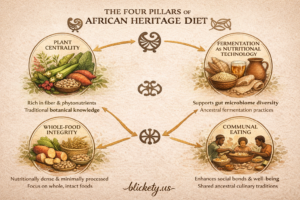
1. Plant Centrality Not plant-based as a trend. Plant-based as the default architecture of eating. Leafy greens, root vegetables, legumes, tubers — these weren’t sides. They were the meal. Traditional African heritage dietary patterns share a consistent emphasis on beans and whole grains supplemented with ample fruits and vegetables, with smaller portions of fish, poultry, and meats — patterns that align closely with current dietary guidelines while being significantly less animal-centric than the standard American diet. PubMed Central
2. Fermentation as Nutritional Technology Your ancestors were running sophisticated microbial science without a lab coat. Ancient fermentation practices in Africa involved processing cereals, roots, milk, and fish into staples like ogi, gari, tef, sorghum, and millet — a practice that preserved food, enhanced nutritional value, improved digestibility, and created culturally significant foods with deep community meaning. ScienceDirect The gut microbiome research emerging right now? Your ancestors were optimizing for that outcome thousands of years before the term existed.
3. Whole-Food Integrity Okra. Sweet potatoes. Black-eyed peas. Collard greens. Plantains. Bitter melon. Moringa. These aren’t exotic superfoods repackaged for a Whole Foods shelf — they are the original whole foods. Traditional African heritage foods in their natural state — from curries and peppers to coconut, fresh herbs, garlic, onions, lemon, and spices — offer low-sodium, high-flavor alternatives that crowd out processed and packaged convenience foods. OLDWAYS
4. Communal Eating as Medicine Food is social infrastructure in African cultural traditions — not a solitary transaction between a person and a delivery app. The healing table, the shared pot, Sunday dinner that stretches to Wednesday. The African Heritage Diet philosophy emphasizes that food is meant to be shared, and that the dinner table can function as a healing space where people reinforce happy, healthy lives through fresh food and community. OLDWAYS Epidemiologists are beginning to understand what Black grandmothers always knew: isolation is itself a health risk, and the communal meal is protective technology.
Decolonizing Your Plate: More Than a Hashtag
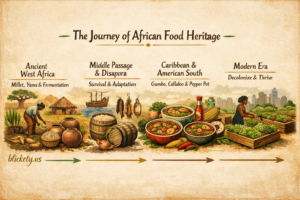
The phrase “decolonize your diet” has become something of a social movement — the hashtag alone appears in more than 15,000 Instagram posts — and at its core it means eating how Black and Indigenous people ate prior to colonialism. Sierra Club
But real talk: decolonizing your plate isn’t an aesthetic. It’s a reckoning. It means understanding that the merger of Southern cooking with African American diet culture was partly a result of colonization and severely limited choices — including pork, which many African communities would not have traditionally consumed, being forced into the diet of enslaved people as a form of control. Zengerfarm The erasure of ancestral food sovereignty wasn’t incidental. It was structural. Deliberate. Part of the same project that burned Black Wall Street, redlined Black neighborhoods, and built food deserts in majority-Black zip codes.
African American neighborhoods are statistically more likely to have dense concentrations of fast food restaurants — “food swamps” — and less likely to have access to full-service grocery stores. Cambridge Core The health disparities didn’t come from personal choices made in a vacuum. They came from a system designed to limit which choices were even available.
The ancestor diet Black wellness framework is the counter-architecture. It says: we know what worked. We have the data, ancient and modern. We have the seeds. We have the recipes in our family memories and on the tongues of our elders. The question isn’t whether our ancestral food knowledge is valid — Nature Medicine answered that in April 2025. The question is whether we’re willing to build the infrastructure to make it accessible.
Ancestor Diet Black Wellness Brands Building the Infrastructure
This is where the Afro-Futurist thread runs hot. The reclamation of ancestral nutrition isn’t happening in a vacuum — it’s being institutionalized, commercialized in the best sense, and extended into a new economy by Black founders who understand that food sovereignty is economic sovereignty.
The African Heritage Diet was formally developed by Oldways, a nonprofit that brought together experts to examine what Africans ate on the continent, how those food traditions adapted during the forced migration of the slave trade, and the resulting health patterns of African descendants — producing a cultural model for healthy eating based on the traditional diets of Africa, the Caribbean, South America, and the American South. DiaTribe That work created a foundation. Now Black entrepreneurs are building the commercial and community layer on top of it.
Brands like Golde — founded by Trinity Mouzon Wofford, one of the youngest Black women to launch at Sephora — center turmeric and plant-based superfoods with direct roots in African and Afro-Caribbean herbal traditions. A Dozen Cousins, founded by Ibraheem Basir, makes culturally rooted, heritage-inspired pantry staples accessible to families who want to eat closer to their roots without spending three hours in the kitchen. Olamina Botanicals, a Brooklyn-based apothecary, crafts herbal formulas, tinctures, and salves using local, foraged, and organic materials — anchoring traditional plant medicine in a contemporary economy. SHOPPE BLACK
From New York to D.C., Black-owned wellness businesses are redefining health through doulas, mental health practitioners, nutrition experts, and inclusive healing spaces — demonstrating that wellness doesn’t have to look or feel one particular way. EBONY
These aren’t trends. They are institutions in formation. They are what Black Wall Street looks like when it moves into the body, the kitchen, the medicine cabinet. The ancestor diet Black wellness economy is building what our great-grandmothers had in their communities — local healers, shared knowledge, food as both sustenance and sovereignty — and giving it digital infrastructure, national distribution, and research backing.
How to Start Eating Like Your Ancestors Today
You don’t have to overhaul your entire pantry on a Tuesday. But you can start shifting the center of gravity. Here’s a practical on-ramp:
Learn your regional heritage. The ancestor diet Black wellness framework isn’t one-size-fits-all. West African, East African, Caribbean, and South American Black foodways each have their own genius. For people who feel disconnected from their ancestral food practices, starting by researching the foodways of the region their family came from — understanding that decolonizing one’s diet isn’t about rigidly recreating the past, but creating a new relationship with food through a balance of experimentation and tradition — offers a sustainable path forward. ShunKeto
Bring fermentation back. Yogurt. Kombucha is fine, but you can also look into traditional African fermented staples — kenkey, ogi, dawadawa, fermented cassava. Your gut flora has been waiting. Oldways has resources on incorporating fermented foods from across the African diaspora into everyday eating.
Double the greens, halve the meat. Using meat as a garnish rather than a centerpiece — with steamed, sautéed, roasted, or raw vegetables in larger portions — reflects the ancestral approach that traditional African Heritage Diet principles recommend. OLDWAYS This isn’t deprivation. It’s recalibration.
Find your heritage plants. Moringa. Teff. Sorghum. Black-eyed peas. Bitter leaf. Baobab powder. Fonio. These grains and greens sustained entire civilizations. Sorghum in particular is a standout grain — comparing favorably to other grains in protein content, antioxidants, and micronutrients, with red sorghum showing especially notable benefits. NutritionFacts.org
Cook communally. Seriously. Invite people over. Make a pot. Share it. The research on communal eating as a health intervention is real, and it’s also just — good. It’s one of the oldest technologies we have, and we keep outsourcing it to apps that charge delivery fees.
Support the builders. Every time you buy from a Black-owned wellness brand grounded in ancestral knowledge, you are funding the infrastructure. BLK + GRN, Problk Health, Black Girl Vitamins — look them up. Spend with intention. Check out The-Afrofuturist.com’s guide to Black-owned wellness for more recommendations.
FAQ: Ancestor Diet Black Wellness Answered
What exactly is the African Heritage Diet? It is a way of eating based on the healthy food traditions of people with African roots, drawing from West and Central Africa, the American South, the Caribbean, and South America — a plant-centered approach that naturally aligns with current nutritional guidelines while honoring cultural heritage. DiaTribe
Is this different from soul food? Yes and no. Soul food as we know it today carries the fingerprints of slavery and economic constraint — the heavy pork, the salt, the fat — layered on top of an originally much healthier African-rooted food tradition. The best of soul food’s origins are tied to the plant-centric West African diet. NutritionFacts.org The ancestor diet reaches back past the forced adaptations to the source.
Can the ancestor diet help with diabetes and heart disease? The research suggests yes. Studies show that plant-based diets following African Heritage Diet patterns are associated with a 30% lower risk of developing Type 2 diabetes, with researchers concluding that culturally tailored nutrition interventions for Black communities should prioritize maintaining healthy aspects of traditional diets. DiaTribe
Do I need to be from Africa to follow this? Not at all. African heritage cooking reflects influences that span West Africa, East Africa, the Horn of Africa, the Caribbean, South America, and the American South — meaning people across the entire African diaspora can find their ancestral thread in this framework. OLDWAYS
Where do I start if I don’t know my specific African heritage? Start with the diaspora foods you already know. Okra, sweet potatoes, black-eyed peas, collard greens, plantains — these are all part of your heritage regardless of which specific region your family came from. The Oldways African Heritage Diet resources are a good foundation. Then let curiosity pull you deeper.
The Future of Black Nutrition Is Ancient 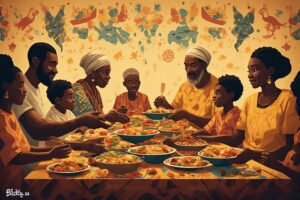
Here’s what the wellness industry is slowly, expensively figuring out: the solutions weren’t waiting to be invented. They were waiting to be remembered.
The ancestor diet Black wellness framework is not nostalgia. It is not tribalism. It is not a rebuke of modernity. It is the recognition that our ancestors — the people who built pyramids, charted stars, established trade routes across continents, cultivated the crops that fed the world — were also doing sophisticated nutritional science. They were doing it in kitchens and fields and communal spaces, passing it through hands and recipes and rituals for thousands of years. Then colonization came and called it primitive.
Research on the African human gut microbiome is now rapidly expanding, driven by the need to understand how diet, lifestyle, and urbanization influence the microbiome in diverse settings — with the recognition that African populations carry the highest genetic and phenotypic diversity on Earth, representing unique evolutionary histories. ScienceDirect That diversity is an asset. That history is a blueprint. The body carries the memory of what it was designed to eat.
So when Dr. Nyemb-Diop says decolonize your plate, she’s not asking you to perform. She’s asking you to remember. When those Nature Medicine researchers clock the anti-inflammatory effect of an African heritage diet in 2025, they’re confirming what was already known — they’re just writing it down in a language the institutions will accept.
The ancestor diet Black wellness movement is building something permanent. Not a trend. An institution. An infrastructure of knowledge, commerce, and community that carries the healing intelligence of the ancestral past into a future Black people are architecting for themselves.
Your ancestors were futurists. They built for generations they would never meet. Eat accordingly.
Have you ever tried to holla at one of these females and she ran this play on you?