Black Men Wearing Bonnets and Slides: A Cultural Reckoning
https://the-afrofuturist.com/wp-content/uploads/2026/03/black-men-wearing-bonnets-and-slides.pdf
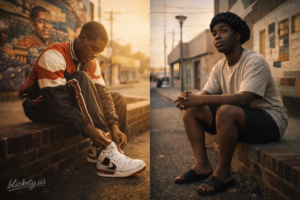
There’s something that happens when you’re a certain age and you step outside and look around. Not a loud thing. Quiet, like a hum you can’t locate. You see a young brother — 17, maybe 22 — moving through a parking lot, phone in one hand, some kind of drink in the other. And when you get to his feet and his head, you feel something you can’t quite name yet. Black men wearing bonnets and slides in public has become so normalized, so gradually, that most people didn’t notice the line being crossed until they were already standing on the other side of it.
That hum you feel? That’s history trying to get your attention.
This isn’t a hit piece. It isn’t pearl-clutching dressed up in Afro-Futurist language. Black men wearing bonnets and slides is a cultural signal — specific, readable, worth examining — and the conversation that article “Why Black Men Are Upset By Black Boys Wearing Bonnets” started deserves a fuller address. Because that piece named a symptom. This one is going to name the disease. The disease isn’t the bonnet. The disease isn’t the slide. The disease is the disappearance of the line between inside and outside, and what that line meant to people who bled to stand on it with dignity.
Two Items, One Signal — What Black Men Wearing Bonnets and Slides Actually Communicates
Black men wearing bonnets and slides outside share one thing in common before we go any further, and it’s the thing everyone keeps stepping around.
The bonnet is a domestic item. Designed for sleep. For the bedroom. For the private space where a woman — and yes, it was designed for women — protects her hair from friction through the night. At its core, a bonnet is meant to protect the hair from the friction and tension of a good night’s rest while preserving your hairstyle and minimizing breakage. Bedroom. Night. Private. That is its origin and its function.
The slide is a recovery item. Locker room. Poolside. Post-shower. The flip-flop’s less-committed cousin, designed for transitional moments between doing something and getting ready to do something else. Not for the street. Not for representing yourself in public.
Both items crossed the same threshold. They came outside. And black men wearing bonnets and slides as a visible, unremarkable, everyday occurrence isn’t a fashion evolution — it’s a cultural signal worth reading without flinching.
The Line That Used to Exist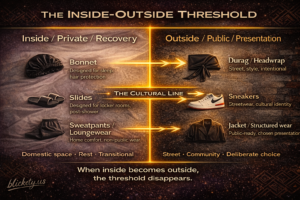
Every culture that survived oppression understood the threshold. The door. The line between private and public space. Between who you are inside the house and who you present when you step out of it.
Let’s be clear about what that line was not. It was not built for white approval. The respectability-politics accusation gets thrown the second any older Black voice questions younger presentation choices, and it’s a lazy deflection that shuts down necessary conversation. The line between inside and outside that Black communities historically maintained was built for self-determination. It was a declaration: the street does not own me, the neighborhood does not define me, what you see when I step outside is what I have chosen to show you.
Following emancipation, many formerly enslaved people sought stylish and high-quality footwear as symbols of freedom and identity. Freedom. Identity. The shoe — the deliberate, chosen, laced-up shoe — was one of the first acts of self-definition available to people who had been stripped of self-definition for generations. You want to understand why the image of black men wearing bonnets and slides sits wrong with older generations? Start there. Start with what it cost to be able to choose what went on your feet when you walked out the door.
According to casual conversations taking place in Blackworld — at barbershops, beauty salons, dinner tables — there is a growing divide between generations in the Black community. That divide isn’t just political. It’s cultural. And the gap in what each generation understands about the significance of public presentation is part of it.
Black men wearing bonnets and slides represents, whether intentionally or not, the erasure of that threshold. The inside is outside. The private is public. The transitional has become permanent. And the hum that older Black people feel watching it is history — not judgment — trying to be heard.
The Bonnet Was Always Domestic — And That Was the Point
Head wraps have been a sign of heritage in Black culture for generations. That heritage is real and worth honoring. But there is a meaningful, historically significant difference between a head wrap worn as adornment and a sleep bonnet worn because you forgot to take it off.
Traditionally, bonnets have been associated with women’s fashion, particularly in the 18th and 19th centuries. Women’s fashion. Centuries of context. Let’s not pretend that history doesn’t exist just because acknowledging it is uncomfortable.
The bonnet debate in Black women’s spaces has been active for years. Mo’Nique addressed it at the airport. The conversation was uncomfortable but it was at least being had. Then bonnets migrated to young Black men — and suddenly any discomfort became policing, any concern became respectability politics, any observation became grounds for cancellation.

Black men wearing bonnets and slides isn’t about what the bonnet is made of or what color it comes in. It’s about what it signals: I did not prepare to be seen. I made no distinction between where I sleep and where I move through the world. That indistinction — not the fabric, not the femininity alone — is what older generations are responding to when they go quiet.
The unkemptness association that follows black men wearing bonnets and slides isn’t a class judgment. It’s a signal-reading. And the signal being read is: nobody told this young man that outside is different from inside, or if somebody told him, he didn’t receive it as information worth keeping.
The Slide Was Never a Street Shoe
Go back twenty years. Thirty. Walk into any Black barbershop and ask what it says about a grown man when he’s wearing slides on the street. You will not get a neutral answer.
That’s not nostalgia. That’s institutional memory.
The sneaker — deliberate, chosen, named, saved-up-for, fresh-out-the-box — was the street shoe of Black male culture for decades. Not because anyone told Black men to wear it. Because Black men built that culture from scratch, turning a rubber-soled athletic shoe into one of the most powerful cultural institutions in modern history. By 2023, the global sneaker market reached $100 billion, with styles and trends predominantly shaped by Black cultural influences. One hundred billion dollars. Built on the specific, identity-laden act of choosing which shoe you put on before stepping outside.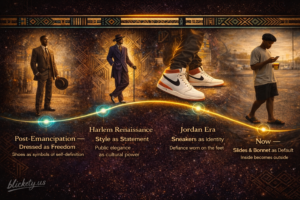
The Jordan 1s came out in 1985, and when Michael Jordan wore those sneakers during the initial games, he was continuously fined. At the time, there was a certain colorway standard for all basketball shoes. He said, “No, I’m going to wear my shoes.” And he wore his shoes and performed the way he performed.
That is the tradition. That is what the sneaker carried. Not comfort. Not convenience. Defiance. Self-determination expressed through footwear in a world that told you what shoes you were allowed to wear. Black men wearing bonnets and slides as casual outside default doesn’t carry that weight. It carries no weight at all. And that weightlessness — that absence of intention — is exactly the problem.
Nike and many other companies continue to use Blackness for profit. The truth is, they will never be more invested in our communities than we are. Corporations have always capitalized on our culture and cool. Which means the sneaker culture that Black people built — with their bodies, their dollars, their cultural energy — is being quietly evacuated from the inside while corporations profit from its history. The slide, in this context, is not neutral. It is the absence of a claim. Some tight HBCU kicks that are way better than slides.
When Femininity Becomes the Default, Not the Choice
Here is the part of this conversation that makes people most uncomfortable, so let’s go straight at it.
The bonnet is feminine. The slide, in its domestic-recovery-poolside origin, leans feminine or at minimum sits outside any historical anchor in Black male street culture. Together, worn publicly as default outside dress, black men wearing bonnets and slides represents a feminization of Black male presentation that is not the product of a conscious liberation movement. It is the product of drift.
There is a difference between a Black man who consciously, intentionally, with full cultural awareness incorporates feminine elements into his presentation as an act of self-expression — and a young brother who just didn’t think about it. One is agency. One is absence. Liberation requires consciousness. You cannot accidentally liberate yourself. You can accidentally drift.
Bonnets have not always been well received, harboring associations with unkemptness when worn in public. The unkemptness association isn’t about the bonnet’s fabric. It’s about what it announces: I did not consider that stepping outside is a different act than staying inside.
When the feminine domestic item and the recovery sandal become the default outside uniform for a generation of young Black men — when black men wearing bonnets and slides stops registering as unusual — the older generation’s discomfort is not bigotry. It is grief. Grief for the intentionality that’s been lost. Grief for a standard that nobody is maintaining anymore because nobody explained what it cost to establish it in the first place.
What the Ancestors Built That We’re Shuffling Away From
The ancestors who walked out of slavery and immediately began building — schools, businesses, churches, entire communities from nothing — understood something fundamental: visibility is power. How you show up matters. Not because the white gaze demands it. Because your own community sees you. Because your children see you. Because you see yourself.
During slavery, enslaved Africans wore practical shoes that were often uncomfortable and restrictive. Following emancipation, many sought stylish and high-quality footwear as symbols of freedom and identity. The suit. The pressed collar. The polished Sunday shoes. Later, the Kangol. The Adidas. The Jordan 1. Each era had its uniform of dignity, its version of saying: I am here, I am deliberate, I am not what they said I was.
Sneakers have led to the creation of a culture driven by freedom of expression and economic success, raising questions about the implications of race and masculinity. That culture was an extension of a much older practice — Black people using their appearance as a declaration of selfhood. Black men wearing bonnets and slides as casual public wear breaks that chain. Not violently. Quietly. Gradually. The chain doesn’t snap — it goes slack, and nobody notices until several links have already dropped into the dirt.
Our ancestors built Black masculinity as an act of architecture. Stone by stone. Choice by choice. Shoe by shoe. The Afro-Futurist understanding of this is not that we must freeze those choices in amber and replicate them forever. It’s that we must understand what they were built for before we dismantle them. You don’t tear down a building until you know what it’s holding up. Right now, a generation of young Black men is wearing bonnets and slides outside, and the building is starting to lean.
Black Men Wearing Bonnets and Slides Is Not Liberation If It’s Accidental
Black men wearing bonnets and slides in public is not a liberation movement. Let’s be precise about that. Liberation requires consciousness. It requires knowing what you’re departing from, why you’re departing from it, and what you intend to replace it with. A young man who steps outside in a sleep bonnet and pool slides because nobody ever explained to him that the inside-outside distinction existed — and why it mattered — is not liberated. He is uninformed. Those are not the same thing.
It seems that one of the few things Black people of all ages agree on is the fact that the differences between generations have grown tremendously. That growing divide is not just political opinion. It includes the transmission of cultural knowledge — the stories, the weight, the understanding of what deliberate public presentation meant to people who fought to choose it.
Where was the conversation? Where did we stop telling the stories? Where did we let comfort culture flood in and fill the vacuum that history left when we stopped teaching it? Black men wearing bonnets and slides is a symptom of a transmission failure as much as it is a choice failure. We stopped passing the knowledge. We let the standard quietly expire without a public announcement, and then expressed surprise when the next generation didn’t observe it.
That indictment is pointed more at the generations above these young men than at the young men themselves. You cannot hold someone to a standard they were never taught. But you can — and must — start teaching it now. That’s what this article is. Not a punishment. A transmission.
The Afro-Futurist continuum is not automatic. It requires deliberate passing of the baton. When black men wearing bonnets and slides becomes the norm and nobody names what’s been lost, the baton hits the ground. And picking it back up starts with the willingness to have the uncomfortable conversation without flinching.
The Afro-Futurist Standard: Intention as Inheritance
Afro-Futurism is not nostalgia. Let’s be exact one more time. The tradition is not about recreating the past — it’s about understanding the past well enough to build a future that honors what it cost. The pyramid builders understood that what you wore to construct something was a statement about what you were constructing. Public presence, for Black people, has always been an architectural act.
Black men wearing bonnets and slides as the unremarkable default disrupts that architecture. Not because the items themselves are unforgivable. Because the absence of intention is. The Afro-Futurist reclamation of Black male presentation does not begin with a dress code. It begins with a question: why am I wearing this? What does this communicate about who I am, where I come from, and where I’m going?
A young Black man who wears a bonnet outside as a deliberate fashion statement — who has thought about what that choice means, who owns the choice consciously — that is agency. That is the tradition honored in a new form. But black men wearing bonnets and slides because nobody told them there was a difference between inside and outside, because comfort culture quietly dissolved the threshold and nobody called it out — that is drift. And in Afro-Futurist thinking, drift is the enemy of legacy.
Participants used sneaker customization to assert their humanity through signaling their personal and group identity, articulating political subversions and solidarities, and seeking to uplift disadvantaged communities. That is the inheritance. Assert humanity. Signal identity. Build solidarity through the deliberate act of choosing. The Afro-Futurist future of Black male presentation is an extension of that practice into a world where our choices are more abundant, more visible, and more consequential than ever before.
The ancestors who polished their shoes on Saturday night before Sunday were not performing for anyone outside their community. They were performing for themselves. They were practicing the discipline of showing up as what they knew themselves to be, in defiance of what the world tried to reduce them to. That practice — that discipline of choosing — is the inheritance black men wearing bonnets and slides as casual outside default is quietly forfeiting.
Lace something up. Know why you chose it. Know what it cost someone else to choose freely. That is the whole lesson. That is the continuum. That is what the Afro-Futurist tradition demands of every generation it passes through — not a specific shoe, not a specific head covering, but the willingness to choose with the weight of history in your hands and the future of your community in your step. Black men wearing bonnets and slides is a conversation that needed to happen. It’s happening now. What you do with it is the next choice.
FAQ
Why are black men wearing bonnets and slides outside becoming so common? The trend has grown through social media normalization, post-pandemic comfort culture, and celebrity influence. More fundamentally, it reflects a generational erosion of the inside-outside distinction that older Black communities maintained as a form of self-determination — and a failure to transmit the cultural weight of that distinction to younger generations.
Is it disrespectful for Black men to wear bonnets outside? Disrespect implies intent. The issue with black men wearing bonnets and slides is not usually intentional disrespect — it’s the absence of awareness that a distinction existed. That absence is the product of a transmission failure across generations, not personal malice.
Why do older Black people react so strongly to this trend? Because they understand, from lived experience or inherited knowledge, what it cost Black people to choose how they presented themselves in public. The discomfort isn’t about fashion preference. It’s about watching a hard-won standard quietly disappear without acknowledgment.
Is there something wrong with men wearing feminine items? The concern about black men wearing bonnets and slides is not femininity itself — it’s the absence of conscious choice. Intentional incorporation of any element into your presentation is agency. Defaulting to domestic and recovery items because you haven’t thought about it is drift. The difference between those two things is everything.
What should Black men wear instead? Anything chosen with intention and awareness of what that choice communicates. The Afro-Futurist position is not a dress code. It is a call to consciousness. Know what you’re wearing. Know why. Know what it connects you to. That knowing is the inheritance. That’s what black men wearing bonnets and slides as default outside wear — unexamined, unremarkable, unconnected to history — forfeits most quietly.
How do we start the conversation with younger generations? Without condemnation. With history. Tell the story of what the shoe meant after emancipation. Tell the story of Jordan 1s being banned. Tell the story of men who pressed their clothes for Sunday not because church demanded it but because they demanded it of themselves. When black men wearing bonnets and slides becomes a conversation instead of a silent judgment, the transmission can begin again. That’s what this article is for.
.