Black Tech at Home: Build a Vision Lab for Black Creators
https://the-afrofuturist.com/wp-content/uploads/2026/03/black-tech-at-home-build-your-vision-lab-today.pdf

Before we talk about desks and gear and morning routines, start with the word.
Maono. Swahili. It means vision.
Not productivity. Not output. Not hustle. Vision — the capacity to see what isn’t there yet, to hold a future in your mind clearly enough to begin building toward it. The word comes directly from the African continent, where local people used it to describe exactly that capacity — seeing forward. BaiduWiki And buried inside that single Swahili word is the entire philosophy behind what Black tech at home can actually become when it’s built with intention.
Because here’s what most Black tech content won’t tell you: the workspace is a technology. Not the laptop. Not the microphone. Not the ring light. The space itself — the boundaries around it, the rituals inside it, the systems running beneath it — is the most sophisticated piece of Black tech you will ever build.
Your ancestors built pyramids. Not by accident. Because someone, somewhere, had a protected space to think. To see. To let vision become architecture.
That’s what we’re building here.
What Black Tech at Home Actually Means 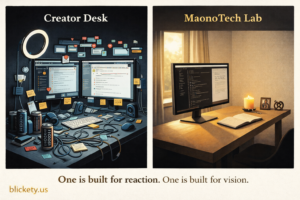
The Western creator workspace is optimized for speed. More content, faster uploads, higher output, better metrics. It is a machine designed to produce reaction — to trends, algorithms, and whatever performed well last Tuesday.
Black tech at home operates on a different frequency.
It is built on three principles that have nothing to do with what gear you buy: Clarity — nothing enters the space that clouds the mind. Agency — every tool amplifies your ability to act, not react. Sovereignty — your data, your rituals, your imagination remain yours.
African philosophical traditions have long argued that technology should be guided by care, solidarity, and co-evolution — not just efficiency. Springer That’s not soft. That’s a systems framework that Black tech builders have been operating from for centuries, with or without the language to name it. Black Wall Street was Black tech. The Timbuktu manuscripts were Black tech. Sun Ra’s cosmic studio was Black tech. The through-line is always the same: vision protected by sovereign infrastructure.
Western tech trains speed. Black tech trains sight. And sight — maono — is the first technology. It always was.
The Four Layers of Black Tech Infrastructure at Home
Serious Black tech home setups are built from four layers: Tools, Rituals, Systems, and Boundaries. Each layer is a technology. Each one compounds the others. Remove any one and what you have left is just a desk.
Layer One: Tools — Black Tech Instruments of Vision
Let’s be direct: the tools are not the point. The clarity they enable is the point. A $3,000 monitor surrounded by notification chaos produces less vision than a $400 laptop in a clean, intentional space. Don’t let gear culture seduce you into thinking equipment is the work. That’s a consumption trap dressed up as a Black tech aesthetic.
That said, a serious Black tech vision lab uses specific tool categories:
A clean machine. Fast, quiet, reliable. Not fighting you mid-thought. Your machine should disappear into the work — the moment you’re aware of the tool, you’ve lost the thread. The Apple MacBook Air M-series or a clean Dell XPS with a disciplined software load serve this purpose well.
A single notebook. Not an app. Not a second screen. A physical notebook for raw vision — the thinking that needs to move slower than a keyboard allows. Leuchtturm1917 and Moleskine are workhorses. One notebook, one pen, one place where unformed ideas land before they’re ready for a screen.
A minimal AI interface. Used as a collaborator, never a crutch. The distinction is direction — you bring the vision, the AI extends it. The moment the AI generates the vision and you edit it, you’ve handed over the sovereignty the Black tech lab was built to protect. Claude, Perplexity, and NotebookLM serve this function well when they’re downstream of your thinking.
A protected archive. External drives. Encrypted cloud storage. Intentional backups. Backblaze for cloud redundancy, a Samsung T7 SSD for local backup. Your ideas, drafts, and unreleased work are intellectual property. A Black tech lab treats them accordingly.
A sensory anchor. A candle. A specific soundscape. A symbol of lineage. Something that signals: vision mode, now. Brain.fm and Endel offer AI-generated focus soundscapes calibrated for deep work. Your grandmother’s photograph on the desk operates through a different mechanism but produces the same result. Both are valid. Both are Black tech.
Layer Two: Rituals — The Code Running Your Black Tech Lab
African organizational philosophy has long recognized ritual, ceremony, and oral tradition as technologies as sophisticated as any digital system. Africasocialwork This is not metaphor in the MaonoTech framework. Ritual is code — a repeatable sequence of inputs producing a predictable output. In a Black tech vision lab the output is a focused, sovereign mind.

Three rituals anchor the space:
The opening ritual. A consistent action signaling vision mode. Three deep breaths, a specific playlist, a candle lit, one paragraph read from a grounding text. What matters is repetition. The nervous system learns the pattern. Eventually the ritual itself becomes the ignition.
The focus ritual. A micro-reset used mid-session when the mind drifts. Brief, repeatable, centering. The Pomodoro Technique pairs naturally here — not as a productivity hack but as a rhythm structure that gives the focus ritual a home.
The closing ritual. The most underrated Black tech practice. A deliberate exit — a note written, a file saved, a summary spoken aloud — that closes the session cleanly. Without it the vision bleeds into noise. You carry unfinished thought into dinner, conversation, sleep. The closing ritual is the boundary made practice.
Rituals stabilize the mind. Stability increases foresight. Foresight is the first technology.
Layer Three: Systems — The Invisible Black Tech Machinery
African philosophical traditions envision technologies that harmonize with people rather than dominate them — guided by care and co-evolution, not efficiency alone. MDPI The systems layer of a Black tech vision lab is built exactly on this principle. They should reduce friction so completely you forget they’re running.
A naming system. Every file, project, and idea follows a pattern. Date-first naming (2026-03-10_ProjectName_Draft01) keeps archives searchable without thinking. Pick one system. Commit. Inconsistency is a tax on future you.
A capture system. Ideas never get lost — they get routed. Notion, Obsidian, or a dedicated inbox you send voice memos to. When a thought arrives it gets captured immediately and routed to the right container. A lost idea is a lost asset. Black tech infrastructure doesn’t lose assets.
An automation layer. Repetitive tasks get delegated to machines. Zapier for workflow automation, Buffer for content scheduling, TextExpander for recurring copy. Every hour saved from repetition is an hour returned to vision.
A review cycle. Weekly or monthly recalibration. Not a productivity audit — a vision check. Are you still building toward the future you declared? What needs to be released, refined, or amplified? The review cycle keeps the Black tech lab a vision engine instead of a busy desk.
Systems create predictability. Predictability creates capacity. Capacity creates future.
Layer Four: Boundaries — The Firewall Around Black Tech Vision
Most people skip this layer. It determines whether everything else works.
No social media inside the lab. No reactive work. No external demands. No chaos. No uninvited voices. A boundary is not a wall — it is a protocol. A decision made in advance so you don’t have to make it under pressure. The notification that arrives mid-vision-session isn’t just a distraction. It is a sovereignty violation. Someone else’s urgency colonizing your imagination.
Freedom and Cold Turkey enforce the protocol digitally. The discipline enforces it personally. Both are required. Both are Black tech.
The Minimal Black Tech Blueprint
A Black tech vision lab does not require expensive gear. It requires intentional architecture:
A small clean desk. A single screen. A notebook. A pen that feels like a tool. A quiet corner. A symbol of lineage — something connecting you to the ancestors who also built without permission, without resources, without anyone believing it was possible. A machine that doesn’t fight you. A ritual that opens the door to vision.
That is enough to build futures. The pyramids weren’t built with the most expensive tools. They were built with the clearest vision and the most disciplined systems. Black tech at home is that same logic applied to the digital age.
Why Black Creators Need This Specific Black Tech Setup
Because the world constantly demands Black reaction. Every notification, every news cycle, every algorithm is engineered to pull Black attention into response mode — reacting to what’s happening rather than directing what’s being built.
African philosophy has long argued that European imperialism deliberately stifled African scientific, technological, and political development Encyclopedia.com — not because the capacity wasn’t there, but because autonomous Black vision threatens systems that depend on Black reaction. A Black creator always responding never has time to build. That’s not coincidence. That’s architecture.
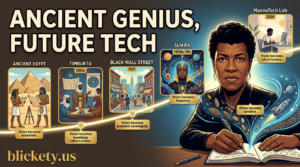
The Black tech vision lab is counter-architecture. The deliberate construction of conditions under which Black vision operates at full capacity — unhurried, uncolonized, sovereign.
Afrofuturism gave us the imagination. Black tech gives us the infrastructure. The future is not built by those who move fastest. It is built by those who see farthest — and who build the spaces protecting that sight.
Activating Your Black Tech Vision Lab 
A Black tech lab activates the moment you declare: this space is for vision.
Not reaction. Not someone else’s algorithm. Not the content calendar or the client deadline or the notification that just arrived. For vision. For the long thought. For the future that doesn’t exist yet and needs you specifically to build it.
From that moment the room becomes a technology. Your rituals become code. Your systems become infrastructure. Your imagination becomes architecture. Your future becomes buildable.
Maono. Vision. The first Black tech there ever was.
A Black tech vision lab is not a place you work.
It is a place you become.
FAQ: Black Tech Vision Lab
What is a Black tech vision lab? A Black tech vision lab — also called a MaonoTech Lab — is a deliberately designed personal workspace built around clarity, agency, and sovereignty. Where a standard creator workspace optimizes for output, a Black tech vision lab optimizes for foresight.
Do I need expensive gear to build a Black tech workspace? No. Intentional architecture matters more than expensive equipment. A clean desk, reliable machine, notebook, and consistent ritual are sufficient to build a serious Black tech vision lab.
What does Maono mean and why does it matter for Black tech? Maono is a Swahili word meaning vision. It grounds the MaonoTech framework in African linguistic and philosophical tradition — establishing that vision, the capacity to see forward and build toward what doesn’t exist yet, is the first and most essential Black tech.
What is the most important layer of a Black tech vision lab? Boundaries. Without the firewall around your imagination every other layer eventually gets colonized by noise and other people’s urgency. Boundaries are the layer that makes everything else possible.
How is a Black tech vision lab different from a regular home office? A home office asks what needs to get done today. A Black tech vision lab asks what future is being built and what the space needs to support that. The difference is sovereignty.
Did you know that Black Teens are thriving in this new system?