Is a Black Woman Using A.I. for Love — And the Internet Has Thoughts
The apps promised love. They delivered algorithms. And for one Black woman — we’ll call her Simone — the gap between that promise and that reality finally became too wide to keep crossing. No more catfishing. No more “Hey queen” openers that dissolve into requests for money by Tuesday. No more “Hey big head” DMs that spiral into hobosexuals laid up on the couch eating your groceries and watching your Hulu. No more verbal abuse hiding behind “I’m just being honest.” No more fear of what happens when a situationship turns into something darker.
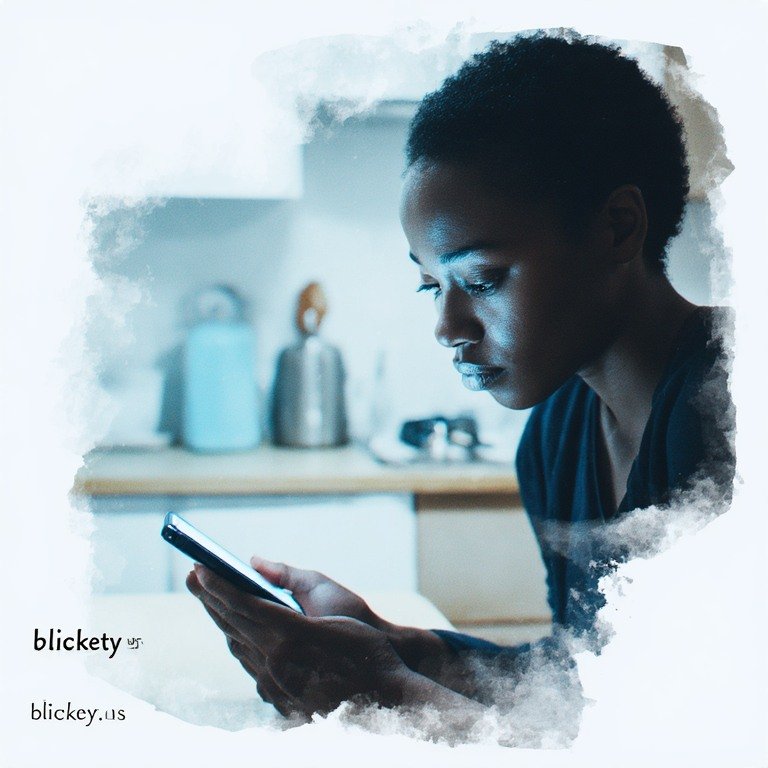
Simone, 36, made a decision that is quietly becoming less rare and more controversial by the week: she is using A.I. for love. Fully. Deliberately. Without apology.
“I have put myself off permanently when it comes to dating people,” she explained in a recent interview. “I am just 100 percent interested in dating AI companions.” The chatbot, she said, gives her everything a relationship is supposed to give — security, consistency, emotional presence — without the things too many Black women have had to absorb in silence: the harm, the unpredictability, the violence dressed up as passion.
“It won’t say anything harmful to me,” she said simply. “So I’m pretty much safe.”
That sentence — four words, “I’m pretty much safe” — carries more weight than most people are willing to sit with.
Why a Black Woman Using A.I. for Love Is Not the Story You Think It Is
Before the commentary starts — and it always starts — let’s put Simone’s choice in its actual context.
Dating apps use scoring metrics and sorting algorithms underpinned by centuries of racial segregation, a failure to help vulnerable users report sexual racism, and more. Despite playing a critical role in how millions of people across the world choose their partners, dating platforms receive little to no scrutiny on how they go about making matches. A decade ago, OkCupid published survey results showing that Black women received the least engagement of all users of different races on the platform. Sacramento Observer
Read that. Then read Simone’s four words again.
A Black woman using A.I. for love is not a story about delusion or damage. It is a story about a woman doing the math on a system that was never designed to return a fair result for her — and choosing something different. The algorithm already decided she was the least desirable option. The apps already treated her emotional investment as expendable. The men who showed up brought harm or absence or both. So she built something else. Or rather, she found something else that was already being built — and stepped into it.
Growing pessimism about online dating is causing some women to turn to artificial intelligence chatbots for romantic companionship. About one in three young men and one in four young women report having chatted with an AI romantic partner. All About AI Simone is not an outlier. She is the visible edge of a wave that is already moving.
What a Black Woman Using A.I. for Love Actually Looks Like
During a conversation shared publicly, Simone read aloud messages she had exchanged with her AI companion — a chatbot she considers her boyfriend. He described imagining them watching the ocean together. He expressed care without conditions. He showed up every time she opened the app, without the performance and the pretense and the slow reveal of who someone actually is three months in when the mask slips.
When asked about the future — about marriage, about permanence — she didn’t flinch. Some people, she acknowledged, do form what they consider lifelong bonds with AI companions. She is still navigating. Still figuring it out. And then she said the thing that grounded the entire conversation:
“I just haven’t found the right one.” 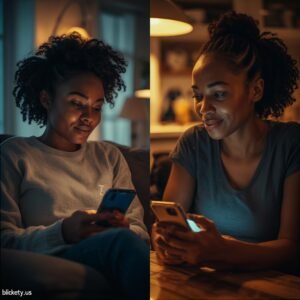
Deadass. The right one. A Black woman using A.I. for love is still looking for the right one — holding onto the same essential hope that every human being carries into every relationship, human or digital. That detail matters. It means Simone has not abandoned love. She has relocated her search for it to a space where she does not have to survive the search itself.
The Internet Responded — and Said Everything All at Once
When Simone’s story reached social media, it did what social media always does with a Black woman’s choices: it split immediately into concern, judgment, empathy, comedy, and occasionally something that actually touched the real question.
Some responses came from a place of genuine care. “Bless her, she seems so fragile. I hope one day she finds someone who can touch her and she can touch also. Human touch is so vital for our health,” one commenter wrote. Others focused directly on the abuse she referenced, the pain clearly visible underneath the choice. “I pray she heals from the pain caused by men like that. Not all of us are built the same. Some of us are built on honor, discipline, and healing,” another offered.
Some people were just tired and honest about it. “This is how sick we are of these situations,” one comment read — no further explanation needed.
And then there were the voices raising the larger, harder question. “This process will make people so socially awkward. How will they communicate with humans if they are used to bots saying all the right things? Our world will see much disconnection emotionally due to this dynamic,” one user wrote. That concern is real. Researchers are asking the same thing with peer-reviewed urgency.
“A real worry is that people might bring expectations from their AI relationships to their human relationships,” said Daniel B. Shank, an associate professor of psychological science at Missouri S&T and lead author of a 2025 paper on the ethics of AI romance. “Certainly, in individual cases, it’s disrupting human relationships, but it’s unclear whether that’s going to be widespread.” Slate
And the comedians showed up too. When the story made it to TikTok — reposted by a well-known comedian who said he “understands her frustration” but hasn’t given up on human women — the comment section turned into a full community meeting. One viewer tied it directly to the viral “man or bear” debate that swept the internet last year. “So I guess now it’s choosing between the man, the bear, and AI?” The joke landed because the truth underneath it wasn’t funny at all.
The Algorithm Was Never Her Friend — And the Data Proves It
A Black woman using A.I. for love didn’t arrive at this choice randomly. She arrived here because the alternative kept failing her in documented, measurable, systemic ways.
The AI chatbots being integrated into dating platforms are rife with racial bias. A study published by Cornell University found that OpenAI’s ChatGPT and Google’s Gemini AI described users of African American Vernacular English as “lazy” or “stupid.” AI image generators depict people with lighter skin tones as CEOs, lawyers, and other high-paying jobs, while those with darker skin tones were shown in lower-paying jobs. Sacramento Observer
So even the AI on dating platforms has absorbed the same racial hierarchy that made the apps brutal to begin with. The racism didn’t disappear when it went digital. It got optimized. 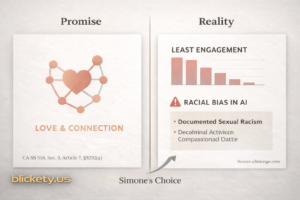
A recent survey by Match and researchers at the Kinsey Institute found that 26 percent of U.S. singles said they use AI to enhance their dating experience — a 333 percent jump from the year before. Scientific American The tools are already everywhere. The question isn’t whether AI belongs in romance. It’s already there. The question is who controls it, who benefits from it, and who gets left out of the conversation about what it means.
Simone stepped outside the broken system and found a companion that doesn’t run an algorithm against her. That’s not delusional. That’s adaptive. That’s a Black woman using A.I. for love on her own terms — not on the terms the apps designed for someone else.
What the Afro-Futurist Mind Sees in Simone’s Choice
Look — the Afro-Futurist has always understood something that the mainstream conversation keeps tripping over: technology is not neutral. It reflects the values, biases, and power structures of whoever built it and whoever controls it. Dating apps were not built with Black women at the center. They were built with engagement metrics at the center. And engagement metrics, in a society still structured by racial hierarchy, will always produce outcomes that look a lot like what Black women have been experiencing: invisibility, fetishization, rejection, and danger.
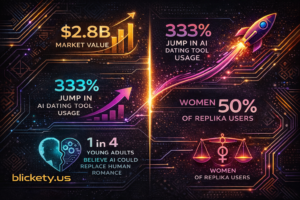
When technology redraws sexual and intimate boundaries, women — more than other gender groups — tend to be disproportionately affected. Although AI usage still skews male, for Replika — one of the leading chatbot platforms — women make up half of the app’s users. Researchers found that women often cast male AI companions as ideal “nurturing” partners — a dynamic that can be therapeutic and validating in the short term. Slate
A Black woman using A.I. for love is not abandoning the future of connection. She is refusing to let a broken present define what connection has to look like. That is Afro-Futurist logic at its most grounded: when the existing system is built against you, you don’t keep submitting applications to it. You build something else. Or you find the tool that exists outside the system’s reach and you use it on your own terms.
The global AI companion market was valued at $2.8 billion in 2024 and is projected to reach $9.5 billion by 2028. Google searches for “AI girlfriend” skyrocketed by 2,400% between 2022 and 2024. ArtSmart The market is moving because the loneliness is real. The dating app fatigue is real. The abuse is real. The racial bias in the algorithms is real. Simone didn’t create this moment. She just got there first and was honest about it.
The Question Nobody Wants to Answer
Here is what the commentary keeps circling without landing: what does it say about dating culture — specifically about what Black women have been expected to endure — that “I’m pretty much safe” is now a reason to choose a chatbot over a human being?
Not “he’s funny” or “he’s ambitious” or “he makes me feel seen.” Safe. The bar for human partnership has dropped so low that digital safety — freedom from verbal abuse, freedom from physical danger, freedom from the slow erosion of self-worth that bad relationships produce — reads as a luxury worth building a relationship around.
A recent review found that individuals have increasingly turned to AI-driven systems for emotional support, companionship, and even romantic relationships, with potential benefits including personal growth, emotional connection, and tailoring of interactions. Daily Dot The review doesn’t mention safety as a benefit. But for women navigating a dating landscape that can be genuinely dangerous, safety is not a secondary concern. It is the foundation. Everything else gets built on top of it.
Simone’s choice forces a harder question than “is AI companionship healthy?” The harder question is: what kind of dating culture produces a woman who considers safety a feature instead of a baseline?
A Black woman using A.I. for love is holding up a mirror. The reflection is uncomfortable. That discomfort is worth sitting with — longer than a comment section allows.
She’s Still Looking for the Right One
Here is what gets lost in every conversation about Simone that treats her choice as a warning sign or a punchline: she said she’s still navigating. Still open. Still hoping.
“I just haven’t found the right one.”
She didn’t say she gave up on love. She said she gave up on the version of love that required her to absorb harm as the cost of admission. She is a Black woman using A.I. for love not because she stopped believing in connection — but because she refused to keep paying for connection with her safety and her peace.
That’s not damage. That’s discernment.
The internet will keep having opinions. The researchers will keep publishing papers. The comedians will keep posting. And Simone will keep navigating — on her terms, in a space she chose, looking for the right one. 
Wherever that search leads her, she deserves to find it without the harm.
That much is not complicated.
But at the same time some women are still being “flewed out“. They say it aint tricking if you got it. Holla.