
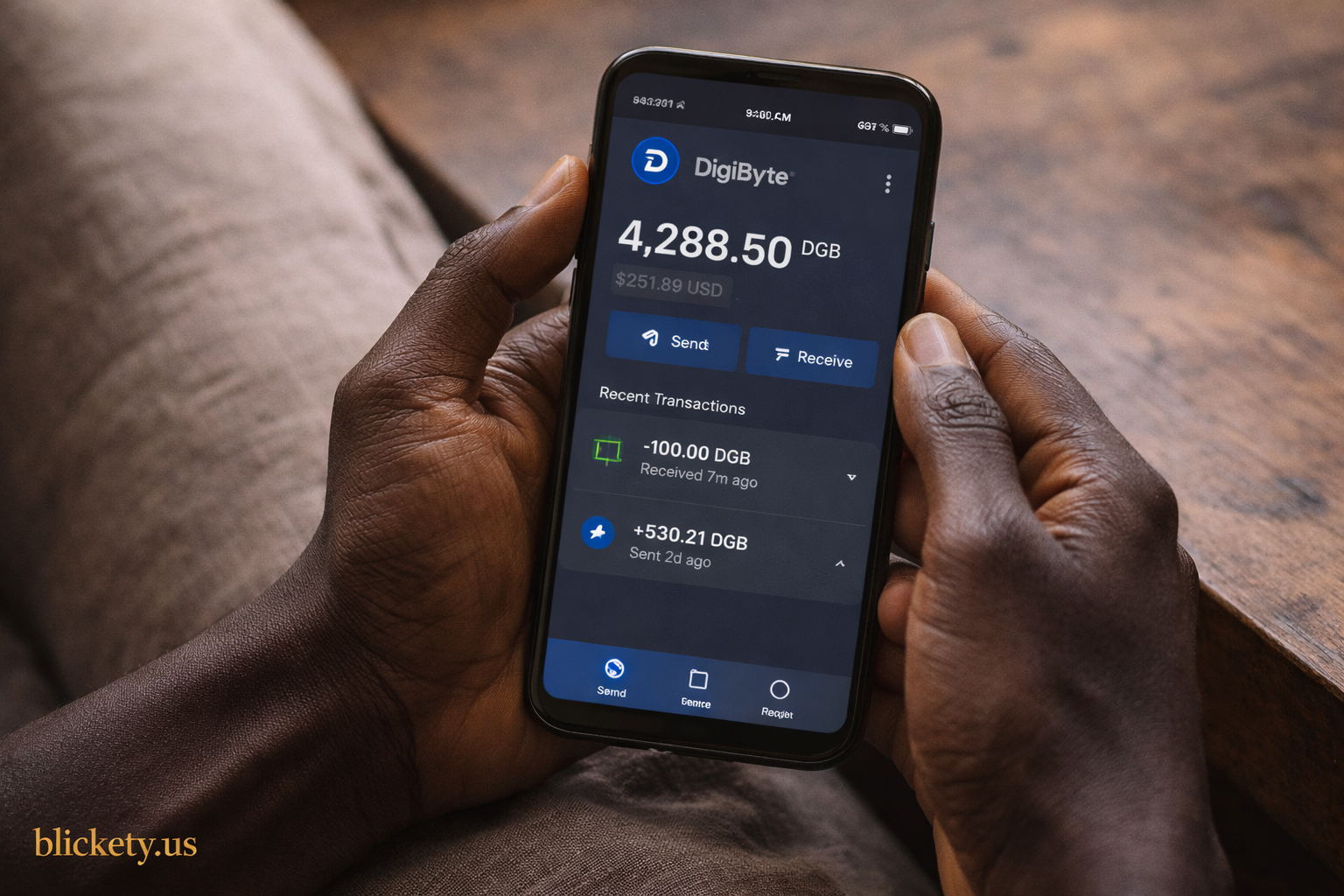
DigiByte Afrofuturism: 12 Years, Zero Downtime, and the Most Sovereign Chain Nobody Claimed

(CURRENT PRICE OF DIGIBYTE IS NOT REFLECTED ON ANY IMAGE IN THIS ARTICLE. TO SEE REAL TIME PRICE CLICK THE COIN GECKO WIDGET ON HOME PAGE AND TYPE IN DIGIBYTE)
There’s a conversation happening in Afrofuturist spaces that mainstream crypto Twitter is too busy shouting “LFG!!!” to notice. The conversation sounds like this: What if the chain — not the bank, not the platform, not the institution — belonged to us?
That question isn’t new. It predates Bitcoin. It predates blockchain. It lives in the long tradition of Black communities building parallel economies when the dominant one locked the door — from the original Black Wall Street in Tulsa to the credit unions of the Civil Rights era to the informal rotating savings circles Black and African immigrant communities have used for generations.
And here is the part nobody claimed: while the crypto world spent twelve years arguing about which coin would moon, which chain would win, which celebrity endorsement would finally legitimize the space — one blockchain just kept running. Quietly. Perfectly. Without a CEO, without a premine, without an ICO, without a single hour of downtime. DigiByte (DGB) launched in January 2014 and has not stopped since. No hack. No failure. No centralized hand on the wheel. In a space built on broken promises and spectacular collapses, that is not a footnote. That is the whole argument.
DigiByte Afrofuturism is not a slogan. It is a structural observation: that this specific chain — its architecture, its values, its twelve-year record — maps almost perfectly onto what Black communities have been demanding from financial systems for centuries. The technology just finally caught up.
The System Was Never Built for Us — That’s the Point
Columbia Law professor Lynnise Phillips Pantin put it plainly in her landmark 2023 Northwestern University Law Review article: the decentralized nature of cryptocurrency is attractive to Black communities precisely because those communities have been historically and systematically excluded from traditional financial markets by both private and public actors. She wasn’t speaking abstractly. She was describing redlining, discriminatory lending, the destruction of Black Wall Street, the racial wealth gap that compounds across generations.
An Afrofuturist framework, Pantin argues, pushes for systemic problems to be solved through wholesale systems change rather than tinkering at the margins — and cryptocurrency, viewed through that lens, becomes a portal for rethinking financial systems and racial equity.
The numbers back this up. A Harris Poll found that 23% of African Americans own cryptocurrency, compared with only 11% of white Americans. Black people are not late to crypto. They are early — and disproportionately present — precisely because the traditional financial system has given them the clearest reasons to look elsewhere.
Research from the Crypto Research and Design Lab found that Black crypto adopters describe blockchain’s offerings as echoing deep cultural traditions around sovereignty, security, and technology as tools for reimagining a better future — concepts with rich precursors in Black experience that predate blockchain entirely. Many told researchers the arrival of this technology feels like an opportunity they had been imagining and anticipating: a chance to support the creation of new systems where Black people can be financially successful and free from a financial system that wasn’t built for them.
That is not hype. That is historical pattern recognition operating at the speed of technology.
DigiByte Afrofuturism: The Architecture of Sovereignty
Let’s talk about what DigiByte actually is — and why its design philosophy maps almost perfectly onto Afrofuturist principles.
No premine. No ICO. No CEO. No controlling entity. DigiByte was not launched to make its founders rich. It was launched by Jared Tate — a former U.S. Army officer who began reworking Bitcoin’s code in 2012 — as genuinely open infrastructure. The code is MIT licensed. Development is volunteer-driven. There is no company headquarters, no marketing budget, no board of directors deciding who gets access.
This is not incidental. This is structural alignment with the core Afrofuturist demand: build systems where the rules cannot be changed by the powerful at the expense of the vulnerable. 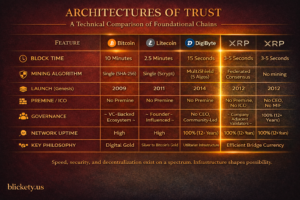
15-second blocks. Bitcoin processes a block every ten minutes. Litecoin every two and a half minutes. DigiByte does it in fifteen seconds — forty times faster than Bitcoin, ten times faster than Litecoin. For a community historically locked out of financial speed (slower credit approvals, longer processing times, higher fees that disproportionately hit smaller transactions), a blockchain that moves at the speed of intention matters. Full confirmation — six blocks of security — arrives in roughly ninety seconds.
MultiAlgo mining. DigiByte uses five separate mining algorithms (SHA256, Scrypt, Skein, Qubit, and Odocrypt — rotating every ten days) rather than one. This architecture specifically resists the centralization that plagues Bitcoin mining, where a handful of massive ASIC farms control an outsized share of hash power. Distributed hash power is distributed control. That is not just a technical choice — it is a political one.
DigiShield and Dandelion++. Real-time difficulty adjustment across all five algorithms keeps the chain attack-resistant. Dandelion++ obscures transaction origins for better privacy. In a surveillance economy that has historically weaponized financial data against Black communities — from redlining analytics to discriminatory algorithmic lending — privacy infrastructure is not a luxury feature. It is protection.
DigiAssets and Digi-ID. The base layer supports tokenized assets (including NFTs and smart contracts) and a passwordless blockchain-based authentication system. These tools enable the kind of community infrastructure — land records, cooperative ownership documentation, identity verification outside state-controlled databases — that Afrofuturist organizers have been demanding.
Isaiah Jackson, author of Bitcoin and Black America, framed the broader argument: the ability for Black-owned businesses to grow is how Black Wall Street and Rosewood happened — communities flourished when currency was not controlled and Black people were not held to standards imposed from outside. Traditional economies locked Black communities out; blockchain opens a path to growth on their own terms.
The Most Sovereign Chain Nobody Claimed
 Here is where the DigiByte Afrofuturism argument lands its hardest punch — and it needs to be stated plainly, not scattered across sections.
DigiByte is the most sovereign chain running in 2026. Not the most valuable. Not the most famous. The most sovereign. Stack the evidence:
No venture capital holds allocation from a private sale. No foundation controls the treasury. No CEO can be pressured, arrested, or bought to change the protocol. The mining is distributed across five algorithms specifically to prevent any single actor — nation-state, corporation, or cartel — from dominating. The code is open. The history is transparent. The supply schedule is fixed and mechanical — 21 billion coins, 1% monthly reward reduction, fully mined by 2035, no discretionary monetary policy, no emergency override, no “the team decided.”
Compare that to every major chain that has faced a moment of crisis and reached for a centralized lever. Compare it to the stablecoins that froze accounts on government request. Compare it to the chains that forked when powerful holders disagreed. Compare it to the NFT platforms that shut down and took the assets with them.
DigiByte never moved. Not because it couldn’t. Because there was no one with the power to move it.
For communities that have watched every institution with power over their financial lives eventually use that power against them — that architecture is not a technical footnote. It is the entire point. Sovereignty is not a feature you add later. It is either in the foundation or it isn’t. DigiByte’s foundation has been sovereign since block one.
And nobody claimed it. No major publication ran a cover story. No celebrity dropped an endorsement. No ETF got approved for DGB. The chain just kept running, kept building, kept producing blocks every fifteen seconds — quietly accumulating twelve years of proof that the architecture works.
That is DigiByte Afrofuturism. Not a moment. A record.
Zero Downtime. Let That Land.
Twelve years. Zero downtime.
Say it again: twelve years, zero downtime.
In a space that has given us the Mt. Gox collapse, the FTX implosion, the Terra/Luna death spiral, the Celsius freeze, the Bored Ape floor collapse, the rug pull of the week every week without exception — DigiByte has produced over 23 million blocks without a single hour of failure.
Not one. Not a maintenance window. Not a “temporary suspension.” Not a “we’re working on it.” Not a “the team is investigating.” Not a “your funds are safe.” Funds were always safe because the chain never went down.
In traditional finance, twelve years of uninterrupted operation at a global institution earns a reputation. In crypto, where the average project’s half-life is measured in months and the average user has been burned at least once by something that promised it was different, twelve years of zero downtime is almost incomprehensible. It means every bear market, every bull run, every regulatory panic, every competitor launch, every industry-wide catastrophe — DGB kept producing its fifteen-second blocks like none of it was its problem.
Because it wasn’t. That is what decentralization without a controlling entity actually looks like in practice. Not a whitepaper promise. A twelve-year operational record.
For the Afrofuturist mind — trained by history to distrust institutions that promise safety while holding the power to take it away — that record means something that a price chart cannot capture. The chain does not need your trust. It has already proven itself.
2026: The Chain Keeps Running — and the World Is Catching Up
As of late February 2026, DigiByte is trading around $0.0042–$0.0043, with a market cap of approximately $77 million and consistent daily trading volume. It is ranked around #269–#320 depending on the tracker — solidly mid-tier, not viral, not dead, not pretending to be something it isn’t.
The network has produced over 23 million blocks without interruption. Core v8.26.1, released in late 2025, integrated significant Bitcoin Core improvements including doubled outbound peer connections and faster initial node synchronization. Taproot was activated on the DigiByte mainnet in April 2025, enabling more efficient and private transaction structures.
Arizona’s Senate Finance Committee advanced legislation in February 2026 that would establish a Digital Assets Strategic Reserve Fund — explicitly including DigiByte alongside Bitcoin and XRP as eligible state-held assets. The bill passed 4-2 and outlines strict custody requirements through qualified custodians and regular audits, with the fund seeded from seized or surrendered assets rather than taxpayer money. Whether it passes full Senate, clears the House, and survives Governor Hobbs’ desk is another matter — but a state government naming DGB in reserve legislation alongside Bitcoin is institutional recognition that twelve years of sovereign operation earns.
And then there is DigiDollar. 
DigiDollar is proposed as the first fully decentralized stablecoin native to the DigiByte blockchain — built directly into the protocol rather than deployed as a smart contract on a separate layer, using time-locked, over-collateralized DGB positions and decentralized price oracles to maintain a 1:1 USD peg without any centralized issuer. Testnet is live. The mainnet activation window is set for May 2026 through May 2028.
The significance here for DigiByte Afrofuturism is hard to overstate. Every existing major stablecoin (USDT, USDC) depends on a centralized issuer who can freeze accounts, comply with government seizure orders, or simply fail. DigiDollar’s design ensures each stablecoin is backed by DGB reserves and can be redeemed in a non-custodial manner at any time — the underlying DGB remains inside the user’s own wallet, under full key control.
Ownership and liquidity as two separate, non-compromising layers. That is Afrofuturist financial architecture. And it is arriving on the chain that has been practicing sovereignty since 2014.
The Boredom Is Real — And So Are the Stakes
Look. Retail crypto Twitter is exhausting. The same tweets every cycle — “so-and-so adopted it,” “it’s the fastest,” “it’s the killer app,” “LFG!!!!!” — are noise. They have always been noise. And the noise machine has a specific victims list: late retail buyers chasing the hype, communities with less margin for financial error who get hit hardest when the cycle turns.
This is exactly what Pantin’s 2023 analysis warned about: asking traditionally marginalized groups to participate in an extremely risky market in pursuit of racial equity is an unrealistic solution given the legacy and reality of financial exclusion. A decentralized system alone cannot fix systemic racial inequality without policy intervention and structural change.
The answer is not to leave crypto. The answer is to stop listening to the noise and start reading the architecture.
DigiByte is not viral in 2026. It is not trending. It is not being pumped by celebrities or meme accounts. What it is: twelve years of uninterrupted uptime, a fixed 21-billion coin supply with transparent gradual emission, five-algorithm decentralization that resists ASIC monopoly, a native stablecoin in testnet, and state-level legislative recognition — all maintained by volunteers with no venture capital, no private allocation, no insider advantage.
The crypto industry and policymakers must create better products, clearer regulations, and consumer protection measures that mitigate risk without precluding innovation — and they must start designing with Black people, and with Black people in mind. DigiByte’s entire architecture, from day one, was designed with that principle structurally embedded: no one gets an insider position, no one holds the keys, no one can lock the door.
The Afrofuturist Infrastructure Argument
Afrofuturism has always been about more than aesthetics — the kente-draped spaceships, the Afropunk visuals, the Sun Ra cosmology. At its core, it is a demand to imagine and build futures where Black people are not afterthoughts, not token participants, not bodies whose labor feeds systems they cannot access. It is architecture before it is art.
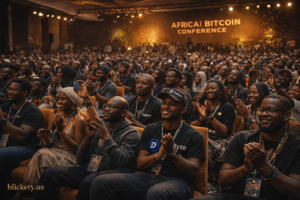
The Africa Bitcoin Conference brings together activists, innovators, and policymakers annually to explore how Bitcoin and blockchain technology can protect fundamental freedoms, strengthen economic autonomy, and build toward lasting sovereignty. The Bitcoin Dada fellowship specifically trains African women for leadership in the Bitcoin ecosystem. Cleve Mesidor, founder of the National Policy Network of Women of Color in Blockchain, has pushed for diversity as structural requirement, not optional feature.
These are not peripheral stories. These are the story.
A blockchain with no CEO, no premine, no controlling entity — that runs blazing fast for over twelve years on volunteer power alone, that is now building a truly decentralized stablecoin and earning state reserve recognition — is not just a speculative asset. It is infrastructure designed by the architecture of its values to be impossible to co-opt.
That is DigiByte Afrofuturism. And it has been running, uninterrupted, since January 2014.
What To Actually Do With This
The community matters more than the price. Here is what moves the needle:
Run a node. Full nodes are the backbone of decentralization. Downloading the DigiByte Core wallet and running it strengthens the network. It costs time and bandwidth, not money. Every new node is a new sovereignty point.
Use Digi-ID. If you run a website, a community platform, or any digital infrastructure, integrate passwordless blockchain authentication. Demonstrate the utility, do not just talk about it.
Watch DigiDollar. The testnet is live. The mainnet window opens May 2026. If a truly non-custodial, protocol-level USD stablecoin on a fast, decentralized PoW chain actually launches and holds its peg, it will be one of the most significant DeFi infrastructure developments of the year — and it will get far less coverage than it deserves because there is no marketing budget behind it.
Talk about it in terms that matter. Not “LFG” and “fastest chain ever.” Talk about what non-custodial means. Talk about what no premine means. Talk about why the Arizona bill naming DGB in a state reserve matters for legitimacy. Talk about it the way you talk about anything that actually affects your financial life — seriously, with specifics, without the hype.
 The Afrofuturist argument for crypto sovereignty is not about getting rich. It is about building the parallel economy that does not require permission. DigiByte Afrofuturism has been doing that work quietly, consistently, and without fanfare for twelve years.
That is not underrated. That is not overrated. That is exactly where it is — and it is building something real.
For a little more insight, check out:
Unlocking Financial Potential: Should You Invest in Cryptocurrency?
FAQ: DigiByte Afrofuturism and Black Crypto Sovereignty
Is DigiByte Afrofuturism a real movement or just a concept? It is a structural argument more than a movement — the observation that DigiByte’s design principles (no premine, no CEO, MultiAlgo decentralization, twelve-year uninterrupted operation) align precisely with what Afrofuturist thought demands from financial infrastructure: systems that cannot be co-opted by the powerful against the vulnerable. Whether it becomes a movement depends on who picks it up.
Why has nobody talked about DigiByte in this context before? Because there is no marketing budget, no CEO to do press, and no VC firm with incentive to push the narrative. The chain does not have a PR machine. It has a record. Twelve years of zero downtime does not generate headlines. It generates credibility — and credibility is a longer game than hype.
Isn’t crypto too risky for communities with less financial margin? Speculative trading and hype-chasing are dangerous, especially for communities with less cushion for loss. The DigiByte Afrofuturism argument is not about speculation. It is about infrastructure: using blockchain tools for remittances, ownership documentation, identity, and community commerce on a chain that has proven it cannot be shut down or captured.
What is DigiDollar and why does it matter for Black communities? DigiDollar is a proposed native, fully decentralized, USD-pegged stablecoin built directly into the DigiByte protocol. Unlike USDT or USDC, there is no centralized issuer who can freeze your funds. Users lock DGB as collateral and mint stablecoins, retaining full key control. For remittances, micro-commerce, and community-level financial infrastructure, a stable, non-custodial dollar on a fast sovereign chain is transformative. Testnet is live. Mainnet window: May 2026–May 2028.
What was the Arizona SB1649 bill? Arizona’s Senate Finance Committee advanced legislation in February 2026 to establish a Digital Assets Strategic Reserve Fund, explicitly naming Bitcoin, XRP, and DigiByte as eligible assets. The fund would be seeded from seized assets, not taxpayer funds. It still faces full Senate, House, and Governor approval — but naming DGB alongside Bitcoin in state reserve legislation is institutional validation twelve years of sovereign operation earned.
What does “zero downtime” actually mean for a blockchain? It means the network has processed transactions and produced blocks continuously for twelve years without a single failure, maintenance window, or emergency pause. No hack, no chain halt, no centralized intervention required. In crypto’s history of collapses and catastrophes, that operational record is almost singular — and for communities that have historically had financial access taken away without warning, a chain that simply cannot be stopped matters enormously.
Sources: Lynnise Phillips Pantin, “Financial Inclusion, Cryptocurrency, and Afrofuturism,” 118 Nw. U. L. Rev. 621 (2023); Crypto Research and Design Lab, “Black Experiences in Web3” (2024); DigiByte Core v8.26.1 Release Notes; Arizona SB1649 Senate Finance Committee Proceedings, February 16, 2026; DigiDollar Whitepaper, DigiByte-Core GitHub Discussion #319; Atomic Wallet DigiDollar Overview; Africa Bitcoin Conference 2025; OneUnited Bank Black Crypto League; Isaiah Jackson, Bitcoin and Black America.