
France Losing African Colonies: The Nationalist Fire Paris Could Not Put Out
On the morning of May 8, 1945 — the same day that church bells rang across Paris and crowds flooded the streets celebrating Nazi Germany’s defeat — French colonial troops, settler militias, and warplanes were massacring Algerians in the town of Sétif.
Some eight thousand people had gathered to mark Victory in Europe Day. They carried Algerian flags. Some wore their French military medals. They had fought for France. They believed that the liberation of Europe meant something for them too — that a continent freed from fascism in the name of human dignity might extend that dignity to the people it had colonized for over a century.
Instead, a French policeman opened fire on a flag-bearer. What followed was weeks of organized slaughter. Estimates of the dead range from 6,000 to 45,000 Algerian Muslims killed by French forces and European settler militias. Aircraft dropped 41 tons of bombs on villages. A French cruiser shelled the coastline. The massacre was censored inside France until 1960.
French General Raymond Duval, the officer who presided over the repression, issued his commanders a warning that reads today like prophecy: “I have secured you peace for 10 years. If France does nothing, it will all happen again, only next time it will be worse and may well be irreparable.”
He was right. Nine years later, Algeria went to war. And the story of France losing African colonies — the real story, not the one taught in French schools — begins not with a referendum or a handshake or a flag being lowered in a ceremonial square. It begins with that massacre. With those medals. With that silence.
The Empire France Refused to Let Go
To understand France losing African colonies, you first have to understand what France believed those colonies were.
By 1945, the French colonial empire stretched across vast swaths of Africa — Algeria, Morocco, Tunisia in the north; Senegal, Guinea, Ivory Coast, Mali, Niger, Chad, Burkina Faso, Benin, Mauritania, and more across West and Equatorial Africa; Madagascar off the Indian Ocean coast. In French imperial ideology, these were not occupied territories. They were extensions of France itself. The mission civilisatrice — the civilizing mission — framed colonization not as conquest but as a gift: France bringing enlightenment, order, and modernity to peoples it deemed incapable of governing themselves. Read FRANCE’S BLACK BOURGEOISIE: The Rise of a Distinctive Social Class
This belief was not incidental propaganda. It was structural. It shaped every institution, every legal framework, every response to resistance. When Algerians demonstrated for independence in 1945, French colonial authorities did not see political demands. They saw disorder to be suppressed. When Madagascans rose up in 1947, France did not negotiate. It killed — estimates range from 11,000 to 89,000 dead in the repression of the Malagasy Uprising.
After World War II ended, France was immediately confronted with the beginnings of the decolonisation movement. Independence was explicitly rejected as a future possibility — the official position was that the civilizing work accomplished by France in the colonies excluded any idea of autonomy, all possibility of evolution outside the French bloc. Wikipedia
That position was a wall. And walls, when held against the current of history long enough, do not hold. They collapse.
The Contradiction That Could Not Be Contained
World War II cracked the foundation of French colonial legitimacy in ways Paris could not fully repair.
African soldiers — Senegalese tirailleurs, Algerian infantrymen, Moroccan goumiers — had fought and died in enormous numbers to liberate France from Nazi occupation. They marched through the streets of Paris in August 1944. They bled at Monte Cassino and in the Vosges mountains and across the Italian peninsula. They had been told that they were fighting for freedom. For civilization. For the rights of all people against fascist domination.
They returned home to find the same colonial system intact. The same forced labor. The same legal restrictions that applied to them but not to white settlers. The same political exclusion. The same poverty. They had fought to free a country that did not consider them fully human — and now that country was celebrating its liberation in the streets while massacring their compatriots in Sétif.
The massacres of May–June 1945 marked a turning point for a generation of Algerians who believed that fighting to liberate France would in turn pave the way for their liberation from colonial rule. France 24
The contradiction was impossible to contain. European powers had just spent six years fighting a war partly justified by the principle that no nation had the right to dominate and exterminate another. They had a hard time explaining fighting World War II in the name of liberty while still oppressing people in their colonies. Study.com The Atlantic Charter of 1941 — signed by Roosevelt and Churchill — had proclaimed the right of all peoples to choose their own form of government. African nationalist leaders, educated in European universities and deeply familiar with the language of self-determination, were not going to let that contradiction pass unmarked.
By 1945, the Fifth Pan-African Congress had demanded the end of colonialism, with delegates including future presidents of Ghana, Kenya, and Malawi alongside nationalist activists from across the continent. Wikipedia
The fire was already burning. France chose to pour water on it — and found, repeatedly, that it was made of something water could not touch.
France Losing African Colonies: The First Fractures
France’s initial response to postwar anticolonial pressure was reform dressed up as generosity — and the colonies saw through it almost immediately.
Following recommendations made during the Brazzaville Conference in 1944, France’s Constitution creating the Fourth Republic in 1947 allowed for the integration of its African territories. The French Empire was replaced by the French Union. African colonies were given the status of overseas territories with the right to representation in the French Parliament and in local councils. The Map as History
This sounded significant. It was not. Power over the colonies remained concentrated in Paris. Local assemblies had no real authority. The representation granted was token — African deputies in Paris could speak but rarely determine. And the legal reforms, while genuine in narrow ways — ending forced labor, granting some civil rights — stopped categorically short of any path to independence. The new French Union, in practice, was the old French Empire with a better name.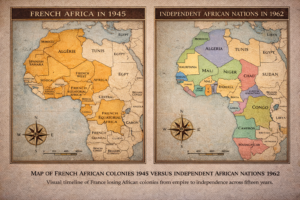
Although the 1946 constitution marked only minimal progress toward political participation for Africans, nationalists seized the moment. Budding nationalist parties came together to form a unified political organization known as the Rassemblement Démocratique Africain (RDA — the African Democratic Rally). Britannica Kids
The RDA became the most important political organization in Francophone Africa — a pan-territorial coalition that would produce the leaders, the arguments, and ultimately the pressure that drove France losing African colonies from possibility to reality. Its affiliates organized across West and Equatorial Africa. They ran candidates. They won elections. They built the institutional muscle that would carry their territories toward independence.
France responded to the RDA’s early growth with harassment, electoral manipulation, and in some cases violence. The colonial administration rigged local elections. Officials pressured RDA members to sever ties with the French Communist Party — which had been an important ally — to isolate the movement. It worked, temporarily. But isolation did not eliminate the demand. It just made the demand angrier.
Dien Bien Phu: The Wound That Changed Everything
The decisive psychological rupture in France losing African colonies came not in Africa but in a valley in northern Vietnam.
On May 7, 1954, Vietnamese forces under General Vo Nguyen Giap decisively defeated the French army at the Battle of Dien Bien Phu. A French force of roughly 16,000 soldiers — including troops from France’s African colonies — surrendered after a 56-day siege. It was the most catastrophic military defeat in the history of French colonialism. France had entered Indochina believing, as it believed about Africa, that its civilization was so superior that resistance was ultimately impossible. Dien Bien Phu destroyed that belief publicly, permanently, and on the front pages of every newspaper in the world.
Between 1945 and 1960, three dozen new states in Asia and Africa achieved autonomy or outright independence from their European colonial rulers. U.S. Department of State Dien Bien Phu accelerated that calendar dramatically. If France could be defeated militarily in Asia, it could be defeated politically in Africa. The myth of French invincibility — already shaken by the Nazi occupation, already cracked by Sétif — was now shattered.
The Algerian Front de Libération Nationale (FLN) launched its armed uprising in November 1954 — exactly six months after Dien Bien Phu. The timing was not coincidence. The FLN’s founding proclamation cited the defeat in Vietnam explicitly, framing it as proof that colonial powers could be broken. Across French Africa, nationalist leaders watched Algeria and drew their own conclusions: France could be moved. The question was how.
Sékou Touré and the Word That Broke an Empire
Of all the figures in the story of France losing African colonies, few delivered a more electrifying single moment than Ahmed Sékou Touré — a former trade union leader and grandson of the legendary anti-colonial resistance fighter Samori Touré — in a speech before Charles de Gaulle himself.
The context was the crisis of 1958. The French Fourth Republic had collapsed under the weight of the Algerian War. De Gaulle returned to power and proposed a new French Community — a restructured relationship that would give African territories “internal self-government” while France retained control over defense, foreign policy, and economic direction. Each territory would vote in a September referendum: join the new Community and receive continued French economic and technical support, or choose immediate independence and lose everything.
The message embedded in that choice was barely coded: take the offer or be economically destroyed.
De Gaulle traveled to Conakry on August 25, 1958, expecting a warm reception. What he got was Sékou Touré, standing before him on Guinean soil, and speaking words that electrified Africa:
“We prefer poverty in liberty to riches in slavery.”
The results showed that more than 95% of voters in Guinea voted against the constitution, with a turnout of 85.5%. Following the referendum, Guinea declared independence on October 2, 1958 — the only French African territory to do so. Wikipedia
France’s retaliation was immediate and vicious. French colonialists in Guinea withdrew from the country as quickly as they could, destroying as much infrastructure as they could in retribution. The Washington Post reported that as a warning to other French-speaking territories, the French pulled out of Guinea over a two-month period, taking everything they could with them — unscrewing light bulbs, removing plans for sewage pipelines in Conakry, and even burning medicines rather than leave them for the Guineans. Wikipedia
The punishment was meant as a lesson to the other colonies: this is what defiance costs. Instead, it had the opposite effect. Guinea’s success encouraged other French colonies to reconsider their positions, and they soon began to demand independence as well. EBSCO Kwame Nkrumah’s Ghana immediately extended Guinea a loan of 10 million pounds, proving that African solidarity could cushion what France intended as a fatal blow. The punishment became advertisement. The lesson taught was not the one France intended.
1960: The Year Africa Broke Free
What followed was extraordinary in its speed. The dam, once cracked, gave way almost entirely within two years.
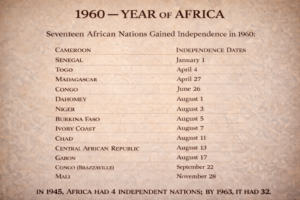 In 1960, many countries challenged their autonomous status within the French Community and began negotiations for full independence. The first country to become independent was Cameroon in January, followed by Senegal in April, and Mali and Madagascar in June. During the summer, a wave of declarations followed: Niger, Upper Volta, Chad, Ivory Coast, Dahomey, Gabon, and Congo Brazzaville. Finally, Mauritania became independent in November. The Map as History
Seventeen African nations gained independence in 1960 alone — a year that became known globally as the Year of Africa. The French Community that de Gaulle had constructed in 1958 as a mechanism for managed, permanent French influence essentially ceased to operate within two years of its creation. Almost all of the former African colonies achieved independence in 1960. Wikipedia
The speed was stunning. France had spent over a century constructing the infrastructure of colonial dominance — the legal systems, the administrative networks, the economic dependencies, the educational institutions designed to produce a French-speaking African elite loyal to Paris. All of it could not hold when the political will of African populations was finally organized, unified, and expressed through both ballots and the credible threat of resistance.
The Cold War complicated and shaped every step of this process. The Soviet Union deployed tactics to encourage new nations to join the communist bloc, while the United States used aid packages and technical assistance to encourage newly independent nations to align with the West. U.S. Department of State France navigating between these pressures — terrified of communist influence in its former territories — often found itself forced to negotiate independence arrangements it would have categorically refused a decade earlier, simply because the alternative was watching newly independent African states turn toward Moscow.
The Empire That Never Fully Left: Françafrique
Here is the part of the story that does not make it into the ceremonial independence photographs.
France losing African colonies, formally and legally, did not mean France losing Africa.
Critics of neocolonialism claimed that Françafrique had replaced formal direct rule. They argued that while de Gaulle was granting independence on one hand, he was maintaining French dominance through the operations of Jacques Foccart, his counsellor for African matters. Wikipedia Foccart orchestrated a network of influence that used economic dependency, military agreements, intelligence operations, and personal relationships with African leaders to keep France at the center of its former empire’s political and economic life — without the administrative cost or international criticism of formal colonialism.
The CFA franc — a currency pegged first to the French franc and later to the euro, managed by the French Treasury — remained the currency of fourteen African nations long after independence. France maintained military bases. French corporations dominated the extraction of resources from former colonies. African leaders who cooperated with French interests received support; those who resisted faced destabilization.
In 1960, the French government launched “Opération Persil,” a covert operation aimed at destabilizing Guinea’s post-independence government due to Touré’s firm rejection of the CFA franc. Africa Defined The message was clear: political independence was permitted. Economic sovereignty was another matter entirely.
This is the full story of France losing African colonies — or rather, the story of what losing looked like when the loser refused to accept the loss. The flags changed. The administrative structures changed. The names changed. The underlying architecture of extraction and control was rebuilt, more quietly, through money and military arrangements and the manipulation of elites rather than through direct governance.
What the Afrofuturist Mind Sees in This History
The Afrofuturist reading of this history is not simply about the past. It is about the template.
France losing African colonies was never about France’s goodwill. It was about the organized, sustained, creative refusal of African people to accept the terms of their domination. The Sétif veterans who marched on VE Day demanding what they had been promised. The RDA organizers who built pan-territorial political infrastructure under colonial surveillance. Sékou Touré, standing before de Gaulle and speaking the sentence that France could not answer. The seventeen nations of 1960 who understood that Guinea’s survival — messy and difficult and threatened as it was — proved independence was survivable.
Every tool France used to maintain the empire was eventually defeated by a corresponding tool of resistance. Military suppression — met with organized guerrilla warfare in Algeria. Electoral manipulation — met with mass political mobilization across West Africa. Economic threats — met with pan-African solidarity from Ghana and others. The French Community — met by the logic of Guinea’s example spreading faster than French economic punishment could contain it.
What was not defeated — what survived formal independence and continues today in the structures of Françafrique, the CFA franc zone, and French military presence across the Sahel — is the subtler architecture of control. The part that doesn’t require soldiers in the streets. The part that works through debt and currency and trade agreements and the education of African elites in French institutions.
The unfinished work of decolonization is not ancient history. It is the present condition of much of Francophone Africa. Understanding how France losing African colonies happened — and how much of that loss was immediately and partially reversed — is not nostalgia. It is the map that shows where the next battles are.
Timeline: France Losing African Colonies, 1944–1962 
1944 — Brazzaville Conference. De Gaulle makes limited concessions to African colonies that helped free France. Independence explicitly rejected as a possibility.
May 8, 1945 — Sétif Massacre. French forces and settler militias kill between 6,000 and 45,000 Algerians on VE Day. The nationalist movement radicalizes.
1946 — Fourth Republic Constitution. French Union replaces colonial empire in name. Power remains in Paris. African territories get token parliamentary representation.
1947 — Malagasy Uprising brutally suppressed. Between 11,000 and 89,000 Madagascans killed. RDA founded as pan-territorial nationalist coalition.
May 7, 1954 — Dien Bien Phu. France defeated in Vietnam. Colonial myth of invincibility collapses. Algerian FLN launches armed uprising six months later.
1956 — Loi Cadre grants internal self-government to African territories. France retains foreign policy, defense, and economic control.
September 28, 1958 — De Gaulle’s referendum. Every French African territory accepts the new French Community — except Guinea. Sékou Touré leads 95% vote for full independence.
October 2, 1958 — Republic of Guinea proclaimed. France retaliates with total economic withdrawal and infrastructure destruction.
1960 — The Year of Africa. Seventeen African nations gain independence, including Cameroon, Senegal, Mali, Madagascar, Niger, Ivory Coast, Chad, and eleven others.
March 1962 — Evian Accords. Algeria achieves independence after eight years of war, 130 years of French colonization, and a death toll estimated in the hundreds of thousands.
FAQ: France Losing African Colonies
Why did France resist decolonization so fiercely? France’s colonial ideology held that its territories were not occupied lands but extensions of France itself. The mission civilisatrice — civilizing mission — framed colonialism as a gift rather than conquest. Relinquishing the colonies meant admitting that the entire ideological framework was a lie. It also meant losing strategic resources, economic markets, and the global prestige of empire. France resisted until resistance was simply more costly than accommodation.
What was the Sétif Massacre and why does it matter? On VE Day, May 8, 1945, French forces massacred thousands of Algerians who had gathered to celebrate the end of World War II while carrying flags and demanding independence. Estimates of the dead range from 6,000 to 45,000. The massacre radicalized a generation of Algerian nationalists, directly driving the armed uprising of 1954 and the eight-year war that ended with Algerian independence in 1962. It is considered the true beginning of the Algerian War of Independence.
Who was Sékou Touré and why was Guinea’s vote historic? Ahmed Sékou Touré was a trade union leader and nationalist politician who led Guinea’s Democratic Party to win 56 of 60 territorial assembly seats in 1957. When de Gaulle offered African territories a choice between joining the French Community or immediate independence in 1958, Touré led Guinea to a 95% vote for independence — the only French African territory to do so. His phrase “we prefer poverty in liberty to riches in slavery” became one of the defining statements of African decolonization.
What was the Year of Africa? 1960 is known as the Year of Africa because seventeen African nations achieved independence in a single year — mostly from France and Britain. For France specifically, it marked the near-total collapse of the French Community structure de Gaulle had built just two years earlier. The speed of decolonization stunned even the nationalist movements that had driven it.
What is Françafrique and does it still exist? Françafrique refers to the network of political, economic, and military relationships through which France maintained influence over its former African colonies after formal independence. It operated through currency control (the CFA franc), military base agreements, personal networks between French officials and African leaders, intelligence operations, and support for cooperative governments against resistant ones. Elements of Françafrique persist today, though they face increasing challenge from African governments asserting greater sovereignty — most recently in the Sahel, where several former French colonies have expelled French military forces since 2023.
Why did the Cold War matter to African decolonization? Both the United States and Soviet Union competed for influence over newly independent African nations. This competition gave African leaders leverage — the threat of turning toward the Soviet bloc pressured Western powers, including France, to accommodate independence rather than risk new nations becoming communist allies. It also limited how harshly France could punish independence movements without driving them directly into Moscow’s arms. Guinea’s turn to the Soviet Union after France’s punitive withdrawal is a direct example of this dynamic.
Sources: Decolonisation of Africa, Wikipedia; French Colonial Empire, Wikipedia; Sétif and Guelma Massacre, Wikipedia; France24, “Remembering Sétif, the VE Day colonial massacres that ‘lost Algeria’ for France” (May 2025); EBSCO Research Starters, “Guinea Gains Independence from France”; EBSCO Research Starters, “Ahmed Sékou Touré”; Britannica, “Sékou Touré”; Africa Rebirth, “How Sékou Touré Led Guinea to Become the First French African Colony to Gain Full Independence”; The Map as History, “Decolonization of French Black Africa”; U.S. State Department Office of the Historian, “Decolonization of Asia and Africa, 1945–1960”; Wilson Center, “Nationalism and Decolonization in Africa during the Cold War.”