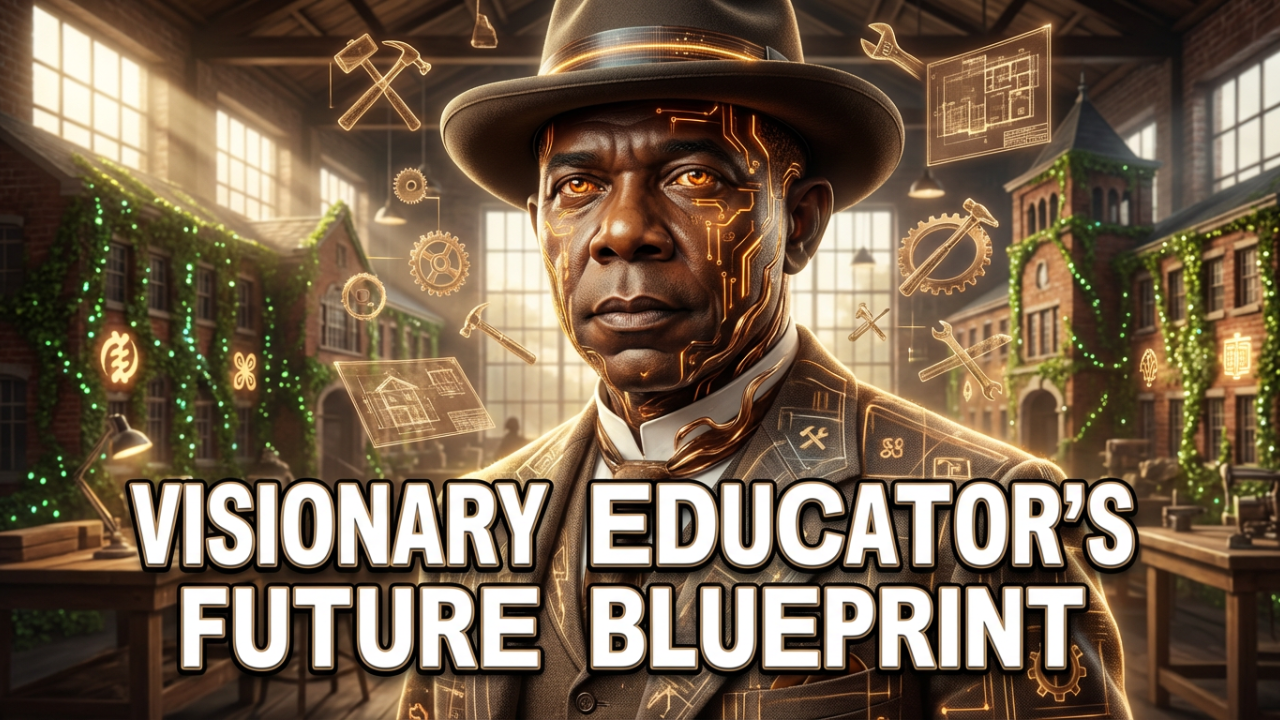
The Blueprint They Abandoned: How Booker T. Washington’s Economic Model Built Empires—Just Not in Black America

There’s a truth buried in American history that makes people uncomfortable: the most successful economic blueprint for minority advancement in America was created by a Black man—but it was perfected by everyone except Black Americans.
His name was Booker T. Washington, and between 1880 and 1915, he built something revolutionary: a comprehensive system for economic independence that didn’t require permission from those in power. Washington believed that African Americans should “concentrate all their energies on industrial education, and accumulation of wealth,” viewing economic power as the foundation for eventual political equality.
But here’s where the story gets complicated—and painful.
While Washington was building Tuskegee Institute, training Black Americans in trades, land ownership, and business creation, another vision was taking shape in the minds of Northern intellectuals. W.E.B. Du Bois, Harvard’s first Black PhD recipient, offered a competing model: elite education, political agitation, and the cultivation of a “Talented Tenth” who would lead through intellectual and moral authority.
Two philosophies. Two pathways. One choice that would shape Black America for the next century.
The Split That Changed Everything
In 1905, ten years after Washington’s famous Atlanta Compromise speech, Du Bois and William Monroe Trotter formed the Niagara Movement to directly challenge Washington’s approach. By 1909, this movement evolved into the NAACP, and the cultural direction of Black America began its historic pivot.
Washington’s model demanded:
- Vocational mastery and skilled trades
- Land ownership and wealth accumulation
- Community economic networks
- Internal discipline and delayed gratification
- Economic leverage to eventually gain political power

Du Bois’ model emphasized:
- Elite academic education
- Political rights and immediate equality
- Intellectual leadership
- Moral critique of systemic racism
- The “Talented Tenth” guiding the masses
One required grinding, unglamorous work that took generations to bear fruit. The other offered intellectual prestige and the immediate satisfaction of moral righteousness.
Guess which one won?
Who Really Backed Du Bois? The Northern Machine
Here’s the part that baffled Washington until his death in 1915: Du Bois had powerful institutional backing—Northern philanthropists, progressive reformers, Ivy League networks, and the founders of the NAACP itself, many of whom were wealthy white Northerners.
Washington was building schools in Alabama, teaching carpentry and farming. Du Bois was attending salons in New York and Boston, writing for The Atlantic, mobilizing elite networks that Washington didn’t even know existed.
The NAACP was well-funded, its leadership contained many powerful white Northerners, and it systematically siphoned support away from Washington’s Tuskegee Machine. Washington never figured out the full extent of the structural forces working against him. He was too busy building.
Why Washington’s Model Didn’t Survive
The brutal truth is this: Washington’s economic model worked—until it didn’t. And there were specific, identifiable reasons why.
The Great Migration Broke the Blueprint
Millions of Black Southerners moved from rural farms to Northern cities. Washington’s model was designed for a land-based, agricultural society where communities could build generational wealth through property ownership and vocational trades. Urban factory life demanded something different—or so people thought.
Economic Independence Threatened Power Structures
When Black communities actually achieved economic self-sufficiency, they faced systemic sabotage: legal restrictions, zoning laws, redlining, and in extreme cases like Tulsa’s Black Wall Street, outright violence and destruction. Washington died in 1915, just before a wave of race riots sparked by economic competition between white and Black workers destroyed many thriving Black business districts.
Narrative Beat Discipline
Here’s the uncomfortable part: Washington built power. Du Bois built story. And in a media-driven culture, story won.
Newspapers, magazines, and later television preferred speeches, protests, intellectual debates, and political drama—they didn’t know how to cover carpentry, farming, land ownership, or vocational excellence.
Building wealth is slow. Demanding recognition feels revolutionary.
Washington’s Successors Weren’t Washington
He was a once-in-a-generation organizer with unmatched strategic vision. After his death, Tuskegee lost its edge. The model required a level of discipline, coordination, and long-term thinking that proved nearly impossible to maintain without his leadership.
The Cultural Shift: From Builders to Storytellers
Between 1915 and 1960, Black America underwent a profound psychological transformation.
From Economic Independence → To Political Advocacy
“Own land, own business” became “Demand rights, demand recognition.”
From Vocational Mastery → To Academic Prestige
“Learn a trade, build wealth” became “Get degrees, gain status.”
From Internal Coordination → To External Critique
“Fix ourselves first” became “Fix the system first.”
From Hierarchy and Structure → To Identity and Expression
“Roles, ranks, discipline” became “Identity, dignity, recognition.”
None of this happened in a vacuum. After centuries of dehumanization, identity-based empowerment felt like healing. Washington’s model didn’t offer emotional relief. Du Bois’ model did.
But empowerment without infrastructure is just a feeling. And feelings don’t build generational wealth.
Who Actually Used Washington’s Blueprint? Everyone Else.
Here’s where the story turns from tragic to infuriating.
While Black America shifted toward Du Bois’ model, wave after wave of immigrant groups arrived in America and executed Washington’s blueprint to perfection:
They Built Ethnic Economies
Korean, Jewish, Italian, Chinese, and other immigrant communities created entire economic ecosystems—wholesalers, retailers, service providers, community banks, and rotating credit associations that kept capital circulating within the group.
Koreatown. Chinatown. Little Italy. Jewish garment districts. Caribbean business corridors.
These weren’t just neighborhoods. They were economic fortresses.
They Mastered the Money Circulation Game
Research shows that immigrant communities use rotating credit associations (RCAs) extensively—34% of business owners in Chicago and 84% in Los Angeles reported using these informal financing systems to start businesses.
A dollar stayed in Jewish communities for 20-30 days. In Asian communities, 17 days. In Black communities? Six hours.
That’s the Washington gap.
They Used Vocational Mastery as Economic Leverage
Trades became power. Korean immigrants dominated the laundromat and grocery business. Chinese immigrants controlled garment manufacturing. Jewish immigrants built entire industries from the ground up. Immigrants start businesses at higher rates than U.S.-born individuals, with over 40% of Fortune 500 companies founded by immigrants or their children.
They Kept Internal Conflicts Internal
Washington preached this relentlessly: don’t air dirty laundry in front of those who don’t wish you well. Immigrant groups practiced tight internal solidarity, using their shared ethnicity as an economic advantage in owner-worker relationships and industry networks.
They Used Economic Power to Buy Political Power
Not through protests. Not through moral arguments. Through cold, hard leverage.
Money → Influence → Representation.
Exactly as Washington prescribed.
The Afro-Futurist Perspective: Reclaiming The Blueprint
Here’s the truth that sits at the heart of Afro-Futurism: your ancestors were futurists.
The pyramid builders didn’t just stack stones—they architected systems that outlasted empires. The post-emancipation generation didn’t just survive—they built schools, farms, banks, and entire towns from nothing.
Booker T. Washington wasn’t an accommodationist. He was playing the long game in a world that demanded Black people either beg for scraps or build their own table.
He chose to build.
And his blueprint still works. Every immigrant success story proves it. Every ethnic enclave economy validates it. Every rotating credit association, every family business, every community bank that keeps capital circulating internally—these are all echoes of what Washington tried to teach.
What Does This Mean for Today?
The digital age has created the greatest opportunity for economic independence since Reconstruction. Blockchain economies. Digital platforms. Remote work. Content ownership. Decentralized finance.
These are the modern equivalents of land ownership, vocational trades, and community banks. The tools have changed, but Washington’s principles remain eternal:
- Build Economic Power First—Crypto wealth, digital businesses, content platforms
- Create Internal Networks—DAOs, Discord communities, Web3 collectives
- Master Valuable Skills—Coding, design, content creation, digital marketing
- Keep Money Circulating—Support Black-owned businesses, invest in community tokens
- Use Economic Leverage for Political Power—Own the platforms, don’t just perform on them
The Question You Have to Answer
Your ancestors built nations with nothing but vision, discipline, and refusal to accept limitation.
What are you building?
Every creator who owns their platform instead of just performing on someone else’s stage extends Black Wall Street into the digital age. Every Black-owned DAO, every community currency, every decentralized business model is a brick in the structure Washington tried to build.
The choice is still the same one Washington and Du Bois argued about:
Do you want recognition, or do you want power?
Recognition requires permission. Power requires infrastructure. 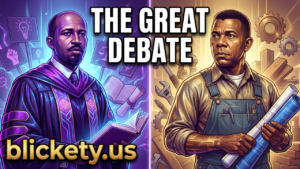
Narrative feels good. Discipline builds empires.
The Hard Truth We Have to Face
Washington’s model required hierarchy, discipline, coordinated effort, and delayed gratification. It demanded that people accept roles, follow structure, and build slowly.
Du Bois’ model offered immediate dignity, intellectual status, and moral superiority. It felt like liberation even when it didn’t produce economic freedom.
We chose the one that felt good.
And we’ve been paying for it ever since.
But here’s the revolutionary part: we can choose again.
The blueprint still exists. Immigrant groups prove it works every single day. The question is whether we’re ready to pick it back up—to return to the mindset of the pyramid builders, the post-emancipation institution creators, the Tulsa entrepreneurs who built an empire called Black Wall Street.
Your ancestors were futurists. They understood that freedom without economic infrastructure is just a better-decorated cage.
The tools are different now. The mission remains the same:
Build systems that outlast you. Create wealth that multiplies throughout your community. Architect a future where Black excellence isn’t just celebrated—it’s systematically supported by structures we own and control.
The pyramids still stand. Black Wall Street’s blueprint endures. Washington’s model still works.
The question isn’t whether the legacy will continue.
The question is whether you’ll help write the next chapter.
Your move.