Melanin Ancestral Inheritance: The Living Archive of Black History
https://the-afrofuturist.com/wp-content/uploads/2026/03/melanin-ancestral-inheritance-the-beautiful-living-archive-of-black-history.pdf

Introduction — Melanin as a Living Archive
The story of melanin ancestral inheritance begins long before written history. Long before borders. Long before race was turned into a political weapon.
Melanin is usually described as pigment. A biological compound produced by melanocytes in the skin. Science explains it as protection against ultraviolet radiation, absorbing sunlight and shielding DNA from damage.
That explanation is correct.
It just isn’t the whole story.
Melanin is also memory.
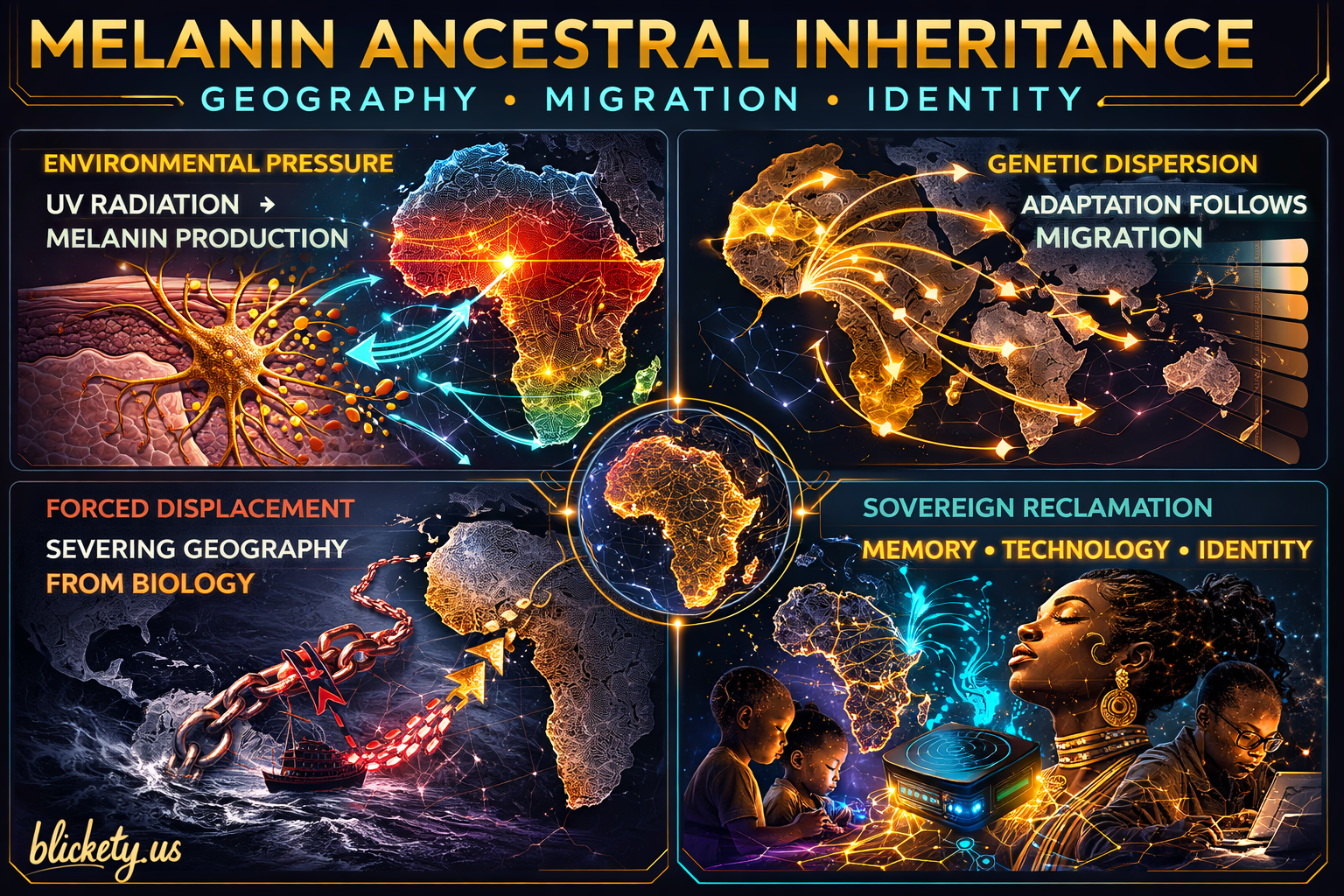
The concept of melanin ancestral inheritance suggests something deeper: that the body carries ecological records of where its ancestors lived, the climates they endured, and the environments that shaped their survival. Skin pigmentation evolved through thousands of years of interaction with sunlight, geography, and environment.
Across the African diaspora, melanin holds both scientific meaning and cultural meaning. It reflects where ancestors walked, where they adapted, and how they endured.
In that sense, melanin ancestral inheritance is not simply biology.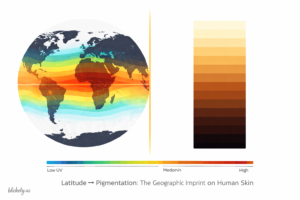
It is a living archive carried in the body.
This essay forms the second pillar in the Eco-Melanin trilogy. The first explored melanin as ecological alignment. This installment turns to inheritance — the story written into the skin itself.
Geography as the First Author of Melanin
Geography wrote the first chapter of melanin ancestral inheritance.
Equatorial regions receive the highest levels of ultraviolet radiation on Earth. Populations that lived in these regions evolved stronger melanin production because darker pigmentation protects against UV damage while preserving critical nutrients in the bloodstream.
This adaptation did not appear suddenly. It unfolded over tens of thousands of years.
Climate shaped biology.
Sunlight shaped survival.
In Africa’s equatorial belt, in the Sahel, and in rainforest regions, environmental conditions favored dense melanin production. Over generations, natural selection reinforced the protective qualities of darker skin pigmentation.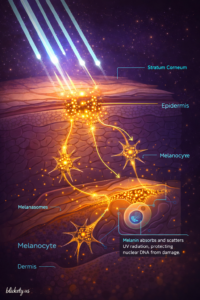
Seen through this lens, melanin ancestral inheritance functions almost like a geographic map.
It reveals where ancestors lived and the solar intensity their bodies adapted to.
Equatorial sunlight demanded resilience. Melanin delivered it.
The result is a biological system that carries environmental intelligence forward through generations.
Migration, Movement, and the Rewriting of Melanin’s Story
Human history is a story of movement.
Long before the transatlantic slave trade disrupted African societies, migration shaped populations across the continent. Expansions across West, Central, and Southern Africa reshaped cultures, languages, and ecological adaptation.
Each migration introduced new environments.
Different altitudes. Different UV exposure. Different ecosystems.
Through it all, melanin ancestral inheritance continued adapting.
But one migration was not voluntary.
The transatlantic slave trade forcibly relocated millions of Africans across oceans and continents. Communities were scattered throughout the Caribbean, South America, and North America.
The geographic continuity that shaped melanin for thousands of years was violently broken.
Yet the inheritance traveled with them.
Melanin carried the imprint of equatorial sunlight into places where winter clouds replaced tropical skies.
The archive moved.
Diaspora Adaptation — Melanin in New Worlds
Life in the diaspora introduced new challenges for melanin ancestral inheritance.
Many enslaved Africans were taken to regions with dramatically different climates than their ancestral homelands. Northern latitudes brought colder temperatures, reduced sunlight, and seasonal darkness.
Biology adapts slowly.
History moved much faster.
In environments with lower ultraviolet radiation, darker pigmentation can influence how the body synthesizes vitamin D. That tension between biological inheritance and environmental conditions shaped new health realities in diaspora communities.
Black communities responded with cultural adaptation.
Food traditions shifted. Lifestyles adjusted. Knowledge passed quietly across generations about how to live in climates ancestors had never encountered before.
Even in unfamiliar environments, melanin ancestral inheritance remained a stabilizing force.
It carried ancestral adaptation into new worlds.
Cultural Memory Stored in the Body
For many Black communities, melanin is not merely pigment.
It represents lineage.
The concept of melanin ancestral inheritance operates in two dimensions at once.
One dimension is biological. Evolution shaped pigmentation as protection against environmental conditions.
The other dimension is cultural. Melanin becomes a visible connection to ancestry.
Beauty rituals across the African diaspora celebrate melanin-rich skin. Spiritual traditions frame dark skin as sacred inheritance. Cultural expression transforms melanin into identity, pride, and continuity.
Colonial narratives tried to distort the meaning of melanin. Yet communities repeatedly reclaimed it.
In this sense, the body itself becomes archive.
Stories erased from official history still live in skin tone, family memory, and cultural identity.
Melanin as Identity — Beyond Aesthetics
Identity is never neutral.
Across the African diaspora, melanin has shaped social perception, political identity, and cultural solidarity. Skin tone has influenced how societies categorize, judge, and treat individuals.
But melanin ancestral inheritance also carries a different meaning inside Black communities.
It signals belonging.
A shared inheritance linking communities separated by oceans and centuries.
Melanin is phenotype, yes.
Yet it is also heritage.
The difference matters.
Phenotype describes physical appearance. Heritage describes lineage, memory, and continuity.
Through melanin ancestral inheritance, identity becomes both biological and historical.
Survival, Resistance, and the Politics of Inheritance
Colonial systems transformed melanin into a political category.
European racial hierarchies were built around pigmentation differences. Legal structures reinforced those hierarchies. Entire economies were constructed around the exploitation of melanin-rich bodies.
The politics of skin color reshaped the world.
Yet the resilience embedded in melanin ancestral inheritance persisted.
What once evolved as protection against intense sunlight became something more.
A visible sign of survival.
Despite centuries of oppression, melanin remained what it had always been: an inheritance from ancestors who adapted, endured, and lived in alignment with their environment.
Resistance grew from that inheritance.
Communities reclaimed melanin as beauty.
As pride.
As truth.
Reclaiming Melanin as Ancestral Technology
The phrase melanin ancestral inheritance reframes pigmentation as something far more sophisticated than a cosmetic trait.
Melanin represents the outcome of thousands of years of environmental intelligence.
Sunlight shaped it.
Climate refined it.
Generations carried it forward.
Modern scientific research continues to reveal the complexity of melanin’s functions, from ultraviolet protection to neurological roles that scientists are only beginning to understand.
Afro-Futurist thought offers another perspective.
Melanin is not merely inherited biology.
It is ancestral technology.
A biological system refined through time, environment, and adaptation.
Long before laboratories studied melanin, African civilizations understood the relationship between skin, sun, and environment.
What science now confirms, ancestral knowledge already recognized.
Conclusion — Melanin as a Living Archive
The story of melanin ancestral inheritance connects geography, migration, identity, and survival.
Sunlight shaped it.
History carried it.
Diaspora communities gave it new meaning.
Melanin remains a record — an archive of ancestral environments, migrations, and resilience.
Understanding this inheritance restores a story colonial narratives tried to distort.
It reminds us that the body remembers.
And that memory continues shaping the future.
The Eco-Melanin trilogy continues from here. Having explored inheritance, the next step examines how melanin interacts with the natural environments that once shaped it. In case you missed the first part, Eco-Melanin: Why African Botanicals Are the Future of C1ean Beauty, click here.
Next: how ancestral African botanical knowledge may reconnect melanin biology with the ecological systems that first nurtured it.