Table of Contents
- The Alchemy That Was Always Ours
- Plastic to Fuel Inventor: Who Is Julian Brown?
- What Plastoline Actually Is — And What the Internet Gets Wrong
- The 5 Reactors: A Blueprint Built From Scars
- Plastic to Fuel Inventor Runs a Rolls-Royce on Trash
- The World He’s Building Against: 2026’s Plastic Crisis in Numbers
- When They Come for the Ones Who See Too Clearly
- Plastic to Fuel Inventor and the Sovereignty Question Nobody’s Asking
- FAQ
- What Comes Next
The Alchemy That Was Always Ours
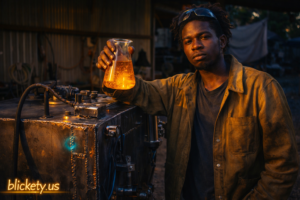
There’s a number that should stop you cold before we even get to Julian Brown. Without decisive action, global plastic pollution will more than double over the next fifteen years — from 130 million to 280 million metric tons — reaching the equivalent of nearly a garbage truck per second polluting the environment by 2040.
The Pew Charitable Trusts A garbage truck. Per second. While the United Nations spent two weeks in August 2025 trying to negotiate a plastic treaty and walked away empty-handed because the world’s largest plastic producers blocked any attempt to cap production, a 22-year-old Black kid from metro Atlanta was in a parking lot in Duluth, Georgia pouring fuel he made from grocery bags into a Dodge Scat Pack in front of a thousand people.
Those two things are not unrelated.
The ones who came before us understood something about the relationship between what empire discards and what genius reclaims. They didn’t have the word pyrolysis. They had something older — the knowledge that what gets thrown away by systems of power tends to become, in the right hands, the foundation of the next civilization. So when the plastic to fuel inventor Julian Brown builds a solar-powered microwave reactor in a carport and turns laundry detergent bottles into 110-octane fuel, maybe the correct response isn’t surprise. Maybe it’s recognition. The continuum from ancestral alchemy to backyard reactor is shorter than you think.
He is not an anomaly. He is a continuation. And the world is only now catching up to what that means.
Plastic to Fuel Inventor: Who Is Julian Brown?
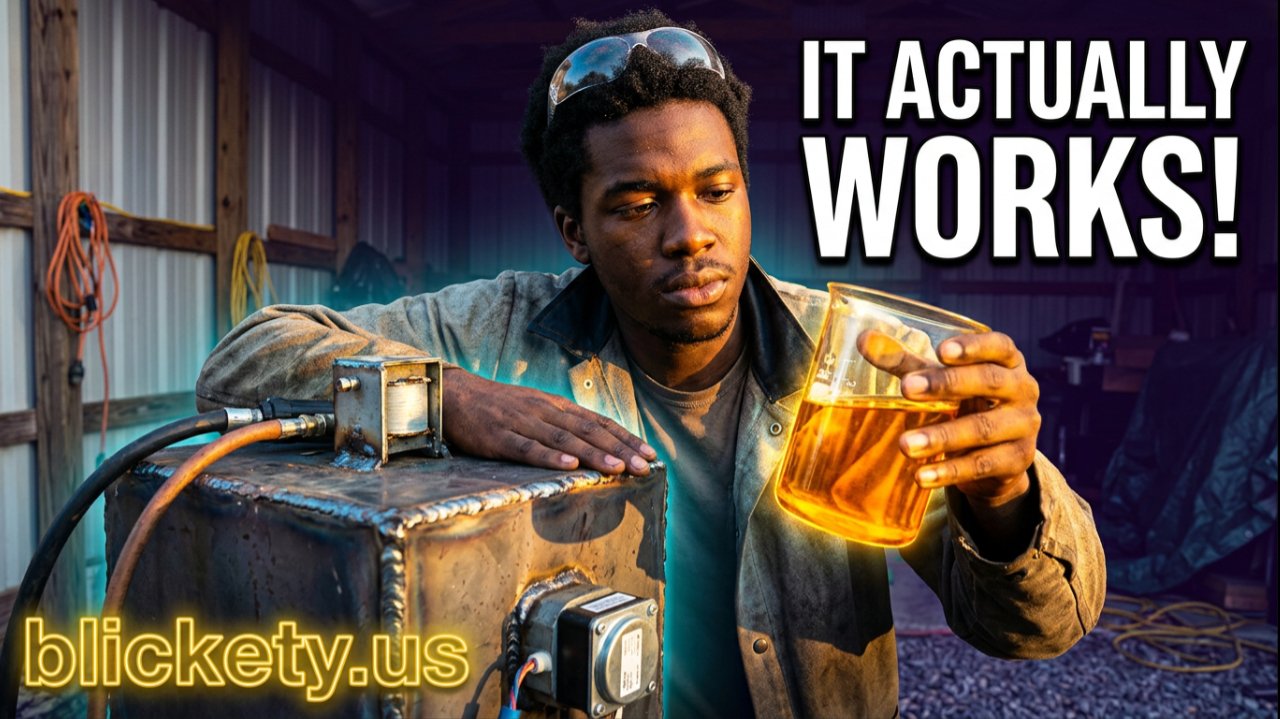
Julian Brown is a 22-year-old inventor gaining viral attention for what he calls Plastoline — a fuel he produces from plastic waste using microwave pyrolysis powered by solar panels. Brown began researching the idea in high school, building his first plastic-to-fuel reactor at age 17. WTVM That sentence reads like a press release. The reality is messier and more instructive. This is a self-taught welder — born in Tennessee, raised in Alabama, relocated to Atlanta — who turned a hand injury in high school into five years of obsessive, dangerous, expensive, occasionally explosive research that nobody funded and nobody asked for.
“When I was five years old, I told my mom that I was gonna create something that would change the world,” Brown has said. “It’s always been within me — I just never knew what it was gonna be.” Men’s Journal That’s not the kind of thing you retrofit onto a story after it goes viral. That’s the kind of thing a kid says and a mother holds onto for seventeen years until her son is pouring fuel made from plastic bottles into a luxury car in front of a live stream audience.
He runs NatureJab — naturejab.com — under which the technology and its mission live. JAB Innovations is the linked nonprofit for tax-deductible support. JabAroma, a natural products brand, funnels profits back into the reactor work. Brown holds a 776 Foundation Climate Fellowship and has received an innovation grant specifically for developing small-scale systems using solar electrical generators and efficient microwave emitters to heat plastics to pyrolysis temperatures. BreezyScroll He has three million followers on Instagram as of early 2026. He has also survived an explosion, a cyberattack on his iCloud, helicopters circling his property at night, and a period of going dark that sent the internet into a full missing-person spiral. Through all of it, he kept building.
That’s the plastic to fuel inventor. Not the press release version. The real one.
What Plastoline Actually Is — And What the Internet Gets Wrong
Let’s be precise, because imprecision costs Brown credibility he’s already had to fight for.
What the plastic to fuel inventor has actually built is a solar-powered microwave pyrolysis system — and the distinction between that specific innovation and “inventing pyrolysis” matters more than most coverage bothers to explain. The process uses microwave pyrolysis, which heats plastic inside a sealed, oxygen-free chamber to break the material down into crude oil, which is then refined into a clean-burning fuel. Rocket City Now Brown frames the chemistry plainly: plastic is made from crude oil, so returning it to crude oil is a reversal, not a miracle.
The vapor condenses back into liquid. That liquid refines into gasoline, diesel, or jet fuel using methods conventional refineries already use. The fuel rates at 110 octane, contains no ethanol — meaning it doesn’t absorb water and has a longer shelf life than conventional gasoline. Rocket City Now
Now — what it isn’t. Brown did not invent the process for turning waste plastic into fuel. His NatureJab system harnesses solar-powered microwaves to heat a pyrolysis reactor — a well-understood chemical process. Research into plastic pyrolysis methods predates Brown’s 2023 founding of NatureJab, with projects like plastic-to-gas initiatives in the Philippines dating back to 2005 and patent applications for similar processes existing since 2013. Yahoo!
Brown doesn’t claim otherwise. He never has. What he built is a solar-microwave implementation that is smaller, more accessible, more community-deployable, and more iteratively demonstrated in real vehicles than anything that preceded it at grassroots scale. That’s actually the harder achievement. Replicating a known process in a way that a community can own and operate without a billion-dollar refinery behind it — that’s the innovation.
Testing at ASAP Labs, a certified facility, confirmed that Plastoline burns cleaner than conventional diesel. Analysis revealed low sulfur content and carbon chains identical to industry-standard fuel. The fuel isn’t a theory. It’s certified. One scientist who reviewed Brown’s diesel variant put it plainly: he found it “surprisingly well distilled” — which, coming from an industry professional, is something close to astonishment.
The 5 Reactors: A Blueprint Built From Scars
The plastic to fuel inventor didn’t arrive at a working reactor. He built toward one, version by painful version, each iteration a lesson in what refusing failure as a final answer actually costs.
The Mark I was his starting point. Mark II addressed leaking problems the first version couldn’t solve. Mark III had design issues that limited its lifespan — though its horizontal shape became a key structural insight Brown carried forward. Mark IV worked efficiently and reliably, providing the scalable base he needed to build from. Yahoo!
Each version took months. Each cost money he didn’t have and required skills he taught himself. The Mark 4.5, his most recent operational unit before the Mark 5, uses ten magnetrons from salvaged microwaves, running at roughly 8 kilowatts. Mixed, unsorted, dirty plastic goes in — grocery bags, detergent bottles, milk jugs. Four to five hours of processing later, he collects a crude substance that looks like contaminated oil before running it through a vacuum distillation process. New Atlas The vacuum distillation apparatus? A ShopVac. That’s not a bug. That’s resourcefulness as an engineering principle.
Brown has at least two active GoFundMe campaigns. One created in April 2025 raised nearly $29,000 against a $16,000 goal, earmarked for a 20-kilowatt solar inverter, 60 kilowatt-hours of lithium batteries, a charge controller, and wiring for his solar array. New Atlas He’s funding a revolution with crowdfunding. The math of that — the gap between what this technology could do and what it costs to build it without institutional backing — is its own kind of indictment.
The Mark 5 is what all five reactors were building toward. A mobile, trailer-based unit with more than 20 solar panels designed for continuous operation and community-level deployment. Brown’s vision: machines on trailers, in oceans, in cities, in homes. “Whether it’s in every house or not, it will be in every city on earth in some type of format,” he said. Rocket City Now He’s not describing a product. He’s describing infrastructure.
Our ancestors built aqueducts, granaries, and trade routes from materials at hand, for communities that needed them, without permission from anyone. The five-reactor arc is the same logic in a different century.
Plastic to Fuel Inventor Runs a Rolls-Royce on Trash
October 4, 2025. Duluth, Georgia. More than a thousand people gathered at a Nissan dealership to watch the plastic to fuel inventor pour Plastoline into a 2023 Dodge Scat Pack. The car ran. Clean. The crowd erupted. Brown had just made history in a parking lot with fuel made from what the municipal waste system couldn’t be bothered to reclaim.
Then March 2026, Huntsville, Alabama. Brown fueled a 2016 Rolls-Royce Dawn with Plastoline — 110-octane gasoline derived entirely from plastic waste. The V12 engine turned over and the luxury vehicle drove without issue. WorldStar The owner, Jabar Westbrook, had no doubt it would work. “I believe in him. I’ve seen what he’s done. I wanted to be a part of history. I believed it was going to work, and I wasn’t nervous at all.” 
Sit with that image. A Rolls-Royce — the definitive symbol of inherited European wealth, colonial accumulation, and generational luxury — running on fuel made from what the system told us was garbage. The colonial model literally reversed. What was extracted from the earth, converted into plastic, sold at profit, discarded into landfills and oceans and the bloodstreams of children, gets reclaimed by a Black man from Atlanta and put back into the machine that represents everything that was never supposed to be ours. That’s not a demo. That’s a statement.
These events are proof of concept at the highest level of public visibility. Brown understands something about narrative that institutional scientists rarely grasp — you can publish a peer-reviewed paper or you can run a Rolls-Royce through Alabama on trash fuel and get three million Instagram followers paying attention to your next reactor. Both are valid paths to legitimacy. One builds a community that owns the outcome.
The World He’s Building Against: 2026’s Plastic Crisis in Numbers
Here’s the scale of what the plastic to fuel inventor is actually working against — because context matters, and the numbers are worse than most people know.
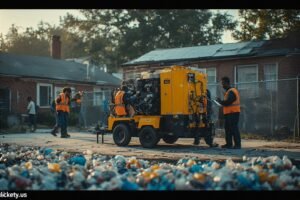
Global plastic waste hit 225 million tonnes in 2025 — five million tonnes more than the year before. Plastic Overshoot Day, the point at which global waste systems could no longer manage the year’s plastic output, fell on September 5, 2025. letsrecycle.com That means for nearly four months of 2025, every piece of plastic produced was already beyond the system’s capacity to manage. US plastic recycling rates have dropped from 9% in 2018 to approximately 5% today — the worst rate in decades — even as plastic production continues to grow. The Global Statistics Five percent. After fifty years of recycling education and infrastructure investment, the number went down.
In 2023, global plastic production reached 436 million metric tons, while trade in plastics surpassed $1.1 trillion. But 75% of all plastic ever produced has become waste, much of which leaks into oceans and ecosystems. UNCTAD And the treaty meant to address this — the UN Global Plastics Treaty — collapsed in August 2025 when the world’s largest plastic-producing nations blocked any production cap. The system, in other words, is not trying to fix itself.
If global plastic production were a country, it would be the third-largest greenhouse gas-emitting nation by 2040. Health impacts from plastic production and waste — including heart disease, asthma, and cancer — will increase by 75% by 2040. The Pew Charitable Trusts Microplastics are already in human blood, brains, placentas, and the first stool of newborn babies. This is the world the plastic to fuel inventor woke up to and decided was unacceptable. Not when he was a 35-year-old PhD with a lab grant. When he was seventeen, with a hand injury and a welding background, in a carport in Alabama.
That’s the actual context for this story. Not “cool science project.” Existential planetary infrastructure failure, met by a young Black man with salvaged microwave parts and a ShopVac.
When They Come for the Ones Who See Too Clearly
This section makes people uncomfortable in different directions. Some reach immediately for conspiracy. Others dismiss it entirely. The Afro-Futurist reading is neither — it’s structural, and it’s historical.
Brown has faced cyberattacks and reported unusual surveillance, including helicopters circling his property and shining spotlights on him during the night. Despite these challenges, he said: “I see it now as, let’s get it in the world and implemented. That’s the whole point of why I started this.” WTVM In July 2025 he posted that he was “certainly under attack” and went quiet. A post on X claiming he had been kidnapped by “the elites” reached 2.6 million views and 28,000 likes. Reddit formed a subreddit called “Where is Julian Brown.” Snopes
Brown later revealed that his phone had been hacked — that attackers got into his iCloud and were remotely watching and viewing his entire device. Men’s Journal His mother confirmed he was safe but couldn’t provide details about his location for security reasons. Newsweek He came back. He kept building. He warned followers about scam crypto tokens using his name and likeness and kept posting demos.
Did Big Oil send helicopters? That’s genuinely not the question. The question is why this pattern is so recognizable. Garrett Morgan, who invented the gas mask and a precursor to the traffic light, watched white businessmen buy his patents and erase his name from the credits.
Lonnie Johnson, inventor of the Super Soaker, had to sue Hasbro for $73 million in royalties they tried to keep. Lewis Latimer improved Edison’s lightbulb filament and spent decades fighting for recognition inside a system that needed his genius but not his name on anything. The pattern is not a conspiracy. It is infrastructure — the infrastructure of American innovation, built to extract value from Black genius while keeping Black inventors at the margins of ownership.
Brown, in his own words on his fundraising page: “Last year, I got into an explosion and was hospitalized and suffered 2nd-degree burns requiring burn surgery. At the same time, I had to find a new safe plot of land to move my operations to. I currently drive four hours to and from every time I wish to work on or operate my machine. This shows my true commitment to the cause.” Newsweek
He said that not as a plea for sympathy. He said it as evidence of resolve. There’s a difference.
Plastic to Fuel Inventor and the Sovereignty Question Nobody’s Asking
Every major outlet covering Julian Brown has focused on the chemistry and the car demos. A few fact-checked whether he invented pyrolysis — he didn’t, says so himself, doesn’t matter. Some covered the disappearance. Almost none have asked what this thing actually means if it scales the way he intends it to.
The plastic to fuel inventor isn’t just building a fuel alternative. He’s building an argument — in steel and solar panels and 110-octane output — that communities don’t need to wait for the energy transition. They can build it themselves.
Pyrolysis can turn plastic waste into fuel that, when tested at certified facilities, produces cleaner emissions than conventional diesel, with low sulfur content and carbon chains identical to industry-standard fuel. HypeFresh The technology works. The question isn’t whether it works. The global plastic waste-to-fuel market was valued at $1.52 billion in 2023 and is projected to reach $3.18 billion by 2031, growing at nearly 10% annually. Chemicalresearchinsight Shell, ExxonMobil, and Neste are pouring hundreds of millions into industrial pyrolysis operations right now. The question is who owns the infrastructure when it scales — and whether the answer, for once, includes the communities that need it most.
If the Mark 5 deploys as Brown envisions — mobile, solar-powered, community-deployable — what does it mean for the neighborhood in Compton that pays 15% more for gas than the suburb two miles away? What does it mean for a rural Black town in Mississippi watching its plastic pile up in a landfill while a refinery two counties over converts fossil fuel into corporate profit? What does it mean for Black farmers, Black logistics operators, Black truckers to generate their own fuel from the plastic they already have, outside the supply chains and pricing mechanisms that have historically extracted wealth from their communities?
Black Wall Street built banks, hospitals, schools, and a self-sustaining internal economy precisely because external systems were engineered to exclude them. The Greenwood District of Tulsa, at its height, had over 600 Black-owned businesses operating in a 35-block area. It was burned to the ground in 1921 by people who understood exactly what it meant for Black communities to own their own infrastructure. The Mark 5 is the next iteration of that same instinct — not a gadget, not a science experiment, but the argument that Black communities can build their own energy systems, own them, and operate them outside the extractive economy that has never served them fairly.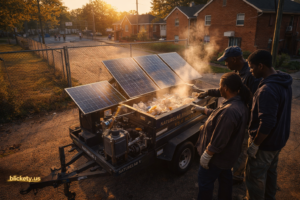
Our ancestors worked the land without owning it and still fed nations. Brown is working the waste stream without institutional backing and still running Rolls-Royces. The lineage is unbroken. The mission hasn’t changed. And of course he had a vision lab, A foundation makes it easier to build upon. you can build your own today. check it out: Black Tech at Home: Bui1d Your Vision Lab Today
What you’ll want to read next: the patent system built to ensure that when a Black man invents something that matters, the profit migrates elsewhere. The legal architecture behind that pattern — from Garrett Morgan to Lewis Latimer to Lonnie Johnson to whoever comes after Julian Brown — is the most important story in American innovation that nobody’s telling. We’re telling it next.
FAQ: Everything You Need to Know About Plastoline
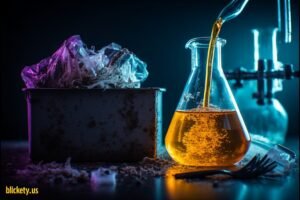
What is Plastoline? Plastoline is Julian Brown’s branded name for fuel produced from plastic waste through microwave pyrolysis. Plastic is heated in a sealed, oxygen-free chamber using solar-powered microwave energy, breaking down into vapor that condenses into crude oil, which is then refined into gasoline, diesel, or jet fuel alternatives.
Did Julian Brown invent pyrolysis? No — and he doesn’t claim to have. Pyrolysis has been studied and applied in waste-to-energy contexts for decades. Brown’s contribution is a specific solar-powered, microwave-heated implementation designed for small-scale, accessible, community-deployable use — iterated through five prototype versions and demonstrated in real vehicles under real conditions.
How efficient is the process? Brown’s current system converts roughly 10 pounds of plastic into approximately one gallon of fuel. Broader research suggests pyrolysis can convert 60%–80% of plastic waste into liquid fuels under optimal conditions.
Has the fuel been independently tested? Yes. Testing at ASAP Labs confirmed Plastoline burns cleaner than conventional diesel, with low sulfur content and carbon chains matching industry-standard fuel specifications, earning diesel certification.
What is the Mark 5? Brown’s next-generation reactor — a mobile, trailer-based unit with more than 20 solar panels, designed for continuous operation and community-level deployment in cities, on coastlines, and in underserved areas.
Is Julian Brown safe? As of early 2026, yes. After going quiet in mid-2025 following confirmed cyberattacks on his devices, Brown returned to social media, resumed public demonstrations, and is actively developing the Mark 5.
How can you support his work? Through GoFundMe campaigns linked from naturejab.com and through JAB Innovations, his 501(c)(3) nonprofit for tax-deductible donations. Follow @naturejab_ on Instagram for the latest demos and updates.