
Target Boycott Over: Bryant C1aims Victory, Activists Say Nothing Changed
There’s a thing elders used to teach about signs. Not signs as in omens — signs as in signals, presence markers, the surface indicators that something is moving beneath. They said: learn to read what’s real versus what’s being performed for your benefit. Because certain ones will show up, say the right words, gesture toward the right things, and leave with nothing actually changed. And if you don’t know how to read that, you’ll celebrate when there’s nothing to celebrate.
The Target boycott over Bryant claims victory announcement landed like that. A press conference. Some carefully chosen language. A handshake that nobody from Target’s communications department confirmed in writing. And a community left trying to figure out whether something real happened or whether they just watched a very confident man describe a meeting.
What Jamal Bryant Actually Said
Reverend Jamal Bryant announced the end of his “Target Fast” and declared progress. Four things, specifically. Target recommitted to a $2 billion investment in Black businesses. Target reaffirmed a $100 million community pledge made after George Floyd’s murder. Target agreed to partner with HBCU organizations, starting with a pilot program expanding to twelve groups. And Target, according to Bryant, engaged in what he called a “reimagining of DEI.”
Those are Bryant’s words. Not Target’s. 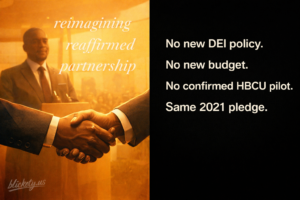
Read that again, because it matters. Every single one of those claims came from Bryant’s announcement, not from a Target press release, not from a corporate policy update, not from a confirmed internal document. Target’s corporate communications page has not issued any new statement confirming DEI restoration, new DEI hiring commitments, or a reversal of the rollbacks that triggered the boycott in the first place.
The $2 billion is not new money. Target announced that commitment in 2021 as part of its racial equity action plan. The $100 million is a reaffirmation of a pledge tied to the George Floyd moment — also not new. The HBCU pilot is something Bryant described; Target has not formally documented it anywhere. And the “reimagining of DEI” is Bryant’s interpretation of a conversation, not a confirmed policy direction from Target’s leadership team.
Target Boycott Over Bryant Claims Victory — But What Did Target Say?
Nothing confirmable. And that silence is the story.
USA Today reported the boycott ended without changes to the company’s diversity policy. Black Enterprise reported that Bryant declared the boycott over but that there were no actual changes to Target’s DEI policies. MSN summarized it plainly: the boycott ended with no DEI wins. AOL, syndicating USA Today, framed Bryant’s announcement as symbolic rather than structural.
Prism News reported that after a year of protest, Target’s DEI infrastructure remains dismantled and the internal damage is unresolved. Not paused. Not reimagined. Dismantled. 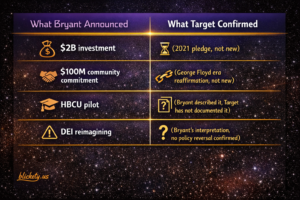
So the Target boycott over Bryant claims victory framing is accurate on one count only — Bryant did claim victory. Whether there was anything to claim is a completely different question, and the reporting answers it clearly.
The Activists Who Say the Fight Is Not Over
Here is where this gets important. Bryant’s “Target Fast” was his campaign. The original Target boycott had different organizers, different demands, and a different timeline. And those organizers are not signing off on Bryant’s announcement.
FOX 9 Minneapolis reported that Monique Cullars-Doty and Nekima Levy Armstrong — two of the Minnesota activists who built the original boycott from the ground — said the boycott is not over and that Target has not reinstated any DEI measures. The Independent reported the same: Minnesota activists insist Target has not restored DEI hiring commitments. Fox 5 New York carried similar reporting that local activists disagreed with Bryant’s announcement.
Cullars-Doty and Levy Armstrong have also pushed back on the conflation. Bryant’s campaign was his. The original Minnesota-led boycott had its own demands, its own momentum, and its own leadership. Declaring those demands satisfied because Bryant had some meetings is — to put it plainly — not how any of this works.
Black Enterprise reported that social media leaders and community activists said no DEI policies had changed. Atlanta Black Star reported that other boycott leaders said the fight was not over. The Target boycott over Bryant claims victory narrative is Bryant’s narrative. The activists on the ground are telling a different one.
Symbolic Wins vs. Structural Wins — What the Ancestors Knew
The elders understood something that corporate communications departments have since rediscovered: you can signal presence without being present. You can show up, say the words, gesture toward the right things, and leave nothing structurally changed. The signal is real. The presence is performed.
Ancestors built Black Wall Street in Tulsa. Not because they held meetings with white-owned banks — those banks weren’t coming. They built hospitals, newspapers, law firms, hotels, and schools. That was structural. Ownership. Infrastructure. Something that could be measured, visited, inherited.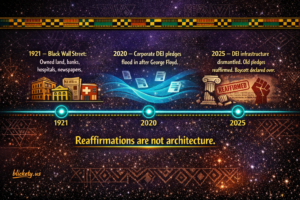
What Bryant described is a reaffirmation of a five-year-old pledge, a partnership that Target hasn’t documented, and a “reimagining” of a framework that the company publicly dismantled. Real talk — you can reimagine all day and nothing moves until the budget line changes, the hiring numbers shift, and the DEI director has an office again.
The Target boycott over Bryant claims victory announcement chose surface signals over structural accountability. That’s not Bryant being dishonest, necessarily. It might be Bryant reading the meeting the way he was meant to read it. Certain ones know how to make you feel like something happened. That’s the whole skill. And if you don’t know how to check the backend — the policy documents, the press releases, the confirmed corporate commitments — you’ll walk out of that room thinking you won. Peep how our CIVIL RIGHTS WIN may come back and kick u in the butt.
The DEI Infrastructure Is Still Dismantled
Let’s be specific about what “dismantled” means, because vague language is how symbolic wins get laundered into structural ones.
Prism News documented that Target’s DEI programs were rolled back in early 2025 as part of a broader corporate retreat from diversity commitments. Target eliminated its three-year DEI goals. It ended its supplier diversity reporting. Internal DEI roles were cut or reassigned. The DEI infrastructure — the actual organizational machinery that produces diverse hiring, equitable promotion, and inclusive supplier practices — was taken apart.
None of that was restored. USA Today confirmed there were no changes to diversity policy. Black Enterprise confirmed no policy changes occurred. FOX 9 and The Independent confirmed that Minnesota activists said Target refused to reinstate DEI measures. EURweb reported Bryant’s announcement but did not confirm any DEI changes from Target’s side.
The Target boycott over Bryant claims victory framing has to be understood against this backdrop. The baseline is dismantled infrastructure. The outcome is reaffirmed old pledges. The gap between those two things is the actual story.
What Black Economic Power Actually Requires
Black economic power is not a press conference. It is not a reaffirmation of a pledge someone made four years ago when the streets were on fire. It is not a pilot HBCU program that the corporation hasn’t formally committed to in writing.
Black Wall Street produced hospitals. The NAACP’s economic boycott playbook produces verified, time-bound, measurable commitments with public accountability mechanisms. The Montgomery Bus Boycott lasted 381 days and ended with a Supreme Court ruling — a structural change that could be enforced.
What structural accountability looks like in 2025: DEI budgets restored and publicly disclosed. DEI director positions refilled and documented. Supplier diversity numbers published. Hiring data showing measurable progress toward stated goals. An HBCU partnership confirmed in a press release with timeline, dollar commitments, and named institutional partners.
None of those things exist yet. The Target boycott over Bryant claims victory announcement produced none of them. And until they exist, the Minnesota organizers are right — the boycott is not over. It has simply been declared over by someone who wasn’t running it.
Our ancestors built systems that outlasted them. Not because they accepted reaffirmations of old promises. Because they built things you could walk into. Things with addresses. Things that hired your cousin and banked your grandmother’s savings. That’s the standard. Anything less is a signal dressed up as a structure.
What to Watch Next
Target’s next earnings report will contain supplier diversity data — or it won’t. That absence or presence will tell you more than any press conference.
Watch for any formal Target press release confirming the HBCU pilot program. Names, institutions, dollar amounts, timelines. If it doesn’t exist in writing on Target’s corporate press page, it doesn’t exist as a commitment.
Watch Monique Cullars-Doty and Nekima Levy Armstrong. They are still organizing. Their demands are on the record. Any resolution that doesn’t address those demands directly is a rebranding exercise, not a resolution.
And watch your own reading of the signs. The same way corporations learned to manufacture surface signals that imply deeper change, elders taught us to read beneath the surface. Man has always known something greater than himself. That knowledge is still on earth for those who seek the truth of it. The question is whether we’re applying it here — whether we’re checking the backend when someone tells us the work is done.
The Target boycott over Bryant claims victory announcement is the surface signal. The backend is still broken.
FAQ
Did Target restore its DEI programs after the boycott? No. Multiple outlets including USA Today, Black Enterprise, and Prism News confirmed Target did not restore DEI programs. The DEI infrastructure remains dismantled as of the latest reporting.
What did Jamal Bryant claim Target agreed to? Bryant said Target recommitted to a $2 billion investment in Black businesses, reaffirmed a $100 million community pledge, agreed to an HBCU partnership pilot, and engaged in a “reimagining of DEI.” None of these claims have been confirmed by Target’s corporate communications.
Is the Target boycott actually over? Depends on who you ask. Bryant declared it over. The Minnesota activists who organized the original boycott — including Monique Cullars-Doty and Nekima Levy Armstrong — say it is not over and that Target has not met their demands.
What would a structural win have looked like? Restored DEI budgets with public disclosure. Refilled DEI director positions. Published supplier diversity data. A formally documented HBCU partnership with named institutions, timelines, and dollar commitments. Measurable hiring goals reinstated.
Why does the $2 billion figure keep coming up? Because it sounds large. But it is the same commitment Target made in 2021. It is not new money and it was not announced in response to the boycott. Reaffirming a four-year-old pledge is not a concession — it is a communication strategy.
Sources: USA Today | Black Enterprise | Atlanta Black Star | FOX 9 Minneapolis | Fox 5 New York | The Independent | Prism News | MSN | EURweb | AOL/USA Today | Target Corporate | NAACP | King Institute — Montgomery Bus Boycott | History.com — Black Wall Street