From Grace Jones to 2026: The Evolution of Afrofuturist Fashion Icons
There is a lineage in fashion that no textbook fully captures. It does not begin in Paris. It does not start on a European runway or in a white designer’s sketchbook. It begins with Black women who looked at a world that had already decided what they were supposed to look like — and chose themselves instead.
That is Afrofuturist fashion. Not a trend. Not an aesthetic borrowed for a mood board. It is a sovereign act. A declaration that the future belongs to the people history tried to erase. And no one has carried that declaration further, louder, or with more precision than the Black women who have been doing it since before the term “Afrofuturism” even existed.
From Grace Jones standing like architecture in Jean-Paul Goude’s lens to Doechii arriving at the 2025 Met Gala in a custom Louis Vuitton tailcoat built for a woman who belongs to no era but her own — Afrofuturist fashion icons are not decorating the future. They are constructing it.
This is the evolution. Chapter by chapter. Woman by woman.
What Makes a Fashion Icon an Afrofuturist Fashion Icon?
Before we trace the lineage, we need to define the difference. A fashion icon wears clothes well. An Afrofuturist fashion icon uses clothing as cosmology.
The term Afrofuturism was coined by cultural critic Mark Dery in 1993 to describe the intersection of African diaspora culture, science fiction, ancient African spirituality, and technology. But as scholar Ingrid LaFleur notes, Afrofuturism’s survival tactic is shape-shifting — and Black women have been deploying that tactic through fashion since long before it had a name.
An Afrofuturist fashion icon does several things simultaneously. She reclaims the Black body as sacred and self-authored rather than surveilled or commodified. She draws from African cosmology, future-forward technology, and ancestral memory in the same breath. She makes fashion armor, mythology, and political statement at once. And critically — she makes it impossible for the industry to pretend she is a trend. She is the origin point.
With that framework planted, let’s move through the generations.
Grace Jones: The Original Blueprint (1977–Present)
Every honest conversation about Afrofuturist fashion icons has to begin with Grace Jones. Not because she was first in the historical sense — Betty Davis was already weaving afro-mysticism and glam rock on her self-produced 1974 album, They Say I’m Different — but because Grace Jones made Afrofuturist fashion undeniable to the mainstream world that had been trying to look away.
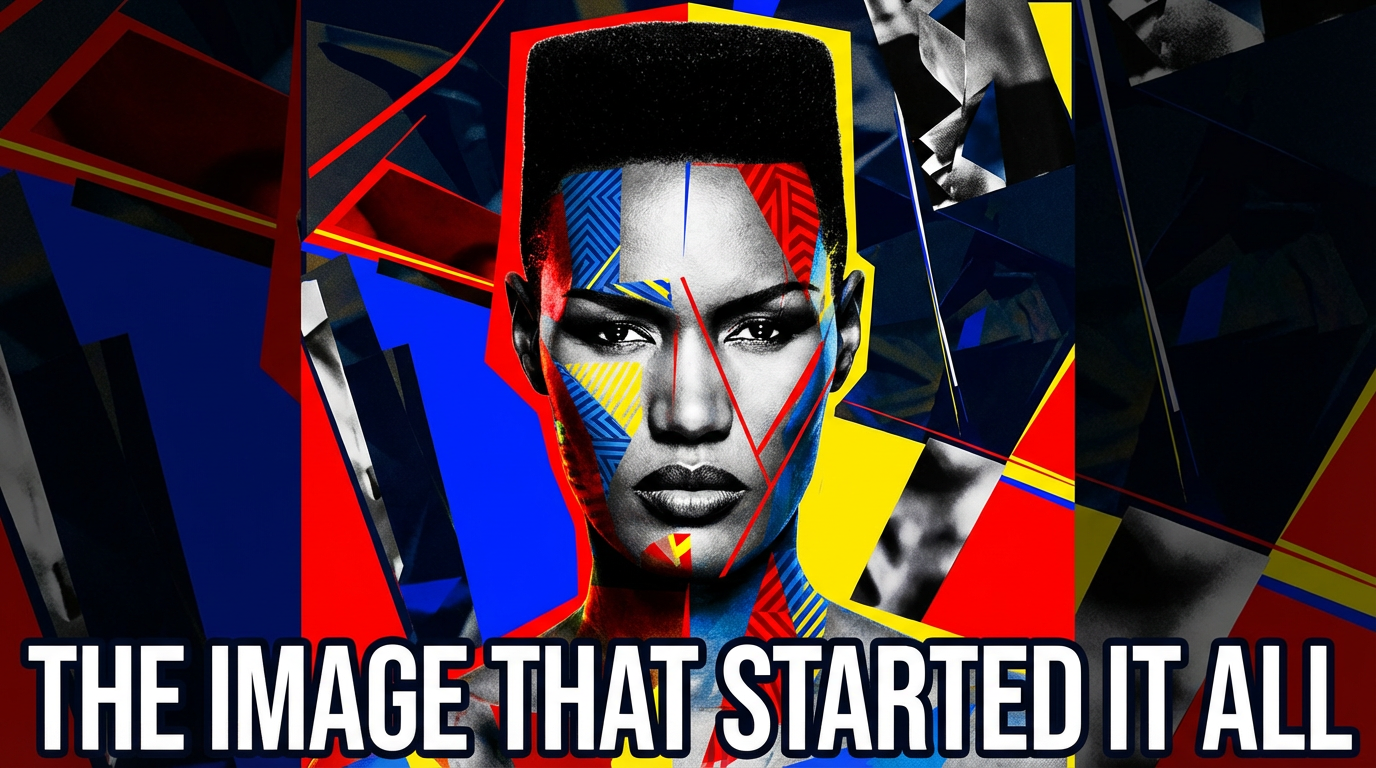
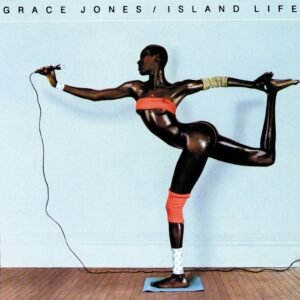
Born in Spanish Town, Jamaica in 1948, Jones arrived in New York in the late 1960s, shaved her head as an act of self-definition, and never looked back. By the late 1970s, working with French photographer and collaborator Jean-Paul Goude, she was constructing an image so geometrically precise, so deliberately non-human, that it forced an entire industry to reckon with its own limitations.
Her flat-top haircut became architecture. Her metallic body paint turned dark skin into something the fashion world had spent centuries refusing to call luminous. Her cubist silhouettes, theatrical shoulder pads, and avant-garde stage costuming were not borrowed from science fiction — they were science fiction, authored from the inside of a Black woman’s body and mind.
Jones herself put it plainly: “I wasn’t born this way. One creates oneself.” That sentence is the entire thesis of Afrofuturist fashion. Identity is not inherited from a system that diminishes you. It is built — deliberately, defiantly, beautifully.
Her collaboration with Issey Miyake, her appearances on covers of Elle and Vogue, her film roles in A View to a Kill and Vamp, her performances in towering headdresses and body paint — all of it added up to something the fashion world had never seen: a Black woman who refused to be legible on anyone else’s terms. At 76, she is still performing, still sharp, still the standard against which every Afrofuturist fashion icon who followed must be measured.
The blueprint she drew in the late 1970s did not expire. It multiplied.
The 1990s and 2000s: Afrofuturist Fashion Icons in the Age of R&B and Hip-Hop
The torch passed through music videos and album covers before it returned to the runway. In the 1990s and early 2000s, Afrofuturist fashion icons were building their cosmologies in the spaces where Black culture was loudest — pop music and hip-hop.
TLC’s No Scrubs video dressed the trio in android-like technological attachments layered over cyberpunk patent cargo trousers aboard a futuristic set. This was not wardrobe. It was worldbuilding. Three Black women in 1999, centering themselves in a future where they were the architects of their own reality, not the background characters.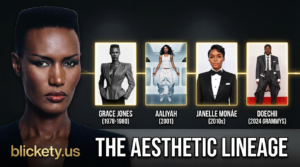
Aaliyah was doing it differently but with the same Afrofuturist DNA. Her video for We Need a Resolution found her levitating — a visual motif that recurs across Afrofuturist visual language because flight has always been a freedom metaphor in Black culture. Her sleek, minimal, futuristic aesthetic — all black leather, midriffs, and gravity-defying presence — made her one of the most referenced Afrofuturist fashion icons in fashion history to this day. Designers still reach for her image when they are trying to describe a certain kind of impossible cool.
Missy Elliott brought something even more radical: humor as Afrofuturist strategy. Her trash bag suit in The Rain (Supa Dupa Fly), her insect-like armor looks, her refusal to dress in ways that centered desirability over power — all of it was Afrofuturist fashion deployed as a rejection of the male gaze. She was not dressing for approval. She was dressing for dominion.
These women were Afrofuturist fashion icons without the label. The category found them later.
Janelle Monáe: The Android Who Built the Bridge (2007–Present)
If Grace Jones drew the blueprint, Janelle Monáe made it a complete architectural system. No living Afrofuturist fashion icon has been more precise, more intentional, or more philosophically coherent in her approach to fashion as identity.
Monáe arrived on the scene in 2007 with a visual language already fully formed: black and white tuxedos, tailored suiting, white gloves, pompadour hair. The choice was deliberate. She said early in her career that the black-and-white palette honored working-class people — the janitors, the service workers, the domestic laborers who wore uniforms as their daily armor. She was making Afrofuturist fashion out of dignity, not luxury.
Her alter ego, Cindi Mayweather — an android from the future — gave her a mythology to inhabit. The android is a recurring figure in Afrofuturist thought because it speaks directly to the Black experience of having your humanity denied, your body made to perform, your personhood treated as property. By declaring herself android, Monáe was not diminishing her humanity. She was expanding the definition of what humanity is allowed to look like.
Monáe has spoken about Afrofuturism in terms that make her relationship to it unmistakable: “Afrofuturism is so important to me because it lets me dream what we can be as Black folks. The future that we create for ourselves is paramount.”
At the 2025 Met Gala, Monáe delivered one of the night’s most conceptually stunning moments — a two-in-one Thom Browne trompe l’oeil suit with a bowler hat and a spinning clock monocle. It was costume design legend Paul Tazewell who co-created the look, and together they produced something that lived simultaneously in the past, present, and future. Which is exactly where every great Afrofuturist fashion icon lives.
Beyoncé: Myth-Making at Scale
Beyoncé operates at a scale that makes her Afrofuturist fashion iconography difficult to isolate — because it is woven into everything she does simultaneously.
The visual album Lemonade in 2016 was the most ambitious deployment of Afrofuturist fashion aesthetics by any single artist in modern history. Antebellum crinolines alongside armor. Honey-drenched visions of Black feminine power alongside West African spiritual iconography. Oshun’s yellow. Ancestral memory stitched into contemporary silhouette. Designer after designer contributed to a visual world that could not be separated from its political meaning.
Her Balmain and Schiaparelli looks throughout 2025 continued to demonstrate that Beyoncé’s fashion is never about the clothes alone. It is always mythological. She is always building toward something bigger than an outfit — a cosmology of Black womanhood that refuses limitation and refuses simplicity.
Beyoncé’s Afrofuturist fashion iconography is also economic. She is one of the most powerful forces in determining which Black designers, which emerging African aesthetics, and which cultural references get elevated to the global stage. Fashion around Beyoncé is not passive consumption. It is curation with consequence.
Rihanna: Sovereignty Without Explanation
Rihanna’s relationship to Afrofuturist fashion is different from all the others in this lineage, and that difference is instructive. Where Monáe theorizes, where Beyoncé mythologizes, Rihanna simply refuses to explain herself. And that refusal is its own form of Afrofuturist sovereignty.
Her yellow Guo Pei gown at the 2018 Met Gala was not accompanied by a manifesto. The papal look at the same event — arriving at the Catholic-themed Met Gala dressed as the pope — required no explanation. The meaning was legible to everyone who had the cultural literacy to receive it. A Black woman from Barbados, the most powerful person in the room, dressed as the head of the institution that blessed the slave trade.
In 2025, Rihanna revealed her third pregnancy at the Met Gala in a pinstripe skirt, blazer, and tie — pregnant, androgynous, unbothered — and the internet processed it as a fashion moment without fully reckoning with how radical it was. A pregnant Black woman arriving at fashion’s biggest night dressed in menswear tailoring is Afrofuturist fashion. The body, the gender disruption, the irreverence, the occasion — all of it together.
Fenty has also made Rihanna an Afrofuturist fashion icon in the economic and structural sense. Her beauty and fashion empire expanded the definition of what Black women’s bodies look like in advertising, in product development, and in the imagination of global style.
Doechii: The Swamp Princess and the New Vanguard (2025–Present)
Doechii arrived. That is the only way to describe it.
At the 67th Grammy Awards in February 2025, the Florida-born rapper accepted her Best Rap Album win for Alligator Bites Never Heal wearing a custom Thom Browne ensemble — bolero jacket, tailored shirt, tie, and dramatically sculptured trousers. The look and the speech landed simultaneously. She told the room: “I know that there is some Black girl out there watching me right now, and I want to tell you, you can do it.”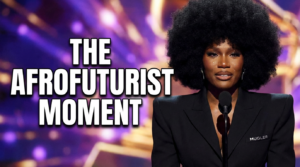
That is Afrofuturist fashion working correctly. The clothing and the message are indivisible.
At the 2025 Met Gala, Doechii debuted a custom Louis Vuitton tailcoat, poplin dress shirt, matching shorts, and an oversized bow tie, crowned by her signature voluminous afro. It was designed in collaboration with Pharrell Williams and anchored in Black dandyism — the tradition of Black men and women using immaculate dress as an act of dignity, defiance, and self-assertion stretching back centuries.
At Paris Fashion Week Fall/Winter 2025-2026, she moved from a gold Valentino gown at the Louvre to a barefoot, flowing Chloé look to a white draped dress with a denim corset at Schiaparelli. She was not chasing any of it. The looks were chasing her.
What makes Doechii an Afrofuturist fashion icon in the fullest sense is that she carries the tradition forward without being trapped by its forms. The preppiness is subverted. The tailoring is exaggerated. The shape-shifting is her native language.
Tyla: Africa as Origin, Not Influence
Tyla represents something specific and necessary in the evolution of Afrofuturist fashion icons: the South African woman who does not wear her continent as an accessory but as an origin point.
The 23-year-old Johannesburg-born artist brings Afrofuturist and Y2K-inspired African fashion to a global audience with a sensibility that is rooted in African aesthetics without performing them for Western approval. At the 2025 Met Gala — where she served on the committee itself, helping to shape the curatorial vision — she was not merely attending. She was architecting.
Her presence alongside committee members like Chimamanda Ngozi Adichie and Doechii signaled what Marie Claire Nigeria called a seismic shift: Black women no longer just as muses but as the architects of fashion’s future.
At the Billboard Women in Music 2025, Tyla wore Jean Paul Gaultier’s spring 2025 couture by Ludovic de Saint Sernin — a formfitting black string construction with a dramatic train. She moves between sensual, structural, and experimental with the confidence of a woman who knows that African women invented the aesthetics that global fashion has spent decades appropriating.
Tyla is also an Afrofuturist fashion icon by proximity and by influence. British-Nigerian designer Tolu Coker — whose Spring/Summer 2026 collection was presented as a short film featuring Naomi Campbell, and whose label has been worn by everyone from Doechii to Rihanna — counts Tyla among her core clientele. The lineage is not just vertical through time. It is lateral, a web of Black women elevating Black women.
What the 2025 Met Gala Told Us About Where Afrofuturist Fashion Is Headed
The 2025 Met Gala — themed “Superfine: Tailoring Black Style” — was the most significant institutional moment in recent memory for the evolution of Afrofuturist fashion icons. For the first time in the event’s 77-year history, Black fashion was not a subcategory or an homage. It was the thesis. 
And Black women ran it. Tyla, Doechii, and Chimamanda Ngozi Adichie sat on the curatorial committee. Costume designer Ruth E. Carter — who brought Wakanda’s visual world to life — dressed Teyana Taylor and Jasmine Tookes. Paul Tazewell dressed Janelle Monáe. Jodie Turner-Smith wore custom Burberry to pay homage to Black horsewoman Selina Lazevski. Ayo Edibiri wore Ferragamo inspired by her father and traditional Edo fashion.
Every one of these choices was narrative, not decorative. The tradition of Afrofuturist fashion icons using clothing as cosmology — which Grace Jones built in the late 1970s — showed up at the 2025 Met Gala as the dominant grammar of the entire evening.
That is not a trend. That is a tradition claiming its rightful place at the table it built.
The Through-Line: Fashion as Sovereignty
What connects Grace Jones in 1979 to Doechii in 2025 to Tyla in 2026 is not a shared aesthetic. It is a shared understanding: that for Black women, fashion is never just fashion.
Every Afrofuturist fashion icon in this lineage has used her wardrobe as a declaration of sovereignty. The right to define one’s own body. The right to draw from African cosmology, from sci-fi mythology, from ancestral memory and future technology, without asking permission. The right to be illegible to a system that has historically profited from Black women’s visibility while denying their humanity.
The term Afrofuturism was coined in 1993, but the practice is older than that word. It is as old as the first Black woman who looked at what the world told her she was supposed to look like and said: no. I create myself.
Grace Jones said it in a flat-top and metallic body paint. Missy Elliott said it in a trash bag. Janelle Monáe said it in a black-and-white tuxedo. Rihanna said it dressed as the pope. Doechii said it in a Thom Browne suit in front of the entire music industry.
And the Black women coming after them will say it in ways we have not yet imagined. That is the whole point.
The future is not coming. For Afrofuturist fashion icons, it is always already here. Check out these Fops from the Congo, Le Sape.
FAQ: Afrofuturist Fashion Icons
What is Afrofuturist fashion? Afrofuturist fashion uses clothing to draw from African diaspora culture, ancestral spirituality, science fiction, and future-forward technology simultaneously. It treats fashion as mythology, armor, and political sovereignty rather than decoration.
Who was the first Afrofuturist fashion icon? The lineage includes Betty Davis and Sun Ra in the early-to-mid 20th century, but Grace Jones is widely credited as the figure who made Afrofuturist fashion undeniable to global mainstream culture, particularly through her work with Jean-Paul Goude beginning in the late 1970s.
How is Afrofuturist fashion different from African fashion? African fashion draws from specific cultural traditions and textiles of the African continent. Afrofuturist fashion is broader — it incorporates those traditions alongside science fiction, technology, and the political experience of the African diaspora, particularly in the context of slavery and its aftermath.
Who are the leading Afrofuturist fashion icons in 2025 and 2026? Janelle Monáe, Doechii, Tyla, and Beyoncé are among the most prominent Afrofuturist fashion icons working right now. Each brings a distinct approach to the tradition while remaining rooted in its core principle: fashion as self-authored identity.
Why does Afrofuturism matter in fashion? Because fashion reflects who a culture believes belongs in its future. When Afrofuturist fashion icons center Black women — their bodies, their aesthetics, their spiritual and ancestral references — they are making a political argument about who deserves to be imagined as the future’s protagonist.
Published on The Afrofuturist | Fashion | Culture | Sovereignty