
When the Numbers Shift: Black Futures in a New Minority-Majority America
Look—every generation gets a moment where the ground moves beneath their feet. Some folks feel it early, like a tremor under the porch boards. Others don’t notice until the pictures on the wall start rattling. But the shift always comes. And in 1994, standing in front of a Black audience that still believed “minority” meant them, Dr. Claud Anderson tried to warn us:
“If you didn’t get anything when you were the top minority demographic, why do you think you’ll get anything after you’ve been leapfrogged by Hispanics and Asians?”
People laughed. Some nodded. Some brushed it off like old-head pessimism. But the man wasn’t guessing. He was reading the census like scripture.
And now here we are—decades later—living inside the demographic future he tried to prepare us for.
A country where:
• no single group holds the majority 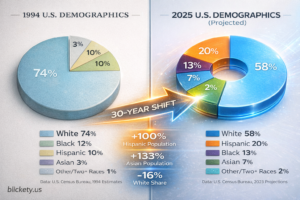
• immigration drives population growth
• Hispanics and Asians expand faster than any other group
• Black Americans remain numerically stable but politically vulnerable
A country where the old civil rights architecture—built for a Black/white binary—now sits inside a multiracial, multi-interest, multi-power landscape.
A country where the question isn’t:
“What will white people do?”
“What happens when we’re no longer the largest minority group in the room?”
And that’s the part nobody wants to talk about.
Not the activists.
Not the politicians.
Not the DEI consultants.
Not the folks who still think “POC solidarity” is a real political strategy instead of a marketing slogan.
But you can’t build a future you refuse to name.
So let’s name it.
Let’s talk about what happens when the demographic deck reshuffles and Black folks—who built the moral, legal, and cultural foundation of civil rights—find themselves in a new kind of America:
• one where numbers don’t favor us
• one where alliances aren’t guaranteed
• one where “minority” doesn’t mean “Black”
• one where civil rights laws can be reinterpreted, narrowed, or repurposed
• one where political leverage must be engineered, not inherited
This isn’t fear.
This isn’t doom.
This is clarity.
Because Afro-Futurism isn’t escapism—it’s strategy.
It’s the ability to look at the map, see the terrain shifting, and still build a road forward.
And to do that, we have to start with the truth:
Demographics don’t determine destiny, but they do determine leverage.
And leverage is the currency of the future.
Historical Context + Dr. Anderson’s Warning
The Moment the Warning Was Spoken
Picture the room in 1994.
Black folks sitting shoulder to shoulder in folding chairs, some with arms crossed, some leaning forward, some nodding before the man even finished his sentence because they already knew where he was going. The air thick with that mix of hope and exhaustion that only comes from decades of marching, voting, surviving, and still waiting for the promise to hit the bank account.
Dr. Claud Anderson stepped up to the mic and didn’t bother with warm-up lines. He didn’t soften the blow. He didn’t wrap the truth in sugar.
He just said it:
“If you didn’t get anything when you were the top minority demographic, why do you think you’ll get anything after you’ve been leapfrogged by Hispanics and Asians?”
It wasn’t a prediction.
It was a diagnosis.
A reading of the demographic vitals.
A warning about the political math.
A reminder that America doesn’t distribute resources based on morality — it distributes them based on leverage.
And in 1994, Black Americans still held a unique position:
• the largest nonwhite population
• the moral center of civil rights
• the primary beneficiaries of anti-discrimination law
• the cultural engine of the nation
• the group whose suffering shaped federal policy
But Anderson saw the shift coming before most people did.
He saw the immigration trends.
He saw the birth rate differentials.
He saw the political coalitions forming.
He saw the way “minority” was being redefined in real time.
And he understood something most people still struggle to accept:
Civil rights was never designed for a multiracial competition economy.
It was built for a Black/white binary — a system where the oppressed and the oppressor were clearly defined, and the remedy was designed to correct a specific historical injury.
But once the demographic landscape changed, the architecture of civil rights would be forced to stretch, bend, and reinterpret itself to accommodate new groups with different histories, different needs, and different political agendas.
And that’s where the tension begins.
The Civil Rights Framework Was Built for Us — But Not Built to Protect Us Forever
Let’s be honest about something most people only whisper: Civil rights laws were built on Black pain, Black struggle, and Black sacrifice — but they were written in race-neutral language.
That means:
• anyone can claim them
• anyone can benefit from them
• anyone can use them to advance their group’s interests
And in a multiracial America, that’s exactly what happens.
Hispanic groups use civil rights law to fight discrimination in housing and employment.
Asian groups use civil rights law to challenge university admissions policies.
Immigrant groups use civil rights law to secure language access and workplace protections.
Meanwhile, Black Americans — the original plaintiffs of the American racial justice project — find themselves increasingly:
• competing for remedies
• competing for representation
• competing for political attention
• competing for resources
• competing for the very protections built on their ancestors’ suffering
This is not hostility.
This is not anti-immigrant rhetoric.
This is structural reality.
When the pie doesn’t grow but the number of people at the table does, the slices get thinner.
And Anderson’s point was simple:
If you didn’t secure your slice when you were the only one at the table, what happens when the table gets crowded?
The Demographic Shift That Reshaped the Playing Field
Fast-forward to today.
The Census Bureau confirms what Anderson warned:
• Hispanic Americans are now the largest minority group
• Asian Americans are the fastest-growing group
• Immigration drives population growth
• Black population growth is stable but not accelerating
This matters because in America, numbers influence power:
• voting districts
• political representation
• funding formulas
• school allocations
• business incentives
• media targeting
• philanthropic priorities
• corporate diversity strategies
When the demographic center of gravity shifts, so does the political attention.
And here’s the part that stings:
Black Americans are no longer the default minority group in the national imagination.
We are now one of several.
And in some regions, not even the second-largest.
This doesn’t erase our history.
It doesn’t diminish our contributions.
It doesn’t invalidate our struggle.
But it does change the political math.
And political math is unforgiving.
The Leapfrog Effect — What Anderson Saw Coming
When Dr Anderson said “leapfrogged,” he wasn’t talking about culture.
He wasn’t talking about morality.
He wasn’t talking about worth.
He was talking about:
• population size
• economic networks
• immigration inflow
• business ownership rates
• in-group hiring patterns
• political coalition building
Hispanic and Asian communities, through immigration and tight-knit economic ecosystems, were positioned to grow faster and consolidate power more efficiently.
And that’s exactly what happened.
Today:
• Hispanic-owned businesses are the fastest-growing segment in the country
• Asian Americans have the highest median household income
• Both groups have strong in-group hiring and contracting networks
• Both groups have rising political representation
• Both groups have growing influence in local courts, schools, and agencies
Meanwhile, Black Americans — despite unmatched cultural influence — remain structurally under-resourced.
And Anderson’s question echoes louder than ever:
If you didn’t secure structural power when you were the largest minority, what happens now?
Present-Day Realities + Afro-Futurist Analysis
The New Landscape — Where Demographics Become Power
Here’s the thing nobody wants to say out loud:
America didn’t suddenly become a land of equal opportunity just because the census pie chart got more colorful.
Diversity doesn’t guarantee equity.
Multiracial doesn’t guarantee justice.
A “majority‑minority” nation doesn’t guarantee Black empowerment.
If anything, the opposite can happen.
Because when the demographic center shifts, the political incentives shift with it.
And politicians — regardless of party — follow numbers, not narratives.
Right now, the numbers say:
• Hispanic Americans are the largest minority group
• Asian Americans are the fastest-growing group
• Immigration is reshaping local and state power
• Black Americans remain foundational but numerically stable
This means the political marketplace is recalibrating.
Campaigns, policies, and funding streams are being redesigned to court the groups with the fastest growth and the strongest economic networks.
And Black Americans — who once held the unique position of being the primary nonwhite constituency — now find themselves in a competitive political ecosystem where:
• attention is split
• resources are divided
• remedies are diluted
• representation is negotiated
• and “minority” is no longer synonymous with “Black”
This is the world Dr. Anderson warned about.
Not a world where Black people disappear — but a world where Black leverage must be engineered, not assumed.
The Rise of Hispanic and Asian Power Blocs
Let’s break this down without emotion, just structure.
Hispanic Communities 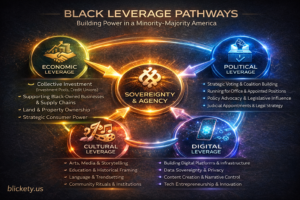
• Strong immigration inflow
• High birth rates
• Rapid business formation
• Dense economic networks
• In-group hiring and contracting
• Growing political representation
• Increasing influence in local courts, schools, and agencies
This creates what some scholars call “Hispanic privilege” — not in the sense of whiteness, but in the sense of group cohesion + demographic momentum + economic interdependence.
Asian Communities
• Fastest-growing racial group
• Highest median household income
• Strong educational pipelines
• High rates of business ownership
• Tight-knit ethnic enclaves
• Rising political influence
• Strategic use of civil rights law (e.g., education cases)
This creates a different kind of leverage — one rooted in economic power + institutional access.
Black Communities
• Culturally dominant
• Politically loyal
• Historically foundational
• Morally central
• But structurally under-resourced
• And numerically stable, not expanding
This creates a paradox:
Black Americans are culturally indispensable but politically vulnerable.
And that vulnerability grows in a system where numbers influence:
• district maps
• funding formulas
• school allocations
• business incentives
• media targeting
• philanthropic priorities
• corporate diversity strategies
In other words:
When the demographic winds shift, the political sails shift too.
What “Leapfrogging” Really Means
People hear “leapfrogged” and think it’s an insult.
It’s not.
It’s a structural description.
It means:
• another group grows faster
• another group consolidates power quicker
• another group builds economic ecosystems
• another group forms political coalitions
• another group becomes the new target demographic
It doesn’t mean they’re better.
It doesn’t mean they’re more deserving.
It doesn’t mean they’re more moral.
It means they have momentum.
And momentum is a form of power.
Dr. Anderson’s point was simple:
If you didn’t secure structural power when you had demographic momentum, you cannot expect to gain it after momentum shifts to other groups.
This is not pessimism.
This is political physics.
Civil Rights in a Multiracial America — The New Competition
Here’s the uncomfortable truth:
Civil rights law is race-neutral, but racial inequality is not.
That means:
• multiple groups can file claims
• multiple groups can demand remedies
• multiple groups can use the same legal tools
• multiple groups can compete for the same protections
And in a multiracial America, that’s exactly what happens. 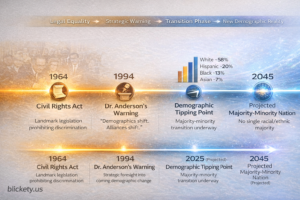
Civil rights becomes:
• a shared resource
• a contested space
• a political battleground
• a legal marketplace
And Black Americans — the group whose suffering built the civil rights framework — now find themselves:
• competing for attention
• competing for remedies
• competing for representation
• competing for enforcement
• competing for political priority
This is not hostility.
This is structural reality.
And it raises a question Anderson asked implicitly:
If civil rights becomes a multiracial competition, who protects the group that built the system?
Afro-Futurism as a Strategic Lens — Not an Aesthetic Escape
This is where Afro-Futurism steps in.
Not as art.
Not as fashion.
Not as neon lights and metallic face paint.
But as strategy.
Afro-Futurism says:
• We don’t wait for the system to recognize us
• We build systems that recognize us
• We don’t rely on demographic leverage
• We create technological leverage
• We don’t depend on inherited power
• We engineer new forms of power
Afro-Futurism is not about imagining a distant galaxy.
It’s about designing a future where Black people are not structurally sidelined by demographic shifts.
It’s about:
• digital sovereignty
• economic ecosystems
• cultural ownership
• technological literacy
• institutional independence
• community infrastructure
• narrative control
It’s about refusing to be a demographic footnote in a future we helped build.
The Afro-Futurist Blueprint for Black Power in a New America
The Future Isn’t Something We Enter — It’s Something We Build
Here’s the truth that sits beneath every census projection, every demographic chart, every political forecast:
Black futures are not determined by numbers — they’re determined by strategy.
We’ve never been the largest group.
We’ve never had the most wealth.
We’ve never controlled the borders, the banks, or the ballot boxes.
And yet—
We shaped the culture.
We shaped the law.
We shaped the moral compass of the nation.
We shaped the global imagination.
So the question isn’t:
“What happens to Black people when the demographics shift?”
The real question is:
“What systems will Black people build to ensure we remain powerful in a world where numbers alone don’t protect us?”
That’s the Afro-Futurist question.
And it demands an Afro-Futurist answer.
Blueprint Principle #1 — Build Economic Ecosystems, Not Just Businesses
If demographic momentum is no longer on our side, then economic momentum must be engineered.
That means:
• Black-owned supply chains
• Black-led tech platforms
• Black-controlled digital marketplaces
• Black venture networks
• Black cooperative models
• Black intellectual property ownership
• Black data sovereignty
Not just “support Black business,” but:
“Build Black infrastructure.”
Because in a multiracial America, the groups with the strongest economic ecosystems — not the largest populations — shape the future.
Hispanic communities have construction, food service, logistics, and contracting networks.
Asian communities have tech pipelines, educational networks, and capital pools.
Black communities must build:
• fintech ecosystems
• AI collectives
• blockchain cooperatives
• digital media syndicates
• cultural IP vaults
• community-owned platforms
This is not fantasy.
This is survival strategy.
Blueprint Principle #2 — Control the Narrative, Control the Future
In a world where demographics shift, stories become power.
Because the group that controls the narrative controls:
• political sympathy
• philanthropic funding
• media representation
• educational framing
• cultural legitimacy
• legal interpretation
Black Americans cannot afford to let our story be flattened into generic “POC” language or diluted into multicultural fog.
We must:
• tell our own history
• define our own identity
• articulate our own grievances
• document our own victories
• publish our own research
• build our own media channels
• archive our own cultural memory
Afro-Futurism isn’t just about imagining tomorrow — it’s about owning the narrative architecture that tomorrow will be built on.
Blueprint Principle #3 — Build Political Leverage That Doesn’t Depend on Population Size
This is the part Dr. Anderson wanted us to understand:
Political power is not guaranteed by numbers — it’s guaranteed by organization.
Jewish Americans are 2% of the population.
Cuban Americans are 0.7%.
Armenian Americans are 0.2%.
And yet each group has:
• concentrated voting blocs
• strong economic networks
• disciplined political agendas
• targeted lobbying organizations
• intergenerational strategy
Black Americans must shift from:
“We vote the most”
to
“We negotiate the hardest.”
That means:
• local political compacts
• district-level leverage
• issue-specific bargaining
• candidate accountability contracts
• Black legal defense infrastructure
• policy think tanks
• civic tech tools
• data-driven organizing
We don’t need to be the largest group.
We need to be the most strategically aligned group.
Blueprint Principle #4 — Build Digital Sovereignty Before the Next Shift Hits
The next civil rights battlefield won’t be lunch counters or bus seats — it will be:
• algorithms
• data rights
• AI bias
• digital redlining 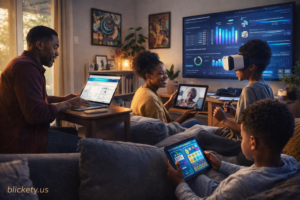
• platform access
• content monetization
• biometric surveillance
• digital identity
If Black people don’t build sovereignty in these spaces, we will be marginalized in ways the 1960s never imagined.
Afro-Futurism demands:
• Black-owned AI labs
• Black-coded datasets
• Black digital cooperatives
• Black cybersecurity networks
• Black blockchain identity systems
• Black metaverse land ownership
• Black digital archives
• Black algorithmic oversight councils
Because the future won’t ask for permission — it will simply arrive.
And we must be ready.
Blueprint Principle #5 — Build Cultural Continuity That Outlives Demographic Shifts
Demographics change.
Borders change.
Economies change.
Political coalitions change.
But culture — when protected — endures.
Black culture is one of the most powerful forces on Earth.
But power without protection becomes exploitation.
We must:
• own our music
• own our images
• own our stories
• own our aesthetics
• own our digital footprints
• own our cultural IP
• own our distribution channels
Because culture is currency.
And currency is leverage.
And leverage is survival.
The Afro-Futurist Conclusion — We Are Not at the End. We Are at the Threshold.
Dr. Anderson didn’t give that 1994 warning to scare us.
He gave it to prepare us.
He wanted us to understand:
• demographics shift
• alliances shift
• political incentives shift
• civil rights interpretations shift
But Black destiny does not shift unless we shift it.
We are not passengers in this demographic transition.
We are architects.
We are not waiting for the future to arrive.
We are building it.
We are not defined by numbers.
We are defined by strategy, creativity, memory, and vision.
And Afro-Futurism — real Afro-Futurism — is the blueprint.
Not neon lights.
Not metallic face paint.
Not sci-fi cosplay.
But infrastructure.
Agency.
Sovereignty.
Continuity.
Power.
The future is not something that happens to Black people.
The future is something Black people build — brick by digital brick, system by system, generation by generation.
And when the smoke clears and the census resets, one truth will remain:
Black futures are unstoppable when Black people build them intentionally.