
Why Black People Love Cognac: Culture, Memory & the Perfect Pour
https://the-afrofuturist.com/wp-content/uploads/2026/03/why-black-people-love-cognac-culture-memory-and-the-perfect-pour.pdf

There’s a bottle somewhere in your family’s house right now. Maybe it’s in the back of a cabinet above the refrigerator. Maybe it’s tucked behind the good dishes that only come out twice a year. Maybe it’s on the bar cart in the living room, the one with the doily underneath it that nobody’s allowed to touch.
It’s cognac. And why Black people love cognac isn’t just a question — it’s a whole entire story.
Smooth. Warm. Complex. A little expensive, never pretentious. It shows up at the cookout and the repast. It’s on the table at the graduation dinner and the New Year’s Eve toast. It’s what the uncle pours when something good happens and what the auntie reaches for when something doesn’t. Cognac isn’t just a drink in Black culture. It’s a mood. It’s a memory. It’s a whole emotional language poured into a glass.
And the story of how it got there? Deadass one of the most fascinating cultural origin stories nobody’s properly told.
What Cognac Actually Is — And Why It Matters
Before we go deep, let’s get grounded.
Cognac is brandy — but not just any brandy. It has to come from a specific region in southwest France, a small town literally called Cognac, and it has to follow strict rules: specific grape varieties, double distillation in copper pot stills, aging in French oak barrels for a minimum of two years. Those rules — the appellation — are what give cognac its consistency, its prestige, and that unmistakable profile: warm fruit, oak, a little floral sweetness, a finish that lingers.
VS, VSOP, XO — those aren’t just labels. They’re aging designations. VS means a minimum of two years in oak. VSOP means at least four. XO means a minimum of ten. The older the blend, the deeper, the more complex, the more expensive.
Understanding that isn’t just trivia. It’s the difference between grabbing whatever’s on sale and actually curating what’s in your glass. And Black folks who’ve been paying attention have been leveling up their palates for decades — which is exactly where this story goes.
How Cognac First Found Us — The Real Origin Story
Here’s where the why Black people love cognac conversation gets layered.
The popular narrative says it started with hip-hop in the ’90s. That’s not wrong. But it’s nowhere near the whole story.
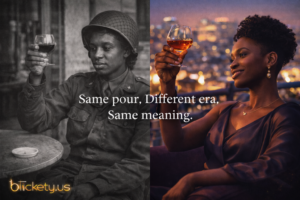
The wartime origin is the one you’ve heard: Black soldiers stationed in southwest France during World War I and World War II, finally exhaling in a country that didn’t treat them as less than human, discovering cognac poured without condition. The cafes served them. The people spoke to them with dignity. They brought the bottle home and passed it down.
That story resonates — and it resonates for a reason. It carries real meaning: the idea that cognac is tied to dignity, to a place where Black men were seen as human, to the first taste of something beautiful in a country that wasn’t their own. Journalists have repeated it in Slate, on Medium, in newspapers of record. The cultural logic is sound.
But some historians push back on whether the military deployment is actually the origin. They point out that African Americans had been encountering, serving, studying, drinking, and selling cognac for at least 100 years before the Second World War. Formerly enslaved Manhattan tavern owner Cato Alexander is one documented example — bringing to life a much longer African American relationship with the spirit than the wartime narrative allows.
The honest answer is probably both things at once: a long, continuous presence in Black life that the wartime experience amplified and crystallized into something cultural. The soldiers didn’t discover cognac for the first time. They discovered what it felt like to drink it as a free person in a country that treated them like one. That meaning is what came home. That meaning is what got passed down.
It was also easier on the palate than whiskey — a spirit with deep branding, manufacturing, and cultural ties to the confederate South. Cognac came from somewhere else. And that mattered.
This wasn’t a drink that was handed to us. We had already found it. We claimed it. And whatever the precise moment it entered our lives — the meaning we attached to it was ours from the start.
 Hennessy Made the First Move — And It Wasn’t an Accident
Look — brands market to everybody. That’s just business. But Hennessy’s relationship with Black America isn’t a campaign. It’s a history.
As far back as 1896, William Jay Schieffelin — Hennessy’s American distributor at the time — befriended Booker T. Washington and joined the Tuskegee Institute’s Board of Directors, then brought influential Americans including Thomas Edison, Mark Twain, and Andrew Carnegie to visit and encouraged them to support the institution. Cocktails Distilled
By the 1950s, cognac had become the drink of choice for African Americans — and Hennessy ran the first spirit ad to appear in Ebony in 1951 and the first spirit ad to appear in Jet in 1953. WBUR While every whiskey company was using racist caricatures in their advertising, Hennessy was putting Black faces in Black publications and saying: you are a market worth respecting. 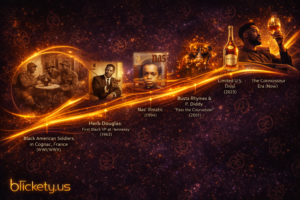
In 1963, Hennessy brought on 1942 Olympic bronze medalist Herb Douglas — he stayed with the company for more than three decades, serving as Vice President of Urban Market Development, only the third African American to carry the title of Vice President in a major national corporation. sommtable
This is the foundation hip-hop was built on. The culture didn’t invent the relationship. It amplified one that already had roots.
The Hip-Hop Era — When Cognac Became Iconography
The ’90s changed everything. Not because cognac entered Black culture — it was already there. But because hip-hop put it on a global stage and turned it into visual language.
The words “Hennessy” or “cognac” are referenced in more than 1,000 songs by artists including Notorious B.I.G., 2Pac, Kanye West, Rick Ross, Nas, Dr. Dre, and 50 Cent. You can’t buy that kind of product placement or endorsement. VinePair
Pac had a whole song called “Hennessey.” Snoop had “Hennessy n Buddha.” Nas claims to be the first to include cognac in his rhymes — in “Memory Lane (Sittin’ in da Park)” on 1994’s Illmatic — and Busta Rhymes and P. Diddy’s “Pass the Courvoisier” in 2001 reportedly produced a 30% increase in U.S. sales. The Conversation
But here’s the thing — those artists weren’t doing ads. They were telling the truth about their lives. Cognac was already on the table at their family gatherings, already in the cups at the celebration, already part of the ritual. Hip-hop didn’t sell cognac. Hip-hop witnessed it. And the whole world took note.
The bottle became a symbol. It said: I made it. I’m here. And I’m celebrating in my own way, on my own terms.
That’s not branding. That’s culture.
The Family Bottle — Cognac at Home
Now here’s the section that’s going to hit different for a lot of folks.
You know the bottle. You grew up around the bottle.
It was in the cabinet between the Crown and the Bacardi, but it wasn’t touched the same way. The cognac was saved. It came out at Thanksgiving when the family was whole. It got poured at the reception after the funeral when nobody knew what else to do with their hands. It was the thing the uncle offered when he wanted to have a real conversation with you — not small talk, but real talk. The kind that happened late in the night when the kids were supposed to be asleep.
There’s generational memory in that bottle. The taste of your grandfather’s New Year’s. The smell of the den at Christmas. The quiet clink of glasses at a graduation nobody thought would happen.
If you are African American, you probably have some of these same memories — attending social gatherings like family reunion cookouts, house parties, or the annual Memorial Day white party where someone is holding his own personal bottle of Hennessy or the table has three bottles on ice. VinePair
That’s not marketing. That’s ritual. That’s inheritance.
White Hennessy — The Bottle That Was Never Illegal, Just Unavailable
Wait, but — let’s talk about the one that had everybody acting like they had a plug.
White Hennessy. Henny White. The bottle people brought back from the Bahamas like it was contraband. The one that showed up in certain shops with a markup that made you do the math twice.
Here’s the truth that a lot of people still get wrong: Hennessy Pure White is not illegal in the United States and has never been illegal. Hennessy simply chose not to officially release it here — that’s a distribution decision, not a legal one. Liquor Laboratory
Since its launch in 1998, Hennessy Pure White has only ever been available in the Caribbean — a limited distribution that built an intriguing aura around one of Hennessy’s most covert brands. Forcemajeure Having a bottle meant you traveled. Or you knew somebody who traveled. Or you knew somebody who knew somebody. Either way, it was a flex. A quiet one. The kind that didn’t need explaining to the right people.
Grey-market imports brought it into some U.S. shops — perfectly legal to own and drink, just not part of Hennessy’s official stateside distribution. That’s why you’d see it at Total Wine or a local spot with a price tag that told the whole story.
Then in October 2023, Hennessy made it official. To celebrate the 25th anniversary of Pure White, Hennessy released a limited-edition U.S. version under the name “Henny White” — the consumer-coined nickname — with a never-before-seen hacked logo as a tribute to the global fandom and devoted community that had long asked for its stateside release. The liquid remained unchanged. BevNET
Pure White stays Caribbean-exclusive. Henny White is the domestic version — same liquid, new label, the brand finally nodding to the name the culture had been using for years.
This isn’t just a product story. It’s a story about how a community turned scarcity into status — a perfect example of how Black people transform what’s withheld into something coveted. Forcemajeure We made White Hennessy mythical before Hennessy even acknowledged it. That’s the culture.
Why This Resonates So Deeply — Cognac as Identity
Real talk: cognac matches us.
Smooth but complex. Warm but not aggressive. It has layers — oak, fruit, floral, spice — and it reveals them slowly, on its own terms. That’s the rhythm of Black storytelling. That’s the texture of Black culture. We don’t give you everything at once. You have to stay in the conversation long enough to earn the depth.
Cognac is layered like a good sample. Warm like a Sunday in the South. Refined without being stiff. It doesn’t shout — it settles. And that resonance isn’t accidental.
It’s also a drink that doesn’t belong to the systems that excluded us. Whiskey has deep ties to the American South and the violence of that history. Beer was marketed away from Black communities for generations. Cognac came from somewhere else — from France, from freedom, from soldiers who tasted something beautiful in a country that didn’t make them feel invisible.
That’s not mythology. That’s meaning.
The New Chapter — From Mainstream to Heritage Houses
Here’s where the story gets exciting for the next generation of Black drinkers.
We’re past the flex era. We’re in the connoisseur era.
The culture is moving — from VS to VSOP to XO to single-cru, additive-free, small-production houses that most people have never heard of. Delamain. Godet. Pierre Ferrand. Gautier. Cognacs that don’t spend on marketing because they don’t need to — the liquid does the talking.
African American consumers choosing to drink Hennessy, Courvoisier, or Rémy Martin isn’t random or happenstance. But the roots of this connection run deeper than targeted marketing campaigns — they date back to a time when Black people found moments to survive, to revel in joy, and cognac was their companion. Slate
Now we’re reclaiming that relationship on a deeper level — asking not just what brand but what region, what grape, what aging, what house. Moving from consumption to curation. From brand loyalty to actual knowledge.
That’s liberation. That’s ownership. That’s the Afro-Futurist move — taking the cultural inheritance and building something intentional with it.
Black Wall Street was built on knowing the difference between spending and investing. The new Black connoisseur culture is built on knowing the difference between buying a brand and understanding a craft. Those are not the same thing — and the ones who know the difference are the ones rewriting the cognac story from the inside.
Cognac Is Ours Because We Made It Ours
Let’s be clear about something before we close.
Cognac is French. France didn’t give it to us. Hennessy didn’t give it to us. Hip-hop didn’t invent the relationship.
We built this. Black soldiers carried it home from a country that treated them like humans when their own country wouldn’t. Black families made it the centerpiece of their most sacred moments. Black musicians put it in their lyrics because it was already in their lives. Black travelers turned a distribution gap into a cultural status symbol. Black drinkers are now studying it, curating it, and demanding better from it.
That’s not a brand story. That’s a cultural one.
And if Afro-Futurism is about honoring the intelligence of our ancestors while building systems and aesthetics for the future — then the Black cognac story is a perfect example of exactly that. We didn’t wait for an invitation. We found something beautiful, made it ours, built ritual around it, and passed it to the next generation with meaning attached. 
That’s not consumption.
That’s culture.
That’s legacy.
Pour accordingly.
For more on Black culture, digital liberation, and the Afro-Futurist tradition of building from what we have — visit the-afrofuturist.com.