Why Jasmine Crockett Lost: 5 Brutal Truths Black Politics Must Face Now

The Pattern, Not the Person
Jasmine Crockett is brilliant. That’s not the conversation. She’s a civil rights attorney who spent years as a public defender before anyone was putting her face on campaign merchandise. She grilled witnesses in congressional hearings while half of Congress was still figuring out how TikTok works. She went viral not because she manufactured moments but because she showed up in rooms that were hostile to her and refused to perform deference.
And she lost.
Not because she wasn’t good enough. She lost because she ran into a pattern so well-worn it has grooves in it. Black women in American politics follow a predictable arc: rise through viral visibility, get praised loudly, get supported quietly, get replaced strategically. The praise is real. The infrastructure is not. Understanding why Jasmine Crockett lost means understanding that this is not about one race in Texas — it’s about how the system manages Black ambition when it gets inconveniently large.
The Infrastructure Was Never Built for Jasmine Crockett
Here’s what a serious statewide campaign looks like: a campaign manager, field operations in every region, television and radio ads running months before the primary, a ground game knocking on doors in cities and rural counties alike, and a fundraising apparatus that doesn’t run dry in the stretch. Talarico had most of that. His campaign spent nearly $4.9 million on ads this year. Crockett’s campaign spent approximately $260,000 — outspent nearly 19-to-1 on the airwaves. NOTUS

No campaign manager was publicly confirmed. By her own aides’ admission, Crockett ran a radically different kind of campaign than most candidates seeking statewide office. NOTUS She leaned on social media followings the way a person leans on a folding chair — it holds until it doesn’t. Her team appeared to genuinely believe that online influence would translate into electoral infrastructure. It does not. It never has. Followers don’t knock on doors in Lubbock. Retweets don’t staff a phone bank in El Paso at 7 p.m. on a Tuesday.
Talarico’s campaign, backed by nearly 30,000 volunteers, held 130 events in 40 cities during the last four days of the primary alone. NOTUS Democrats in Texas reported seeing little comparable operation from Crockett’s side. The lesson here is painful and simple: visibility is not infrastructure. A million Instagram followers cannot substitute for a field director who has built voter contact lists in 15 counties. Mistaking one for the other is a strategic error that cost her the race before March 3 even arrived.
The best way to leverage power in the political pantheon is to participate, and not compromise with nothing to gain. Do you think the Congressional Black Caucus is doing what we need them to do?
Electability Is a Rigged Game — And Everyone Knows It; Why Jasmine Crockett Lost
The word “electability” did a lot of work in this primary. A lot of quiet, destructive work. Organizers and activists took offense to Talarico’s messaging that he was more electable than Crockett, seeing it as a dog whistle that she was too Black, too loud, and — being a woman on top of that — couldn’t win. MS NOW And look, that’s a real and legitimate read. The coded language of electability has been used to sideline Black candidates, women candidates, and particularly Black women candidates for decades.
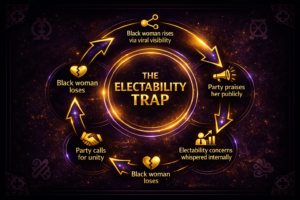
But here’s where it gets complicated and where a lot of people don’t want to sit: electability is also, sometimes, a self-fulfilling prophecy manufactured by institutional actors. Former President Barack Obama called Talarico “a really talented young man” during an October podcast interview — a clip Talarico’s campaign later promoted aggressively. Breitbart Meanwhile, Obama declined to endorse Crockett. The man who spent the better part of 2024 chastising Black men for not showing up for a Black woman opted, when a Black woman was actually on a primary ballot, to praise her opponent. That is not ambiguous. That is a structural choice dressed in neutrality.
Our perceptions of who is electable and what power looks like are shaped by race and gender — white men have had a near-monopoly on political power in America for centuries, and so when a white man speaks in a cadence familiar to those who watched the Obama years, it sends an invisible signal of authority and familiarity. Slate Voters don’t always know they’re responding to that signal. Institutions absolutely do. And they route resources accordingly.
The Rhetoric Didn’t Have a Receipt for Why Jasmine Crockett Lost
This is the part nobody on Crockett’s side wants to talk about, so we’re going to talk about it. Her “we ain’t going back” brand of rhetoric was electric online. It hit different in a reel. But messaging without economic architecture behind it tends to collapse under the weight of practical voters who have bills due. Working-class voters — the people who aren’t tuned into political Twitter, who catch news in fifteen-minute windows between shifts — needed to hear something beyond a vibe. They needed to hear a plan.
Crockett first elected to a Dallas-based House seat in 2022, broke out on the national stage as a progressive firebrand with tough questioning of witnesses before the House Oversight Committee and attacks against President Trump and Republicans. But her approach drew criticism and concerns about viability in a general election. The 19th News That criticism wasn’t always rooted in racism. Some of it was rooted in the entirely reasonable expectation that a candidate seeking to flip a state that went to Trump by nearly 14 points in 2024 would need more than confrontational charisma to move persuadable voters.
The Cardi B endorsement is worth examining here too. Not because celebrity endorsements are inherently worthless — they’re not — but because pairing a celebrity endorsement with a campaign that couldn’t afford to buy consistent television airtime sent a confusing signal. It reinforced a perception, fair or not, that the operation was built around cultural momentum rather than political machinery. Voters forgive a lot. What they find harder to forgive is the feeling that someone ran for office without fully believing they could win.
Why Jasmine Crockett Lost Is Not New: From Abrams to Crockett, the Pattern Holds
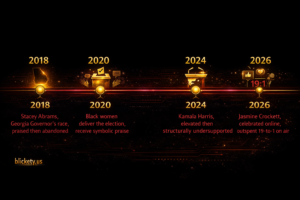
Stacey Abrams built a ground operation in Georgia that transformed the state’s electoral map and she still lost the Governor’s race — twice — while the Democratic establishment patted her on the head and pointed to the Senate seats she helped deliver for other people. Kamala Harris was elevated to the Vice Presidency, managed an impossible position for four years, and then watched the institutional support she needed for a presidential run materialize approximately six weeks too late.
Now Jasmine Crockett. Republican gerrymandering efforts practically pushed her out of her home district in Dallas. In response, she got tough and announced her bid for Senate, becoming one of eight Black women to run in 2026. The Root She ran. She lost. And the cycle — visibility, utility, abandonment — completes itself again.
There’s a frustration throughout the Democratic Party that the party wants Black people’s campaign labor and Black people’s votes but considers Black candidates too risky for high-profile swing races. MS NOW That frustration is warranted. It’s also not going to resolve itself through frustration alone. The pattern only breaks when Black political actors build infrastructure that does not require institutional permission to function — independent fundraising networks, community-based field operations, media ecosystems that don’t depend on mainstream validation.
The Texas Democratic Party needs a statewide win for the first time in thirty years. They need Black voters to deliver it. They will ask. They will ask enthusiastically, emotionally, with speeches about history and legacy and turning Texas blue. Watch whether the ask comes with resources or just rhetoric.
Jasmine Crockett’s Loss Helps Us Understand Sovereignty, Not Slogans
The Afro-Futurist lens on this moment isn’t about blame. It’s about clarity. What Jasmine Crockett’s loss reveals is what every previous iteration of this story reveals: symbolic representation inside systems not built for you has a ceiling, and that ceiling is load-bearing for the institution. They need Black faces in high places enough to use them as proof of inclusion. They do not need Black faces in high places enough to structurally guarantee their success.
The future of Black political agency is not another more perfectly executed version of the same campaign inside the same party relying on the same gatekeepers who have shown, repeatedly, how they make decisions when the cameras are off. The ancestors who built Black Wall Street weren’t asking the broader economy’s permission to create economic sovereignty. The architects of the HBCU system didn’t wait for predominantly white institutions to validate the need for Black-controlled education infrastructure.
The lesson of why Jasmine Crockett lost is not that she should have been less herself. The lesson is that the next generation of Black political infrastructure needs to be built so that its success is not contingent on a party that praises its candidates in October and quietly funds their opponents in February. It needs field operations funded by community investment. It needs media ecosystems that don’t require mainstream co-signing to reach Black voters. It needs economic policy that speaks to someone working two jobs in a city where rent has doubled, not just someone doom-scrolling between committee hearings.
Crockett said Texas is primed to turn blue. She may be right. The question is who gets to build what that looks like — and who gets credited, resourced, and protected when they do. Because if the pattern holds, we already know the answer. And we should be building accordingly.