Midnight Star: The Missing Link Nobody Talks About
Look—we need to have a real conversation about how we tell the story of Black futurist sound.
You know the one. The narrative everybody repeats without thinking: Sun Ra imagined the cosmic future, Parliament made it theatrical, Janelle Monáe brought it to the mainstream. Clean. Academic. Easy to digest.
And completely missing the most important bridge.
Because between Sun Ra’s interstellar philosophy and Janelle’s android mythology, there’s a whole universe of Black people who didn’t just imagine the future—they made it sound like something you could dance to on a Saturday night. They took cosmic Blackness out of the avant-garde and put it on the skating rink floor, in the mall, in the back seat of your homegirl’s Cutlass Supreme with the sound system that cost more than the car.
That sound? That’s Midnight Star.
And if you don’t know their name, that’s the problem we’re here to fix.
The Lineage They Won’t Teach You
Here’s what really happened.
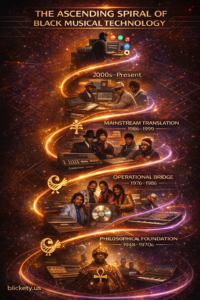
Sun Ra’s 1948 home recording “Deep Purple” included notes that later became associated with extraterrestrial signals Carnegie Hall, laying the groundwork for an entirely new way of thinking about Blackness and technology. He gave us the philosophy: We are cosmic. We are from the future. Technology is our liberation.
But Sun Ra was esoteric. Intellectual. The kind of artist professors write dissertations about while regular folks are just trying to make it through their shift.
Parliament took that cosmic energy and wrapped it in characters, spaceships, and funk-opera spectacle. George Clinton turned philosophy into performance art you could groove to. Parliament’s Mothership Connection was recognized for its themes of Black liberation and space in song arrangement, lyricism, and album visual aesthetics Wikipedia.
But here’s what they skip in every Afrofuturism 101 class: Parliament was still analog. Still band-based. Still rooted in the mythology of the 1970s.
The real revolution—the moment when Black futurism became operational—happened in a rehearsal room at Kentucky State University in 1976.
Enter Midnight Star: The Translators
Midnight Star was formed in 1976 at Kentucky State University by trumpeter Reggie Calloway, vocalist Belinda Lipscomb, and a collective of musicians who would go on to reshape the sound of Black popular music WikipediaNotable Kentucky African Americans Database.
They weren’t trying to be philosophers. They weren’t building elaborate mythologies or dressing up like aliens for album covers.
They were doing something way more revolutionary: taking synthesizers, drum machines, vocoders, and sequencers—tools that white rock bands and European electronic acts had been using—and saying, “Nah, this is ours now. This is how Black folks build the future.”
Midnight Star established themselves as a bonified electro-funk band with their double-platinum LP No Parking on the Dance Floor (1983) that produced two hit singles (“Freak-A-Zoid” and “Wet My Whistle”). These songs blend electronic sound technologies with funky music and catchy lyric arrangements Carnegie Hall.
Real talk? “Freak-A-Zoid” did more for Black digital futurism than half the think pieces written about Afrofuturism in the last twenty years.
The Sound That Built Tomorrow
Let’s talk about what Midnight Star actually brought to the table.
The Technology:
- LinnDrum precision
- Oberheim synthesizers layered thick as Sunday morning grits
- Vocoders that made human voices sound like transmissions from another dimension
- Sequencers that turned rhythm into architecture
The Aesthetic:
- Neon futurism that looked like your cousin’s basement party crossed with a space station
- Black tech optimism that said technology wasn’t something to fear—it was something we already owned
- Mall-era cool that put the future in reach of everyday people
The Cultural Translation: They took Sun Ra’s “space is the place” and made it “the skating rink is the place.” They took Parliament’s Mothership and landed it at the Black nightclub on the south side.
And here’s the thing nobody wants to admit: that’s harder than building mythology.
It’s easy to be cosmic when you’re abstract. It’s revolutionary when you make the future accessible, affordable, danceable—when you put tomorrow in the hands of regular Black folks who can’t afford to philosophize because they got work in the morning.
The Ripple Effect Nobody Credits
Without Midnight Star, there is no:
Jimmy Jam & Terry Lewis The duo were noted for early use of the Roland TR-808 drum machine, which was used in most of its productions Wikipedia. They took the Midnight Star template—synthesizers meeting precision meeting soul—and refined it into the sound that defined Janet Jackson’s Control and launched a thousand imitators.
Janet Jackson’s Control (1986) was one of the first successful records to influence the rise of new jack swing by creating a fusion of R&B, rap, funk, disco and synthesized percussion Wikipedia. That digital R&B blueprint? Midnight Star wrote it first.
New Jack Swing Teddy Riley gets all the credit, but listen to “Freak-A-Zoid” from 1983 and then listen to Guy’s “Groove Me” from 1988. You hear it, right? The drum machine precision. The synth bass. The way the vocoder sits in the mix like it’s having a conversation with the future.
OutKast’s ATLiens You think André 3000 pulled that sound out of thin air? Nah. That whole “Southern futurism” thing—the idea that Black folks in Atlanta could be just as cosmic as anybody in New York or LA—that’s the Midnight Star legacy. Everyday futurism. The kind you can bump in your car.
The Neptunes Pharrell and Chad took the Midnight Star formula and stripped it down to the studs. All those minimal, alien-sounding beats that defined the 2000s? That’s Midnight Star’s electro-funk skeleton with all the flesh removed.
Why They Get Erased
So if Midnight Star was so important, why don’t people know?
Because their futurism wasn’t:
- Theatrical enough for the academics
- Avant-garde enough for the critics
- Mythology-heavy enough for the think pieces
- Dead enough to be “safe” to celebrate
They made functional futurism. Skating-rink futurism. House-party futurism. The kind that got played at the Black mall in 1984 while you were trying to talk to that girl from biology class.
And functional Black innovation—the kind that improves daily life instead of making white people comfortable—always gets erased first.
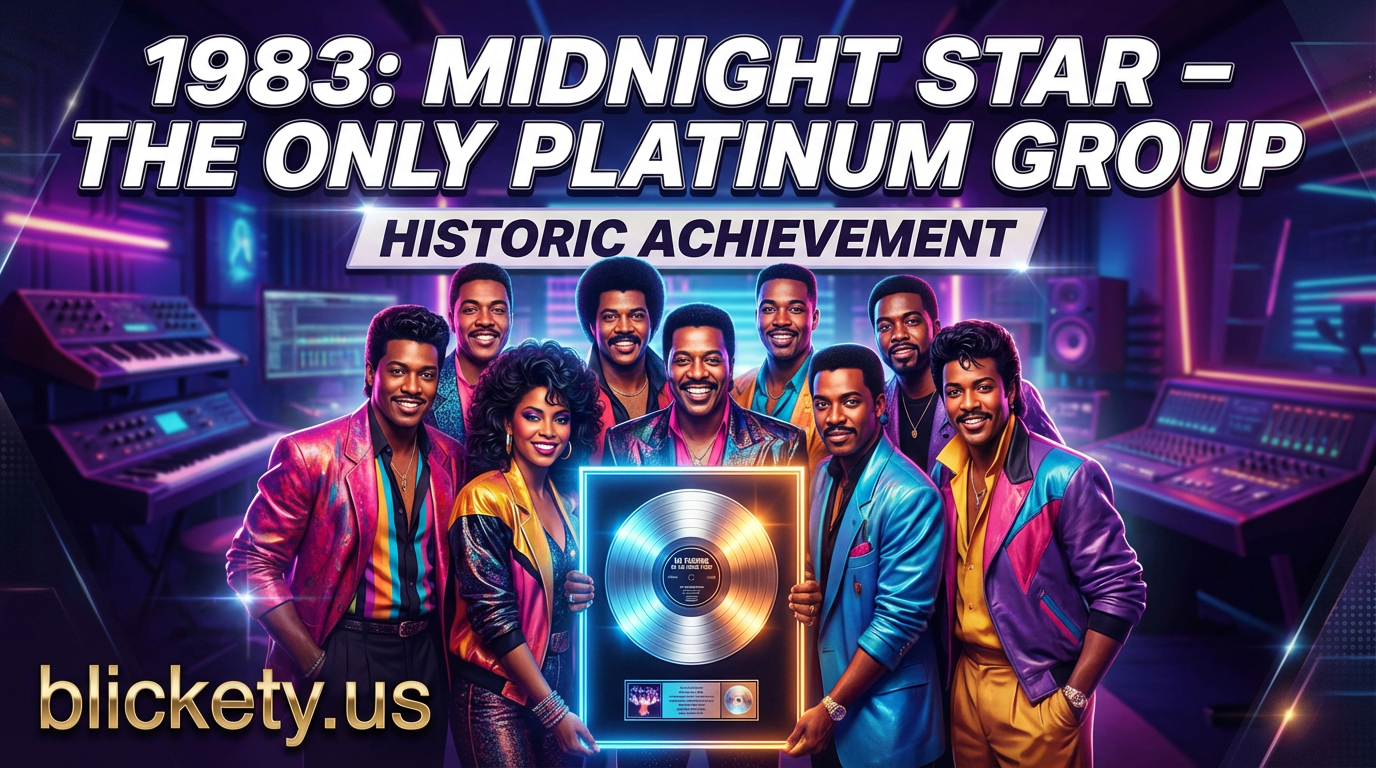
Midnight Star was the only African American group with a platinum album in 1983, thanks to the huge success of the single (and album) No Parking on the Dance Floor Notable Kentucky African Americans Database. The only one. And how many times have you heard their name in an Afrofuturism conversation?
Exactly.
The Real Continuum 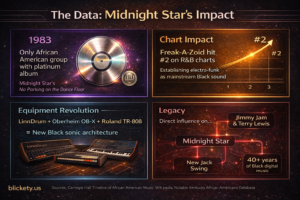
Here’s the lineage nobody teaches:
Sun Ra → cosmic philosophy
↓
Parliament → mythological theater
↓
Zapp & Roger → proto-digital translation
↓
MIDNIGHT STAR → operational digital futurism
↓
Jimmy Jam & Terry Lewis → precision refinement
↓
New Jack Swing → mainstream synthesis
↓
OutKast → narrative expansion
↓
The Neptunes → minimalist evolution
↓
Janelle Monáe → contemporary mythology
Midnight Star is the center of gravity. The hinge. The moment when Black futurism stopped being something you pondered and became something you lived.
What Midnight Star Teaches Us Now
In 2026, as we’re building new platforms, new systems, new ways of thinking about Black digital futures, Midnight Star offers a blueprint:
1. Accessibility Is Revolutionary
Making the future available to everyday people is more radical than keeping it in the academy or the art gallery.
2. Function Over Philosophy
The technology that improves daily Black life matters more than the technology that impresses white critics.
3. The Mall Matters As Much As The Museum
Cultural production that reaches the people has more impact than cultural production that reaches the elite.
4. Own The Tools
Because of the closing factories and dwindling blue-collar jobs in the early 1980s, people began to understand that they would have to master technology if they wanted to continue putting food on the table Vanderbilt University. Midnight Star understood: if we don’t control the synthesizers, the drum machines, the sequencers—somebody else will control how our futures sound.
5. Build Infrastructure, Not Just Art
Every Midnight Star album was a brick in a structure. They weren’t making individual statements—they were constructing a sonic architecture that others could build on.
The Correction
So the next time somebody starts talking about Sun Ra to Janelle Monáe like there’s nothing in between, correct them.
Tell them about the band that formed at an HBCU in Kentucky.
Tell them about “Freak-A-Zoid” going to number 2 on the R&B charts.
Tell them about the double-platinum success that established Midnight Star as world-renowned songwriters, producers, and entertainers Wikipedia.
Tell them about the synthesizers and vocoders and LinnDrums that became the language of Black digital futures.
Tell them that before Janelle Monáe’s ArchAndroid could rebel, somebody had to build the factory where androids got made.
That factory was Midnight Star.
And if you want to understand how Black folks really built tomorrow—not in theory, but in practice, not in manifestos but in music you could skate to—you start there.
Not with the cosmic philosopher looking at the stars.
But with the band from Kentucky State that brought the stars down to earth and made them groove.
Where the Sound Lives On
The Midnight Star aesthetic never died. It just evolved.
You hear it every time a producer layers synthesizers like they’re building a world. Every time a drum machine hits with that crisp, digital precision that still sounds warm because Black hands programmed it. Every time somebody takes technology that wasn’t built for us and makes it sing our futures anyway.
Dam-Funk knows. Kaytranada knows. Thundercat knows. Flying Lotus knows.
They all know that somewhere between the cosmic and the commercial, between the avant-garde and the accessible, between Sun Ra’s mythology and Janelle Monáe’s narrative—
There’s Midnight Star.
The band that taught us the future doesn’t have to choose between being visionary and being danceable.
The band that proved everyday Black life is the future.
The band that showed us you can build tomorrow while living today—and make it groove so hard that people will still be skating to it forty years later, whether they know your name or not.
Now you know the name.
Say it loud: Midnight Star.
The missing link. The true bridge. The band that made Black digital futurism something you could feel.