At
My girlfriend and I were in one of those kitchen debates that sounds small but isn’t.
Butter versus margarine.
She’s team butter, always has been. I’m known to use both—whatever’s in the fridge, honestly. But then I mentioned something I’d heard years back, one of those facts that sticks with you even if you’re not sure it’s entirely true:
“Margarine is supposedly one molecule away from being plastic.”
She stopped. Looked at me. Said she wanted to learn how to make butter.
And just like that, I was back in Ms. Johnson’s classroom at Deaf Smith Elementary, watching a mason jar full of cream make its way around a circle of nine-year-olds, each of us shaking it like our lives depended on it until—somehow, like magic—it turned into actual butter.
I told my girl: “Making butter is easy.” 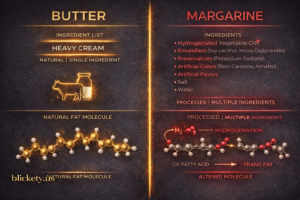
Because it is.
But also? It’s more than that.
The Margarine Question Nobody Wants to Answer
Let’s talk about that “one molecule away from plastic” thing for a second.
Is it literally true? Eh, kind of. Margarine and plastic aren’t the same thing, but they share some structural similarities at the molecular level—both involve hydrogenation, chemical processing, and a whole lot of laboratory intervention. The point isn’t that margarine is plastic. The point is that margarine is so far removed from anything that grows, lives, or exists in nature that comparing it to industrial materials isn’t even that much of a stretch.
Butter? Butter is cream that got agitated until the fat separated from the liquid. That’s it. Cream → shake → butter. A process humans have been doing for thousands of years, long before anyone had a chemistry lab or a marketing budget.
Margarine? Margarine is vegetable oil that got chemically altered—hydrogenated—so it would solidify at room temperature and spread like butter. It was invented in 1869 by a French chemist responding to a challenge from Napoleon III, who wanted a cheap butter substitute for the army and the poor.
From day one, margarine was about replacing real food with something cheaper to produce and easier to control. And for decades, corporations convinced people it was healthier than butter—better for your heart, lower in saturated fat, the modern choice for modern people.
Then the science caught up. Turned out those trans fats created by hydrogenation? Way worse for you than the natural fats in butter. So bad that the FDA eventually banned artificial trans fats in 2018.
But by then, margarine had already done its job: it taught people that food could be engineered, that “natural” wasn’t necessary, that you could trust a laboratory more than a cow.
That’s the real problem. Not the molecule. The mindset.
What Deaf Smith Elementary Taught Me About Food Sovereignty
I don’t remember the lesson plan. I don’t remember if Ms. Johnson explained the science of emulsification or fat separation or any of that.
What I remember is the jar.
Heavy glass, cold cream sloshing inside, lid screwed tight. We sat in a circle—maybe twenty of us—and passed it around. Each kid shook as hard as they could for as long as they could before passing it to the next person.
At first, nothing happened. Just cream, sloshing, moving around in the jar like it always did.
Then it started to thicken. Got heavier. The sound changed—less liquid, more solid resistance against the glass.
Then suddenly—and I mean suddenly, like you could feel the exact moment it happened—the cream broke. Clumped together. Became something else entirely.
Butter.
We’d made butter. With our hands. In a classroom. From cream.
And in that moment, even as a nine-year-old who didn’t have the words for it yet, I understood something fundamental: Food isn’t magic. Food is process. And process is something we can do ourselves.
That’s food sovereignty. Not just knowing where your food comes from, but knowing you could make it if you needed to. Knowing the corporations and the supply chains and the grocery stores aren’t the only option. Knowing that your hands, your knowledge, your effort can produce something real.
They don’t teach that anymore. Most kids grow up thinking food comes from packages, that “cooking” means opening boxes and following microwave instructions, that anything requiring actual transformation—raw ingredients becoming something new—is too complicated for regular people.
But our grandmothers knew how to make butter. Their grandmothers knew how to churn cream, render lard, preserve vegetables, cure meat, bake bread from flour they might have ground themselves.
That knowledge was power. A power to feed yourself and your family without depending on anyone. The power to know exactly what you’re eating. The power to say “no” to corporate substitutes and cheap replacements.
When we lost that knowledge, we lost sovereignty. We became consumers instead of creators. Dependent instead of self-sufficient.
Making butter in a jar isn’t just a cute kitchen project. It’s reclaiming something that was taken from us.
How to Make Butter in a Jar (The Way Ms. Johnson Taught Us)
Here’s the thing: This is stupid easy. If a classroom full of fourth-graders can do it, you can do it.
Ingredients:
- 1 cup heavy whipping cream (not ultra-pasteurized—that stuff won’t work the same)
- Optional: pinch of salt for flavor
Tools:
- A clean mason jar with a tight-fitting lid (pint-size works best)
- Your hands
- 10 minutes of your time
Step-by-Step:
1. Fill the jar halfway
Pour the heavy cream into the jar. Only fill it about halfway—you need room for the cream to move around and slosh when you shake it. This is important. Too full and you won’t get enough agitation. Too empty and it’ll take forever.
2. Seal and shake
Screw that lid on tight. You’re about to shake this thing like you’re angry at it.
Now shake. Vigorously. Like you mean it.
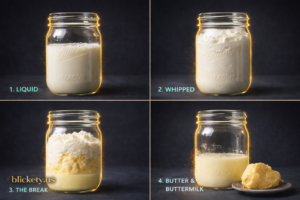
For the first few minutes, nothing much happens. The cream sloshes around, maybe gets a little foamy. Keep going.
Around the 5-minute mark, you’ll feel it start to thicken. It’s turning into whipped cream now—thick, heavy, resistant. Your arm’s probably getting tired. Keep going.
Then—somewhere between 7 and 10 minutes, depending on how hard you’re shaking and how fresh your cream is—you’ll feel it break. Suddenly. The thick whipped texture collapses, and you’ll hear a different sound: solid butter sloshing in liquid buttermilk.
That’s the moment. You just made butter.
3. Drain the buttermilk
Open the jar. You’ll see a clump of yellowish butter and a bunch of liquid (that’s buttermilk—don’t throw it away, that stuff is gold for baking).
Pour off the buttermilk into a container. Save it. Use it for pancakes, biscuits, cornbread, whatever.
4. Rinse the butter
This step is important if you want your butter to last more than a day or two.
Add cold water to the jar with the butter. Shake it gently. Pour off the cloudy water. Repeat until the water runs clear—usually 2-3 times.
You’re rinsing out the remaining buttermilk. If you leave it in, the butter will spoil faster and taste sour.
5. Add salt or flavor (optional)
This is where you can get creative.
Basic salted butter? Add a pinch of salt and mix it in.
Want to go fancy? Try:
- Garlic herb butter: minced garlic, fresh parsley, thyme, black pepper
- Cinnamon honey butter: cinnamon, honey, maybe a touch of vanilla
- Spicy chili butter: chili flakes, smoked paprika, lime zest
Mix whatever you want into the butter while it’s still soft. You’re the chef now.
6. Store it
Scoop the butter out of the jar and pack it into a small container with a lid. Or roll it into a log with parchment paper if you want to be fancy.
Store it in the fridge. It’ll keep for about a week—though honestly, it’ll probably be gone in three days because homemade butter hits different.
What’s Actually Happening? (The Science Part)
You know what? Let’s talk about what you just did, because it’s actually beautiful.
Cream is an emulsion—fat globules suspended in liquid. Those fat globules are surrounded by membranes that keep them separate from each other and from the water.
When you shake the jar, you’re agitating those fat globules. You’re breaking down the membranes. You’re forcing the fat to clump together instead of staying suspended.
First, it whips—the fat traps air, creates structure, turns into whipped cream.
Then, with more agitation, the structure collapses. The fat fully separates from the liquid. The globules merge into a solid mass.
That solid mass is butter. The liquid left behind is buttermilk.
Not chemicals. No hydrogenation. No mysterious ingredients you can’t pronounce. Just mechanical separation of fat from liquid through physical force.
This is the same process that’s been used for millennia. In Ethiopia, they use a kirbe—a clay pot that gets rocked back and forth. But In West Africa, gourds. In Europe, wooden churns. In a fourth-grade classroom in Deaf Smith Elementary, a mason jar.
Different tools. Same principle. Humans transforming raw ingredients into food with their own hands.
Why This Matters in 2026
Look—I get it. You can buy butter at the store. It’s cheap. It’s convenient. You don’t have to shake anything for 10 minutes or rinse buttermilk or deal with any of this.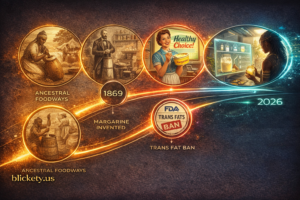
So why bother?
Because every time you make something yourself, you take back a little bit of power.
Seize power from the corporations that convinced you that food has to come from them. Power from the supply chains that can break, the prices that can spike, the shortages that can happen.
Power from the systems that want you dependent, that want you to believe transformation is too complicated, that want you buying instead of making.
When you know how to make butter, you know you can feed yourself. You know the process. You know what real food looks like, tastes like, feels like. Teach your kids. You can share with your neighbors. You can build community around something tangible and real.
And yeah—you also know that when someone tries to sell you margarine and call it progress, you can say “nah, I’m good” and make your own butter in 10 minutes with a jar and some cream.
That’s Afro-Futurism. Not rejecting technology or modernity, but reclaiming the knowledge and skills that keep us rooted, sovereign, capable. Using ancestral wisdom to navigate corporate systems. Building futures where we’re not just consumers but creators, where we pass down knowledge instead of depending on corporations to feed us.
Our ancestors churned butter because they had to. We churn butter because we choose to. Because we remember. Because we refuse to forget how.
The Bigger Conversation About Real Food
Making butter opened up something for my girlfriend and me. We started talking about all the other things that got replaced, rebranded, chemically altered in the name of “progress.”
Margarine instead of butter. High fructose corn syrup instead of sugar. Vegetable oil instead of lard or tallow. “Cheese product” instead of actual cheese. Chicken raised in six weeks in a warehouse instead of six months in a yard.
Every replacement came with the same promise: cheaper, easier, better for you, more modern.
And every replacement pulled us further from knowing where our food comes from, how it’s made, what’s actually in it.
The corporations won when they convinced us that food is too complicated to make ourselves. That we need them. That convenience is worth giving up sovereignty.
But it’s not.
Making butter takes 10 minutes. Baking bread takes an hour, most of it hands-off. Growing herbs takes a pot and a windowsill. Cooking dried beans takes a pot and some time.
None of this is complicated. None of this requires special skills or expensive equipment. Our grandparents did all of it as a matter of course, and they didn’t have YouTube tutorials or instant pots or any of the tools we have now.
We’ve just been taught to forget. Taught to believe we can’t. Taught to buy instead of make.
Learning to make butter is the first step in remembering.
What You’ll Teach Your Kids
Making your own food is essential, necessary. Not because it’s cute. Not because it’s a fun activity for a rainy afternoon—though it is that.
Because we want them to know that food doesn’t come from corporations. It comes from cream and effort and knowledge passed down. We want them to understand transformation—how raw ingredients become something new through process and intention.
We want them to have the power we’re reclaiming. The power to feed themselves. And the power to say “I can make that” instead of “I need to buy that.”
The power to remember what their great-great-grandparents knew: You don’t need permission to eat well. You just need knowledge and the willingness to use your hands.
That’s the legacy worth passing down. Not brand loyalty. Not convenience. And dependence.
Knowledge. Sovereignty. The ability to create.
Ms. Johnson gave me that at Deaf Smith Elementary, even if she didn’t know it. A mason jar full of cream and a lesson I’m still learning from decades later.
Now I’m passing it to you.
Start Here. Start Now.
Go get a jar. Go get some heavy cream. Shake it until your arm hurts and then shake it some more.
Make butter.
Then make it again. Add garlic and herbs. Add honey and cinnamon. Experiment. Fail. Try again.
Then teach someone else. Your kids. Partner. Friends. Your neighbors.
Build a kitchen culture where making is normal. Where knowing how is expected. Where sovereignty is practiced, not just talked about.
Because one jar of homemade butter won’t change the world.
But a generation of people who know they can make their own food, who refuse corporate substitutes, who remember ancestral knowledge and build future systems on that foundation?
That changes everything.
The revolution starts in the kitchen. With a jar. Some cream. With your hands.
Make butter. Reclaim power. Pass it forward.
When someone asks why you’re bothering when you could just buy it at the store, tell them:
“Because I can. My ancestors could. My descendants will.”
That’s reason enough.