Eco-Melanin: Why African Botanicals Are the Future of Clean Beauty
 There is a $163 billion industry built largely on ingredients it did not invent, sourced from land it does not own, refined from knowledge it never credited. The global clean beauty market knows how to say “natural.” What it has historically refused to say is “African.”
That is changing. Not because the industry had an ethical awakening — but because African botanicals clean beauty is now too large an economic and cultural force to ignore, and the Black women, African scientists, and Afrofuturist entrepreneurs driving it are not waiting for anyone’s permission.
This is the Eco-Melanin moment. The convergence of ancestral botanical wisdom, Afrofuturist innovation, and a melanated consumer base that finally has the platforms, purchasing power, and political clarity to demand beauty on its own terms.
The future of clean beauty has always been African. The world is just now catching up.
What Is Eco-Melanin — and Why It Matters Now
Eco-Melanin is not a brand. It is a framework. A way of understanding the relationship between African botanical science, melanin-rich skin, ecological sovereignty, and the radical idea that the people who developed the world’s most powerful skincare knowledge over thousands of years should be the primary beneficiaries of its commercial value.
Melanin is not just a pigment. It is a biological architecture — a complex polymer that gives darker skin its UV resilience, its density, its capacity for deep hydration retention, and its particular sensitivity to specific formulation errors that the mainstream beauty industry spent decades ignoring. African botanicals clean beauty works not because “natural is better” in some vague, greenwashed sense. It works because African plants co-evolved with African environments and, by extension, with the skin of the people who have inhabited those environments for hundreds of thousands of years.
Shea butter was not popular in West Africa because it smelled good. It was used because the women who developed and refined its applications understood something about fatty acid composition, UV protection, and skin barrier repair that dermatological science is only now formally documenting. Baobab oil was not the Tree of Life’s cosmetic export because of branding. It was because its omega-3, 6, and 9 fatty acid profile — alongside twice the antioxidant concentration of pomegranates or goji berries — made it one of the most potent skin-regenerating substances on the planet.
Eco-Melanin is the recognition that this knowledge is not historical. It is not folklore. It is science — with an unbroken chain of empirical application stretching back millennia — and it belongs to the people who developed it.
The Science Behind African Botanicals Clean Beauty
The African continent contains approximately 25% of the world’s total plant biodiversity. It has the richest botanical pharmacopeia on earth. And a growing body of peer-reviewed science is validating what African healers, grandmothers, and beauty practitioners have always known: these plants are formidably effective for skin. 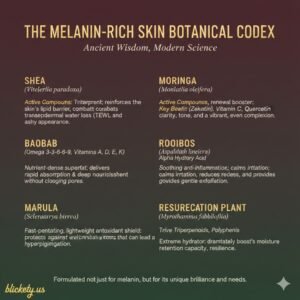
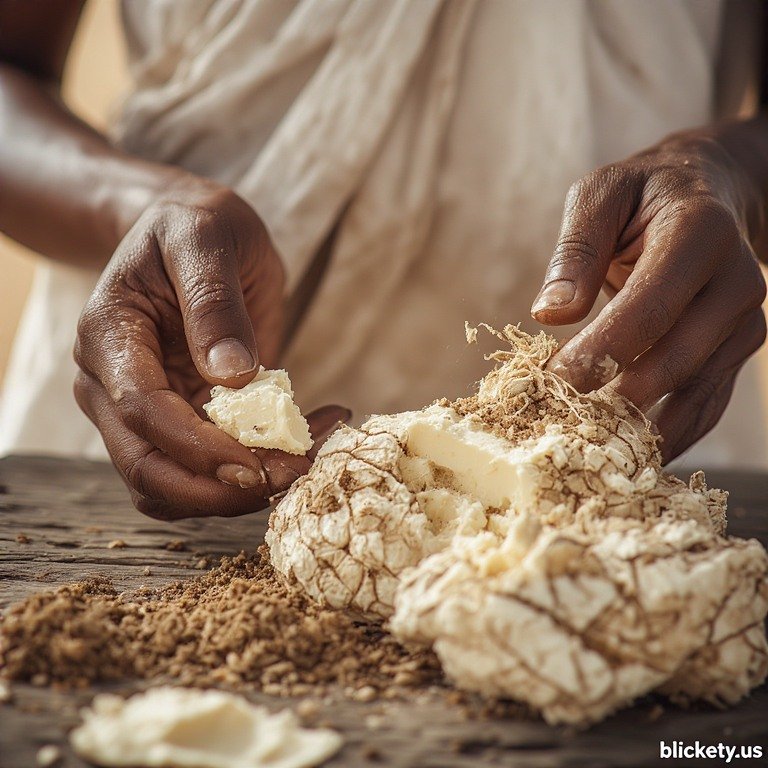
Shea Butter (Vitellaria paradoxa): Sourced primarily from West Africa’s shea belt — stretching from Senegal to Ethiopia — shea butter is rich in vitamins A and E, triterpene alcohols with documented anti-inflammatory properties, and a fatty acid composition that mirrors the skin’s own natural lipids. Research published in the International Journal of Molecular Sciences confirmed its skin barrier repair and anti-inflammatory effects. It has been used in West African communities for postpartum healing, infant care, and daily moisture protection for centuries. Cleopatra is reported to have kept it among her beauty essentials. The San people of the Kalahari used it for UV protection long before SPF was a concept.
Baobab Oil (Adansonia digitata): Extracted from the seeds of the Tree of Life — one of Africa’s most ancient and ecologically significant trees — baobab oil carries vitamins A, D, E, and F alongside a balanced breakdown of saturated, monounsaturated, and polyunsaturated fatty acids that formula botanists describe as exceptional for regenerating and revitalizing tissue. Its antioxidant levels are roughly double those found in pomegranates. It is particularly effective for mature skin, hyperpigmentation, fine lines, and scarring — conditions that are disproportionately undertreated in mainstream skincare formulated without melanin-rich skin in mind.
Marula Oil (Sclerocarya birrea): The Zulu people of South Africa have used marula oil as a moisturizer for dry, cracked skin for generations. Modern cosmetic formulation science has validated exactly why: marula oil has an exceptionally high concentration of antioxidants, phenolic compounds, essential amino acids, and flavonoids that defend against environmental stressors and photo-aging. With 70-78% oleic acid content making it one of the most stable botanical oils available, it is non-comedogenic, deeply absorbing, and supports natural collagen production. It is, as Afrika Botanicals describes it, a miracle oil — and it comes from sub-Saharan Africa’s King of Trees.
Moringa (Moringa oleifera): Called the “miracle tree” across East and West Africa, moringa oil has a fatty acid profile comparable to olive oil, with high behenic acid content and natural antimicrobial properties. It excels in anti-pollution skincare — a critical formulation need as global urbanization exposes more melanin-rich skin to oxidative environmental stress. S’Able Labs, the African botanicals clean beauty brand co-founded by Sabrina Dhowre Elba and actor Idris Elba in 2022, sources their moringa specifically from Kenya. Their Black Seed Toner — built around its brightening and soothing properties — became one of the brand’s top performers, with Sabrina noting that moringa was an ingredient she recognized from her childhood growing up as a first-generation African woman.
Rooibos (Aspalathus linearis): Native to South Africa’s Cederberg Mountains and nowhere else on earth, rooibos is one of the most aspalathin-rich plant sources known to science. Aspalathin is a rare antioxidant with documented anti-inflammatory and anti-diabetic properties. In skincare, rooibos extract protects against UV-induced oxidative stress, reduces redness, and supports barrier function — making it particularly beneficial for the reactive skin presentations common in melanin-rich skin.
Resurrection Plant (Myrothamnus flabellifolius): Perhaps the most extraordinary entry in the African botanicals clean beauty pharmacopeia, the resurrection plant survives complete desiccation — losing up to 95% of its water content — and fully rehydrates when water is available again. The trehalose sugars and arbutin compounds that allow it to survive those conditions have profound skincare applications: preventing oxidative stress, enabling deep hydration, and inhibiting the tyrosinase activity responsible for hyperpigmentation. It is, quite literally, a plant engineered by evolution to survive the harshest conditions on earth, and its compounds do the same thing for skin.
The Africa cosmeceuticals market reached $4.12 billion in 2025 and is projected to climb to $6.33 billion by 2031. The global clean beauty market sits at $163 billion in 2025, growing at 10.12% annually. The market for Africa-sourced moringa alone is forecasted to reach $25.1 billion by 2035. These numbers are not projections about a trend. They are the beginning of a reckoning.
The Afrofuturist Frame: This Was Never Just Beauty
To understand why African botanicals clean beauty is an Afrofuturist project and not merely a wellness trend, you have to understand what was done to African botanical knowledge before “clean beauty” was a category.
It was taken. Systematically, for centuries, and in many cases without compensation, consent, or credit. The technical term is biopiracy — the appropriation of indigenous plants, seeds, and traditional knowledge by corporations who patent them for commercial use while the communities that developed and stewarded that knowledge receive nothing.
Africa has been the primary target of botanical biopiracy. The San people of the Kalahari spent years fighting Pfizer after the active molecule in the Hoodia cactus — which San communities had used for centuries to suppress hunger — was sold to the pharmaceutical company without consent or compensation. After legal action, they eventually secured a share of royalties. But the default, without the fight, was theft.
South Africa’s rooibos, Hoodia gordonii, Sceletium tortuosum (kougoed), and Pelargonium sidoides have all been subjects of documented biopiracy cases and subsequent benefit-sharing battles. A 2025 peer-reviewed study in the Journal of World Intellectual Property specifically examined the cosmetics industry’s relationship to biopiracy — noting that the sector’s global reach and dependence on botanical genetic resources makes it one of the highest-risk industries for the misappropriation of African indigenous knowledge.
The 2024 WIPO Treaty on Intellectual Property, Genetic Resources and Associated Traditional Knowledge — the GRATK treaty — represents the first meaningful international legal step toward protecting indigenous communities from this kind of extraction. It requires “disclosure of origin” in patent applications. It is a beginning. Not an ending.
Afrofuturism has always been interested in this question: what does the future look like when the people whose knowledge built it are actually in it? When the women of West Africa’s shea cooperatives are not suppliers to someone else’s clean beauty brand but owners of the entire value chain? When the botanical pharmacopeia of the African continent is commercialized by Africans and the diaspora, for Africans and the diaspora first, and the world second?
That is the Eco-Melanin vision. Not just better ingredients. Sovereign beauty infrastructure.
A-Beauty: The Movement That’s Rewriting the Industry
The clean beauty world already has K-Beauty (Korean) and J-Beauty (Japanese) as recognized, celebrated aesthetic frameworks. A-Beauty — African beauty — is arriving with the same gravitational force, and in 2025 and 2026 the global retail infrastructure is beginning to acknowledge it.
By late 2025, retailers including Sephora, Ulta, Goop, Space NK, and Amazon are carrying African beauty brands. Sub-Saharan Africa’s beauty sector is expected to grow by $5 billion between 2021 and 2026. Online beauty sales on the continent are expanding at nearly 15% annually. Africa’s digital commerce value is on track to hit $72 billion by 2026, with beauty as a headline category.
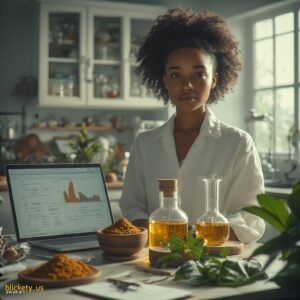
The brands leading A-Beauty’s global push are not legacy multinationals. They are Black and African founders building exactly the kind of sovereign beauty infrastructure that Eco-Melanin demands:
S’Able Labs (founded by Sabrina Dhowre Elba, 2022) sources moringa from Kenya, marula from Namibia, and prickly pear from Madagascar. Every ingredient is African-sourced and scientifically validated. Their Black Seed Toner — built around brightening and soothing properties — received Vogue coverage, and in October 2025 they launched their first step into color cosmetics with a tinted moringa formulation.
R&R Luxury (founded by Valerie Obaze in Nigeria) reimagined solid shea butter into a modern liquid format and expanded into the UK and UAE markets. The brand recently celebrated 15 years in business — a Black African woman building global clean beauty distribution on her own terms.
True Moringa — stocked in Whole Foods and featured in Forbes and Allure — built a high-performance anti-aging skincare line around ethical moringa sourcing that demonstrates African botanicals clean beauty can reach the highest tier of mainstream recognition without compromising its origin story.
Tolu Coker — the British-Nigerian designer whose Spring/Summer 2026 collection was presented as a short film featuring Naomi Campbell — has built a fashion-adjacent beauty aesthetic worn by Doechii, Rihanna, and Tyla, with all manufacturing kept in the UK and every garment traceable to the seamstress who made it. The ethos is identical to Eco-Melanin: provenance as power.
What all of these brands share is the refusal to be suppliers to someone else’s story. They are the story.
The Biopiracy Problem and the Sovereignty Solution
The mainstream clean beauty industry has a structural problem that African botanicals clean beauty is forcing into the open: the difference between using African ingredients and centering African knowledge.
A white-owned American skincare brand that puts baobab oil in a serum and sells it for $85 at Sephora without any sourcing transparency, without cooperative partnerships, without benefit-sharing with the communities whose ancestors developed baobab’s cosmetic applications — that is not clean beauty. That is extraction wearing a wellness label.
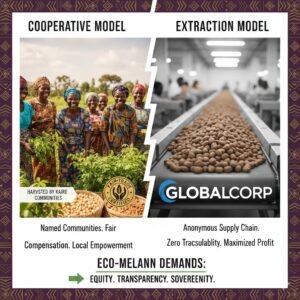 Eco-Melanin demands the distinction. African botanicals clean beauty in its sovereign form means: traceability from seed to shelf, fair-trade cooperative sourcing (particularly from women-led cooperatives, which produce the majority of Africa’s shea butter), transparent supply chains, Black and African ownership of the value chain wherever possible, and a rejection of the biopiracy model even when it is legal.
The African Continental Free Trade Area (AfCFTA) is creating the infrastructure conditions for this sovereign model to scale. Zero-tariff trade agreements are reducing raw material costs for African beauty brands. Eight African states had enacted harmonization statutes by mid-2025, beginning to standardize the regulatory environment that domestic brands need to compete globally. The GRATK treaty, once ratified broadly, will give communities legal standing to require disclosure and benefit-sharing before their traditional knowledge can be patented.
The window for African beauty sovereignty is open. The Afrofuturist question is who walks through it — and who gets left waiting at the door again.
What Melanin-Rich Skin Actually Needs — and Why African Botanicals Deliver It
The mainstream skincare industry was not formulated for melanin-rich skin. This is not rhetorical. It is a formulation fact. Dermatological research focused predominantly on Fitzpatrick skin types I-III — lighter European skin tones — for most of the 20th century. The hyperpigmentation, post-inflammatory discoloration, keloid formation, and transepidermal water loss patterns common to melanin-rich skin were undertreated and often worsened by products formulated without them in mind.
African botanical ingredients are structurally better suited to melanin-rich skin for reasons that science is continuing to document. The plants themselves evolved in high-UV, high-heat, high-oxidative-stress environments — and the compounds that protect them from those conditions are precisely what protects melanated skin from the same stressors.
Baobab oil targets hyperpigmentation and scarring — two of the most common and undertreated concerns for darker skin tones. Rooibos’s aspalathin compounds address the reactive, inflammation-prone skin presentations that harsh synthetic products have long exacerbated. Resurrection plant’s arbutin compounds inhibit tyrosinase activity — the enzymatic process behind uneven melanin distribution — more gently and effectively than the hydroquinone-based brighteners that dominated the market for decades and were found at dangerous concentrations in 46% of sampled skin-lightening creams in Nigeria.
Moringa’s anti-pollution properties address the urban environmental stressors that disproportionately affect melanin-rich populations in high-density African cities. Marula oil’s non-comedogenic, rapidly absorbing profile works with the natural oil balance of darker skin rather than disrupting it.
This is not coincidence. This is co-evolution. And it is the scientific foundation of African botanicals clean beauty as a category built not to include melanin-rich skin as an afterthought, but to center it as the primary design brief.
The Afrofuturist Blueprint: Building Eco-Melanin Infrastructure
Afrofuturism does not romanticize the past. It uses the past as intelligence for building the future. And the Eco-Melanin future requires infrastructure, not just inspiration.
That infrastructure looks like this: women-led shea cooperatives in Ghana, Burkina Faso, and Mali that are equity partners in the brands they supply, not just low-cost labor for someone else’s clean beauty margin. African-owned cosmeceutical labs developing proprietary formulations from the continent’s botanical pharmacopeia, holding their own patents under the protections the GRATK treaty is beginning to provide. Pan-African distribution networks that move product between Lagos, Nairobi, Johannesburg, Accra, and the diaspora cities of London, Houston, Toronto, and Atlanta without surrendering controlling ownership to multinationals.
Procter & Gamble’s May 2025 acquisition of a majority stake in Ethiopian cosmetics manufacturer Amano Cosmetics is a signal. L’Oréal’s 2024 strategic partnership with Morocco’s Saiden Chemicals is another. The multinationals are paying attention. The question for Afrofuturist beauty entrepreneurs is whether these partnerships represent genuine collaboration or the latest iteration of extraction dressed in corporate social responsibility language.
Eco-Melanin as an Afrofuturist project says: build the infrastructure that makes extraction impossible, because African botanical wealth is held by African people, protected by African-led legal frameworks, commercialized through African-owned supply chains, and celebrated by a global Black diaspora that finally has the cultural language to name what it wants.
The clean beauty industry told us for decades that purity was the point. Eco-Melanin says: purity is not enough. Sovereignty is the standard.
But sometimes its not flaws or lacking that may be the reasons your pictures dont hit. Cameras lie to us.
FAQ: African Botanicals Clean Beauty
What is A-Beauty? A-Beauty — African beauty — is the emerging global framework for skincare and cosmetics rooted in African botanical ingredients, traditional knowledge, and formulation practices designed for melanin-rich skin. Like K-Beauty and J-Beauty before it, A-Beauty is gaining mainstream global recognition through brands like S’Able Labs, R&R Luxury, and True Moringa.
Which African botanicals are best for melanin-rich skin? Shea butter, baobab oil, marula oil, moringa, rooibos, and the resurrection plant are among the most scientifically validated African botanicals for melanin-rich skin. Each offers specific benefits — from barrier repair and hyperpigmentation treatment to anti-pollution protection and deep hydration — that correspond directly to the formulation needs of darker skin tones.
What is biopiracy in clean beauty? Biopiracy is the appropriation of indigenous botanical knowledge and genetic resources by corporations — often without the consent, credit, or compensation of the communities that developed that knowledge. The cosmetics industry is one of the highest-risk sectors for biopiracy involving African botanical ingredients. The 2024 WIPO GRATK treaty is the first international legal framework designed to address this.
What is Eco-Melanin? Eco-Melanin is an Afrofuturist framework for understanding African botanical clean beauty as a project of both scientific excellence and economic sovereignty — one that centers the knowledge, labor, and intellectual property rights of African and diaspora communities in the commercial value chain of the ingredients they developed.
How is the African botanicals clean beauty market growing? The Africa cosmeceuticals market reached $4.12 billion in 2025 and is projected to reach $6.33 billion by 2031. The global clean beauty market sits at $163 billion in 2025, growing at over 10% annually. Africa-sourced moringa alone is projected to reach $25.1 billion in market value by 2035.
Published on The Afrofuturist | Beauty | Sovereignty | Science