This article is for educational and informational purposes only. It is not financial advice. Crypto assets are highly volatile. Never invest more than you can afford to lose. Always do your own research. Staking yield figures are estimates based on current rates and are not guaranteed.

Uphold staking Flare — buying FLR tokens on Uphold and staking them to earn yield — is available to anyone with $10 and a Tuesday. That is the whole thing. The institution deploying $100,000 into FLR this week is running the exact same logic as the person putting $10 on Uphold every week. Buy it, stake it, compound it, come back in a year. The framework is identical. The discipline is identical. The only thing different is the comma placement in the account balance.
You know Acorns, right? The app that rounds up your spare change from every purchase — your $4.35 coffee becomes $5.00, and that $0.65 goes straight into a diversified investment portfolio. ETFs, which are exchange-traded funds — think of them as baskets of stocks and bonds that trade like a single share — automatically, without you having to think about it. Acorns works because it does two things simultaneously: it builds the habit of consistent small investing AND it puts that money into assets with real appreciation trajectories. You are not just collecting spare change. You are collecting fractional ownership in things that grow.
Uphold staking Flare is that same idea — applied to infrastructure crypto. Small, consistent, automatic. With an asset that has specific, verifiable reasons it could be worth more per token in the future. Not just more coins. More valuable coins. We will get into exactly why in a minute.
The live FLR price today, April 12, 2026, is $0.007908. Ten dollars buys approximately 1,265 FLR on Uphold right now. Here is what that builds over 52 weeks — and why the timing matters more today than it did last month.
What Is Uphold Staking Flare — and Why Does the Infrastructure Matter
Before the math, the infrastructure thesis. CryptoBro9000 does not stack tokens he cannot explain. So here is Flare Network straight, no chaser.
Flare Network is a Layer 1 blockchain. Layer 1 means it is its own independent chain — not built on top of Ethereum or Solana or anyone else. It was built for one specific job: giving smart contract capabilities to blockchains that do not have them natively. A smart contract is a self-executing agreement written in code. When the conditions are met, it executes automatically — no bank, no broker, nobody in the middle taking a percentage.
The primary target is XRP. XRP processes 1,500 transactions per second. Visa does about 1,700. Bitcoin does 7. XRP settles in 3 to 5 seconds and costs fractions of a cent per transaction. Legitimately fast, legitimately cheap. The problem? XRP cannot run smart contracts natively. That means developers cannot build complex financial applications directly on it. Which caps what XRP can do in the world.
Flare fixes that. Flare gives XRP the programmability of Ethereum without sacrificing XRP’s speed or its cost advantage. The result is XRPFi — DeFi, which stands for decentralized finance, meaning financial products built on blockchain without a traditional bank in the middle — built on XRP’s rails, powered by Flare’s execution layer. The best of both worlds in one protocol.

The numbers are real. As of March 2026, Flare’s Firelight protocol — its flagship staking product — surpassed 50 million staked XRP, worth approximately $67 million, filling its initial deposit cap in six hours. Not days. Six hours. By April 2026, Flare had surpassed 100 million FXRP — which is XRP wrapped into a Flare-native token so it can participate in DeFi — bridged from the XRP Ledger, with approximately 70% actively deployed in staking, lending, and vault protocols. Capital being put to work, not just moved around.
Uphold’s own CEO Simon McLoughlin called Flare a “thriving” DeFi ecosystem and confirmed the company is exploring XRP staking through Flare, describing it as “feasible and promising.” Uphold has over 10 million users in 140 countries. That is not a retail tip. That is an institutional read on an infrastructure play.
Why FLR Could Be Worth More — The Appreciation Thesis
Most crypto articles show you staking math and call it a day. More coins. Cool. But the question your money is actually asking is this: will those coins be worth more per coin when you come back? That is the appreciation thesis. And for FLR right now, there are three specific, verifiable reasons the answer might be yes.
Catalyst One: FIP.16 — The Deflationary Upgrade
Today, April 12, 2026, FLR is up 1.40% while Bitcoin dropped 1.63%. Why? Governance proposal FIP.16. A governance proposal is a formal vote by FLR token holders — everyone who holds FLR gets a say in how the protocol evolves. FIP.16 proposes two things: cut annual FLR inflation from 5% to 3%, and create an on-chain treasury called FIRE that uses protocol revenue to buy and burn FLR tokens permanently.
Inflation in crypto means new tokens entering circulation continuously. More supply, all else equal, means each existing token is worth a little less — same reason printing money weakens a currency. Cut that supply growth from 5% to 3% and you slow the dilution. Buy and burn means tokens get permanently removed from existence using real revenue from real usage. Less supply. Growing demand. That is not hopium. That is economics. Every FLR you stack today becomes relatively more scarce if FIP.16 passes.
Catalyst Two: Bitcoin Integration by End of 2026
Flare CEO Hugo Philion confirmed plans to bring Bitcoin into the Flare ecosystem by end of 2026. Bitcoin — like XRP — cannot run smart contracts natively. Bitcoin holders currently cannot earn yield through DeFi protocols without workarounds that most people do not want to deal with. Flare plans to change that by replicating the XRPFi model for Bitcoin.
When Bitcoin joins Flare’s ecosystem, the total addressable market — the full universe of capital that could flow through Flare — expands from XRP’s pool into the largest liquidity pool in crypto. More demand for FLR as gas, the fuel that powers every transaction on the network. More demand with controlled supply equals upward price pressure potential. The CEO confirmed it publicly. The execution timeline is end of 2026.
Catalyst Three: TVL at All-Time Highs While Price Lags
TVL stands for Total Value Locked — how much capital is actively deployed and working inside a protocol. Flare’s TVL is at all-time highs. The price of FLR is approximately 95% below its all-time high of $0.1501. That gap — strong and growing fundamental network usage with a price that has not caught up — is historically one of the most reliable signals of an undervalued infrastructure asset. The price has not caught up to the network activity. It typically does. And when it does, the people who accumulated during the disconnect benefit most.
This is the Acorns parallel in full. Acorns works because it puts spare change into ETFs with real appreciation trajectories — companies with real revenue, real growth, real futures. Uphold staking Flare puts that same discipline into an infrastructure token with three specific pending catalysts. More coins that could be worth more per coin. That is wealth building. That is sovereign.
Uphold Staking Flare: The $10 Weekly Stacker Math
Narrative math for storytelling purposes. Not a guarantee of returns. Crypto is volatile. Never stake money you cannot afford to lose. All figures use current prices and rates as of April 12, 2026 and will change over time.
FLR live price: $0.007908. Ten dollars buys approximately 1,265 FLR.
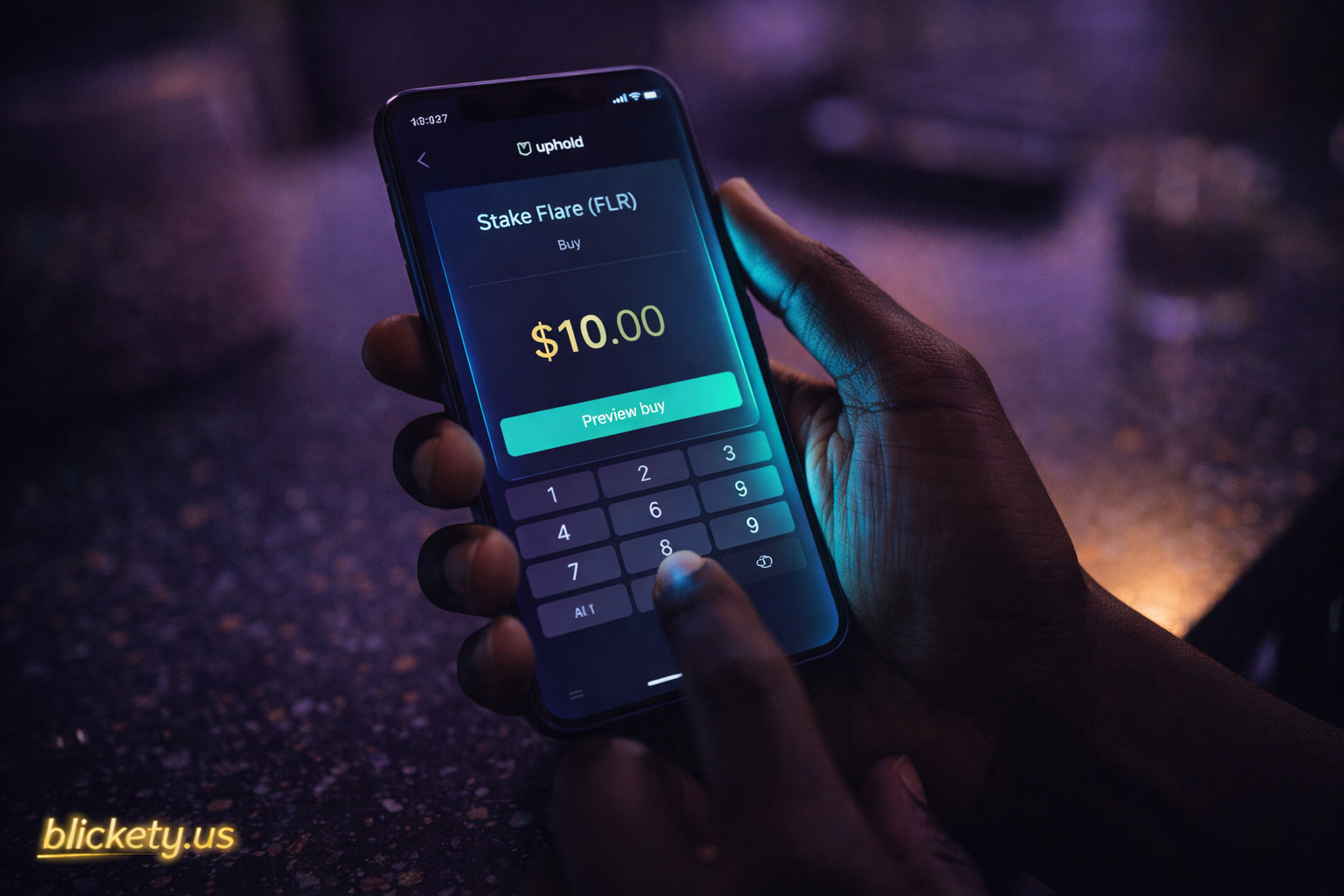
Here is the weekly stacking model. Every week, instead of spending that $10 on something that evaporates — a delivery fee, a subscription you forgot to cancel, a snack run that did not need to happen — you go to Uphold. You buy 1,265 FLR. You stake it. You set a reminder for next Tuesday and do it again.
| Milestone | Figure |
|---|---|
| Weekly FLR purchased | ~1,265 FLR |
| Total invested — 52 weeks | $520 |
| Total FLR accumulated | ~65,780 FLR |
| Staking yield at 8% APY (estimated) | ~2,631 FLR |
| Total FLR after 1 year | ~68,411 FLR |
| Value at current price | ~$540 |
TWEETABLE STAT: “$10 a week on Uphold. 52 weeks. 68,000+ FLR stacked. The institution is doing the same thing with more zeros. Put your riches on layaway. #FLR #Uphold #CryptoBro9000” 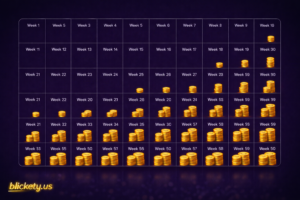
Now add the appreciation thesis. If FIP.16 passes and the Bitcoin integration drives demand, and FLR recovers even 30% of the distance toward its previous all-time high — not back to the high, just 30% of the way there — that $540 position becomes significantly more valuable. Not because you added money. Because each coin you already own is worth more. That is the full equation. Discipline plus appreciation. Acorns figured it out with spare change and ETFs. CryptoBro9000 figured it out with $10 and FLR.
An institution deploying $100,000 into FLR at $0.0079 buys 12,645,036 FLR. At 8% APY they earn approximately 1,011,603 FLR in annual yield. They are watching FIP.16. They are watching the Bitcoin integration. They are building this exact position — at a different scale, with more commas. Same logic. Same protocol. Same thesis.
How Uphold Staking Flare Actually Works — Step by Step
Native Flare Network staking — staking directly on the Flare blockchain through the official portal — requires a minimum of 50,000 FLR and technical knowledge including a non-custodial wallet, meaning a wallet where you hold your own private keys rather than an exchange holding them for you. That is a different conversation for a different article.
Uphold is the play for the $10 weekly stacker. Uphold is a regulated digital asset platform — regulated meaning it operates under government financial oversight, which means legal accountability most crypto exchanges do not have — that lets you buy and stake FLR directly in the app. No separate wallet. No gas fees — the small costs paid to the blockchain network to process transactions. No minimum beyond what the platform requires.
Step one — Create your Uphold account. Download the app or go to Uphold.com. Sign up and complete KYC verification. KYC stands for Know Your Customer — the identity check required by financial regulations to confirm you are who you say you are. Usually a government ID and a few minutes.
Step two — Fund your account. Add $10 via bank transfer, debit card, or existing crypto. Bank transfer is usually the lowest fee option.
Step three — Buy FLR. Search Flare Network or FLR in the app. Buy at market price. Always check the live price on CoinMarketCap or CoinGecko first — $0.0079 today, different number tomorrow.
Step four — Stake your FLR. Navigate to the staking or earn section. Select FLR. Stake your position. Your APY — annual percentage yield, the interest rate you earn on staked tokens expressed as a yearly percentage — gets distributed directly to your Uphold account.
Step five — Set your weekly reminder. Same day. Same time. Every week. This is not the boring step. This is the whole strategy. Showing up when the chart looks ugly is what separates the stacker from the spectator.
The Risk Statement
CryptoBro9000 does not skip this. Uphold staking Flare carries real risk and you need to hear it plain before you move a dollar.
FLR is down 95% from its all-time high of $0.1501. Most short-term technical signals are bearish right now — meaning indicators that suggest downward price pressure in the near term. FIP.16 has not passed. If the governance vote fails or gets delayed, the bullish momentum around it reverses. Nobody — not CryptoBro9000, not the CEO, not CoinMarketCap — knows where the price goes next.
Flare faces competition risk. If Ripple Labs builds native smart contract capabilities directly into the XRP Ledger through a project called Hooks, the need for a separate smart contract layer like Flare diminishes. That is not imminent but it is real.
Exchange staking means you trust Uphold. Their platform, their regulatory compliance, their financial health. If Uphold has problems, your staked position feels those problems. This is different from holding tokens in your own non-custodial wallet where you control the keys.
Low trading volume — FLR’s daily volume runs around $5.5 million against a $637 million market cap — means price moves on relatively small orders. That cuts both ways. It amplifies gains in good times. It amplifies losses in bad ones.
If $10 a week is rent money, grocery money, or your emergency fund — do not do this. Build your foundation first. Then stack Flare.
The Broader Point About Uphold Staking Flare
Uphold staking Flare is the sovereign version of Acorns. Same discipline. Same automatic accumulation. Different asset class — and in CryptoBro9000’s view, a higher-ceiling appreciation thesis if the execution follows the roadmap.
Acorns invests your spare change into ETFs backed by Apple, Microsoft, Vanguard index funds — established, institutional assets. Real companies, real revenue, real track records. The growth is steady. The ceiling is what large-cap markets can deliver over decades. Uphold staking Flare puts that same disciplined accumulation into an infrastructure protocol at an earlier, more volatile stage — with a potentially higher return trajectory if FIP.16 passes, Bitcoin arrives, and the TVL-to-price gap closes.
Neither is wrong. Both work. The question is where you are in your financial journey and what your stomach can handle when the chart goes red for three weeks straight.

The $10 weekly stacker is not playing a different game than the institution. Same game. Different scale. The institution has a treasury committee, a compliance team, and a Bloomberg terminal. The $10 weekly stacker has Uphold, a Tuesday reminder, and the discipline to not sell when it gets uncomfortable.
Put your riches on layaway. Uphold staking Flare is the sovereign entry point — $10, weekly, repeat. Stack FLR. Come back in a year.
If you are building independent income across multiple platforms and want to see how other Black creators are stacking money, read this next: Own Your Bag: Apps Black Creators Use to Build Independent Income
What infrastructure token are you stacking right now? Drop it below.
FAQ SECTION
Q: What is Uphold staking Flare and how do I get started? Uphold staking Flare means buying FLR tokens on the Uphold platform and locking them in the staking section to earn yield — with no separate wallet, no gas fees, and no technical setup required. Create an Uphold account, complete KYC identity verification, buy FLR, and stake it directly in the app. Current estimated APY ranges from 7–10% depending on platform and lock period.
Q: Why might FLR increase in value beyond just earning more coins? Three specific catalysts: FIP.16 governance proposal would cut FLR inflation from 5% to 3% and create a buy-and-burn treasury, reducing supply. Bitcoin integration planned for end of 2026 expands the total addressable market dramatically. Flare’s TVL — total value locked, meaning capital actively deployed in the protocol — is at all-time highs while price sits 95% below its all-time high. That fundamental-to-price disconnect historically resolves upward.
Q: How is Uphold staking Flare different from Acorns? Acorns invests spare change into diversified ETF portfolios of established companies — lower ceiling, lower volatility. Uphold staking Flare accumulates FLR, an early-stage infrastructure token with specific pending catalysts for price appreciation — higher volatility, potentially higher ceiling. Both use the same micro-investing discipline: small amounts, automatic, consistent, compounding over time. One is the traditional market. The other is the infrastructure frontier.
The next piece in this series breaks down the PayFi narrative — five infrastructure tokens accessible under $500 that are building the financial rails of the next decade. If Flare is the smart contract layer for XRP, PayFi tokens are the payment plumbing. The rails are being laid. The question is who gets on them first.