
Look—we need to talk about something that’s been simmering for a minute now, and it’s time to say it plain.
Black History Month is Black History Month. Not “melanated people’s month.” Not “people of color month.” Nor is it some kumbaya umbrella where everybody gets to claim the shine but nobody wants to carry the weight.
Black.
And before anybody starts with the “you’re being divisive” routine or the “we’re all in this together” speech—sit down. Because this conversation isn’t about building walls. It’s about protecting something specific that was built with specific blood, specific struggle, and specific names attached to it.
The Man Who Started It All
Carter G. Woodson—son of formerly enslaved parents, self-taught scholar who didn’t enter high school until he was 20—created Negro History Week in February 1926. Not because February was convenient. Not because it was the shortest month and therefore the easiest to ignore. He chose February because it already contained the birthdays of Abraham Lincoln and Frederick Douglass, two figures Black communities had been celebrating since the 1860s and 1890s.
Woodson wasn’t asking for permission. He founded the Association for the Study of Negro Life and History in 1915 after being barred from American Historical Association conferences despite being a dues-paying member. He started the Journal of Negro History in 1916 because white-dominated historical spaces had zero interest in Black contributions. By the late 1960s, as young Blacks on college campuses became increasingly conscious of links with Africa, Black History Month replaced Negro History Week. In 1976, fifty years after the first celebration, the Association used its influence to institutionalize the shift from a week to a month, and from Negro history to Black history.
This wasn’t handed down from on high. This was fought for. Built. Defended.
So when I hear people—including some Black folks—referring to February as “melanated people’s month” or trying to rebrand it into some catch-all “people of color” celebration, I gotta ask:
What are we doing?
The Math Isn’t Mathing
Here’s where it gets wild.
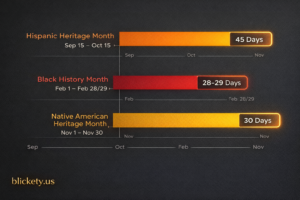
Hispanic Heritage Month runs from September 15 to October 15—that’s a month and a half, 45 days. September 15 was chosen as the starting point because it’s the anniversary of independence for Costa Rica, El Salvador, Guatemala, Honduras, and Nicaragua, with Mexico celebrating September 16 and Chile on September 18.
Native American Heritage Month occupies all of November—30 days. In 1990, President George H.W. Bush signed the joint resolution officially designating November as National American Indian Heritage Month.
Black History Month? Twenty-eight days. Twenty-nine if we’re lucky enough to catch a leap year.
We get the shortest month of the year to commemorate:
- Four hundred years of chattel slavery
- Jim Crow and domestic terrorism
- The architects of jazz, blues, rock and roll, and hip-hop
- The backbone of the Civil Rights Movement that expanded freedom for everybody
- The people who literally built this country for free
And now—now—people want to take even those 28 days and turn them into “people of color month”?
Nah.
When “Hispanic” Already Includes Everyone
Let’s be clear about what “Hispanic” actually means as a census category—because this is important.
Hispanic isn’t a race. It’s an ethnicity label that includes:
- White people (Spanish descendants, many Argentinians, Cubans)
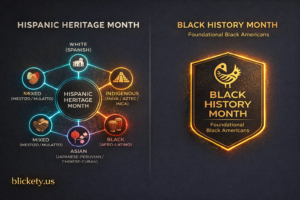
- Indigenous people (Maya, Aztec, Inca descendants)
- Black people (Afro-Latinos from Dominican Republic, Puerto Rico, Panama, Colombia, Venezuela)
- Asian people (Japanese Peruvians, Chinese Cubans)
- Mixed-race folks (mestizo, mulatto, countless combinations)
So when we say “Hispanic Heritage Month,” we’re already talking about a multi-racial umbrella category—people who may or may not speak Spanish, who may have been here for generations or just arrived, who trace lineage to dozens of different countries and cultures.
But when we say “Black History Month,” we’re talking about something specific: Foundational Black Americans. Descendants of enslaved Africans who were brought to these shores in chains, who survived the Middle Passage, who built wealth for this nation while being denied the fruits of their labor, who created entirely new cultural forms from the wreckage of cultural genocide.
That’s not an umbrella. It’s a lineage. That’s a specific historical experience that doesn’t get watered down just because somebody wants to feel included.
And yet—Hispanic/Latino heritage gets 45 days spanning two calendar months, Native Americans get 30 days, and Black folks get 28. And we’re the ones being pressured to make ours less specific? To dilute it into “melanated people” so everybody can share?
Where they do that at?
The Problem Isn’t Infiltration—It’s Invitation
Here’s the thing that hurts: The call is coming from inside the house.
Nobody’s forcing us to share Black History Month. Yet, we are choosing to. We’re the ones saying “melanated people’s month” like Blackness is just a shade on a color wheel instead of a specific historical, cultural, and political identity forged in the furnace of American oppression and resistance.
We’re handing over the keys. Opening the door. Making it generic because we’ve been conditioned to believe that boundaries are selfish, that specificity is divisive, that saying “this is ours and ours alone” makes us the bad guys.
But look around: Nobody else is doing this.
Hispanic Heritage Month celebrates “the contributions and influence of Hispanic culture” with its specific dates and focus. Native American Heritage Month in November pays tribute to “the rich ancestry and traditions of Native Americans.” Asian American and Pacific Islander Heritage Month has May. Each community maintains its specificity without apology.
So why is Black History Month—the one with the most specific designation, created by a Black man to address the erasure of Black contributions—the one that needs to accommodate everyone else?
The “Invited to the Cookout” Problem
While we’re here, let’s talk about this embarrassing pattern we’ve got going.
We are the only people who give out lifetime memberships for doing the Electric Slide.
Watch how this plays out:
To get invited to our cookout, all you gotta do is:
- Hit a dance move on TikTok
- Say something vaguely progressive about race
- Collaborate with a Black artist
- Show up in a space with us and not say anything racist for five minutes
That’s it. That’s the whole application. There is no understanding of the struggle. No solidarity when it counts. No showing up when we need allies in the courtroom, the ballot box, the school board meeting. Just vibes and performance.
But to get invited to their spaces?
You marry in? You’re still an outsider. You speak the language perfectly? Still not really “one of them.” You convert to the religion, learn the customs, live in the neighborhood, raise your kids in the culture—and you might get a conditional seat at the table. Maybe. If you’re lucky. And even then, they’ll remind you where you came from.
We’re out here handing out guest passes for catching a rhythm, while everybody else requires a dissertation defense.
And when we give out these easy invites, we’re not building coalition. What we are doing is performing inclusivity. We’re saying “see, we’re not like those Black people who are all exclusionary.” We’re tap-dancing for approval.
Everything Ain’t For Sale
There’s a line in “Straight Ballin” where 2Pac says, “the game is to be sold not told.”
Every time I hear that, I cringe.
Because that’s not how it’s supposed to work. If the game can be sold, then whoever’s got the money gets the knowledge—no lineage required, no loyalty expected, no understanding of what it cost to build.
The game isn’t supposed to be sold. The game gets passed down. From elder to youth. From someone who lived it to someone who’s ready to carry it. It’s not a transaction. It’s a transfer of stewardship.
You don’t sell precious jewels to the highest bidder. You pass them to someone worthy, someone who understands their value, someone who’ll protect them and pass them forward.
But look at what we do:
- We let “melanated” replace Black because we don’t want to seem exclusionary
- We let “people of color” hijack our movements because we’re afraid of being called anti-coalition
- We dilute Black History Month into some generic melting pot because somebody might feel left out
- We give away our culture, our slang, our music, our style—and then watch it get repackaged and sold back to us
Everything isn’t to be sold. Some things are meant to be held close, protected, and transferred only to those who’ve earned the right through lived experience, through legacy, through blood.
Black History Month is one of those things. It’s not inventory. It’s inheritance.
This Isn’t About Being a Victim
Let me be clear: This isn’t about blaming racism for everything. This isn’t about positioning ourselves as perpetual victims or making whiteness the center of the conversation.
This is about safeguarding something specific.
Cultures blend in America. People share food, music, language, traditions. That’s normal. That happens. Nobody’s mad about cultural exchange.
The issue is when Black History Month—specifically created to document and celebrate Foundational Black American history—gets rebranded into “melanated people’s month.” That’s not cultural blending, it’s erasure. That’s taking something with a specific lineage and turning it generic.
It’s simple:
- Hispanic Heritage Month: September 15 – October 15
- Native American Heritage Month: November
- Asian American and Pacific Islander Heritage Month: May
- Black History Month: February
Each community has their specific recognition. Nobody’s trying to turn Hispanic Heritage Month into “melanated people’s month.” Nobody’s rebranding Native American Heritage Month into something vague and diluted.
So why is Black History Month the one getting watered down?
That’s the question. Not “who’s doing it to us” but “why are we allowing this specific thing to lose its specificity?”
What We’re Actually Protecting
We’re not safeguarding Black History Month because we’re gatekeeping. We’re protecting it because we lived it.
Not “earned it” like we got a gold star for good behavior. Not “deserve it” like it was a reward for passing some test.
We lived it.
The blood. The trauma. The brilliance. The survival. The culture. The innovation. You don’t earn your own story. You live it.
And here’s the paradox: We shouldn’t need permission to celebrate ourselves. Black History Month was a compromise—a concession wrestled from a system that wanted to ignore us entirely. It’s 28 days out of 365 where schools and corporations do their performative acknowledgment, dust off the same five figures, then go back to business as usual in March.
We should be celebrating ourselves every single day. In our homes, our communities, our businesses, our art. Not waiting for February to roll around for someone else to tell our story—usually badly.
But even this compromise—this one month—is under siege.
The Real Work Ahead
So what do we do?
First: Stop giving it away. Black History Month is for Black history. Foundational Black American history. Not a potluck where everyone brings a dish.
Second: Protect the specificity. When someone calls it “melanated people’s month,” correct them. When a school or organization tries to broaden it into “people of color month,” push back. Specificity isn’t division—it’s accuracy.
Third: Educate our own. Some Black folks are co-signing the dilution out of well-meaning attempts at coalition building. Sometimes it’s respectability politics. Sometimes it’s exhaustion from being called divisive every time we ask for something exclusively ours. But good intentions don’t stop erasure.
Fourth: Remember what this is about. As historian Daryl Michael Scott notes, Black History Month is “as much about today as it is about the past” because “there is no more powerful force than a people steeped in their history.”
This isn’t just about honoring dead heroes. This is about understanding that we are part of a continuum—from the enslaved Africans who survived the Middle Passage, to the architects of Black Wall Street, to the foot soldiers of the Civil Rights Movement, to the innovators building tech startups and creating new art forms today.
When we protect Black History Month’s specificity, we’re protecting the ability of future generations to see themselves in that lineage. To know that their story—this specific story—matters. That it’s not interchangeable with any other story. That it’s worthy of its own space, its own recognition, its own month.
The Line in the Sand
February is for Black history.
Not Native American history—they have November.
>Not Hispanic/mestizo/Latino history—they have September through mid-October. 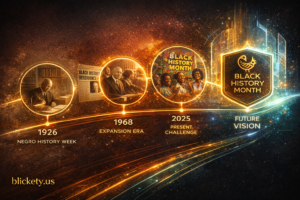
>Not “melanated people.”
>Not “people of color.”
Black. History. Month.
Twenty-eight days. That’s what we have. And we need to stop letting people—including our own people—give it away.
This isn’t about competition. This isn’t about taking from other groups. This is about maintaining what’s ours. What Carter G. Woodson built. What generations of Black educators, historians, and activists fought to preserve and expand.
We can honor other groups without colonizing our month. You can build coalitions without erasing distinctions. You can celebrate diverse histories without turning Black History Month into “everyone’s heritage month presented by people who weren’t even part of the original struggle.”
The game isn’t to be sold. The game is to be protected—and passed to those who understand what it cost to acquire it in the first place.
We’re not losing Black History Month to outsiders. We’re giving it away. And that’s harder to fight, because the call is coming from inside the house.
But it’s not too late. The door’s still ours. The keys are still in our hands.
Time to stop opening it for every passerby who catches a vibe and start protecting what generations built, died for, and passed down to us with the expectation that we’d do the same for the next generation.
February belongs to us.
Not because we’re gatekeeping. Because we lived this.
And that’s not something to share, compromise, or rebrand.
That’s something to protect.