Black Makers Slow Living: 5 Bold Reasons the Hands Are Remembering What We Forgot
By DyAnne Pepper
Black makers slow living is not a trend. Let me be clear about that from the jump — not an aesthetic, not a Pinterest board, not the craft supply haul your algorithm served you between two ads. What is happening right now, in studios and kitchens and garages and bedrooms across Black America, is something older and more necessary than any content cycle can contain. A return. And returns with this kind of weight tend to mean something.
The hands are remembering things the mind forgot to hold onto.
: The World That Made This Necessary
Fifty-two percent of creators have experienced burnout directly because of their work. That number comes from a 2025 study by Billion Dollar Boy, surveying a thousand creators across the US and UK. Thirty-seven percent have considered leaving the industry altogether. The leading causes? Creative fatigue, demanding workloads, and constant screen time. Three in four creators believe the algorithm punishes anyone who stops posting constantly.
I have watched this happen in real time. Brilliant, funny, visionary Black people pouring everything they had into platforms that did not pour anything back. The optimization eating the joy, slow and methodical, the way termites eat a house — from the inside, invisibly, until one day the floor gives.
The screen does not know when you are tired. It does not care that you have been performing yourself for strangers since 6am. Refresh and ask for more. That is all it does.
Which is why, when I started noticing something shift — Black women posting about their pottery wheels, their herb gardens, their quilting frames, their woodworking benches — I did not dismiss it as a vibe. I recognized it as a verdict. The body had rendered a verdict on the speed. And the body, it turns out, is a more honest critic than any algorithm.
The Ancestral Memory in the Hands
There is a particular feeling when you do something your grandmother did. Not quite memory — closer to a frequency. Something in the body recognizes the motion before the mind catches up.
This is what black makers slow living is actually about, underneath the beautiful ceramics and the natural dye baths and the hand-stitched garments. The frequency. The recognition.
Sewing, quilting, pottery, herbalism, beadwork, woodworking — Black people are not discovering these practices. They are recovering them. Discovery implies arrival. Recovery implies return. The distinction matters deeply.
The quilts at Gee’s Bend in Alabama are not folk art curiosities. They are a continuous conversation between generations of Black women who used the only materials they had to make something undeniably, defiantly beautiful. Faith Ringgold’s story quilts carry histories that institutions refused to hold. The apothecary knowledge that enslaved women carried in their bodies — the herbalism, the plant medicine, the tinctures and salves — was sophisticated, empirical, and kept people alive. Not primitive. Not naive. Science that smelled like earth and worked. 
When a Black woman today sits down with dried lavender and beeswax and renders something healing from what the earth offered, she is being ancestral. Nostalgia looks back. Ancestry carries forward. Those are not the same thing, and I will not pretend they are.
What Black Makers Are Building Right Now
The black makers slow living movement is not one thing. It is an ecosystem, and I have been paying attention.
Textile work is everywhere — sewing, natural dyeing, upcycling, visible mending. It has always been political for Black women. Clothing as identity armor, as cultural archive, as the thing you made yourself because making it yourself meant no one could take it from you. The Great British Sewing Bee has had multiple Black women winners. Latifah Saafir in California is designing fabric patterns that carry Afrofuturist aesthetics into domestic spaces. These are architects of a visual language, not hobbyists.
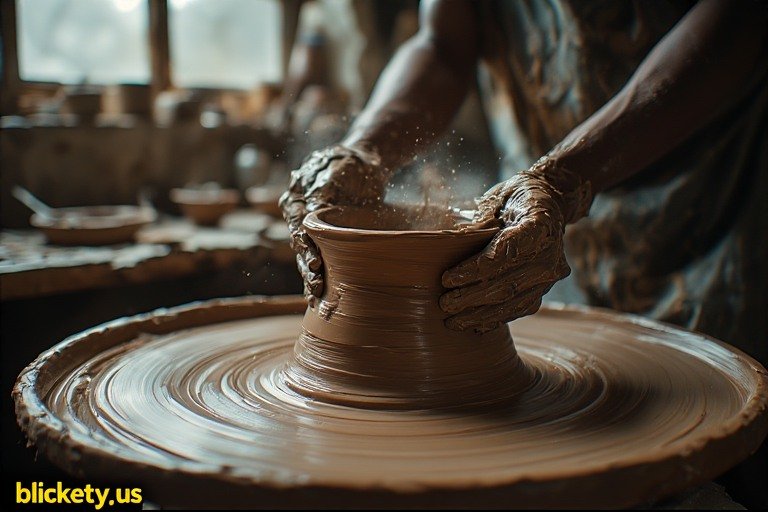
Ceramics and pottery have become their own quiet revolution. Tracie Hervy studied at Greenwich House Pottery and the Rhode Island School of Design, and now makes minimal vessels inspired by prehistoric forms. Lolly Lolly Ceramics — Lalese, out of Columbus, Ohio — makes mugs and plates by hand. What is remarkable is not only the beauty of the work. It is what making it does to the maker. “It’s one of the only times where I lose complete track of time,” one ceramicist told the Craft Industry Alliance. “That sense of complete absorption and calm and peace.” The wheel as nervous system reset. Clay as the only thing that needs you present. 
Herbalism and apothecary work are reclaiming plant knowledge as a wellness technology. Third-generation herbalists in Houston. Natural skincare founders drawing on African ancient wisdom. Plant medicine that was dismissed as folk remedy is being recentered as exactly what it always was — accumulated, body-specific knowledge that survived because Black women protected it. Teas, tinctures, salves, oils made in small batches with intention.
Woodworking and metalwork show up as sovereignty work — building altars, furniture, tools, and physical environments designed with intention rather than purchased without thought. When you build the table your family eats at, that table carries a different energy. Everyone who sits at it knows it. The maker knows it most.
Digital-craft hybrids are where the Afrofuturist signal comes in clearly. Laser cutting, 3D printing, CNC carving — the fusion of ancestral craft logic with futuristic tools. A woman using a laser cutter to etch Adinkra symbols into wood is doing one continuous thing. The technology is a more precise chisel.
Slow Living as Political Act
Here is what nobody says in the black makers slow living content, but I will say it plainly: the refusal to be rushed is a political act when you are Black.
There is a particular violence in the extraction economy’s relationship with Black bodies — the expectation of constant availability, constant productivity, constant performance, without rest and without protection. The algorithm wants your content. Your labor, your presence, your nervous system. The demand for speed from Black bodies has colonial roots that run deeper than TikTok.
Choosing craft — a practice that cannot be rushed, that has no algorithm, that rewards presence over productivity — is a refusal. Quiet and real and consequential.
The meditative quality of repetitive motion is not wellness language for decoration. When your hands are doing something that requires total attention — throwing clay, pulling thread, working wood, steeping herbs — the nervous system genuinely settles. The parasympathetic system, the rest-and-digest half of your autonomic nervous system, actually activates. Repetitive motion is neurologically grounding. The body knows something the productivity culture refuses to admit: you cannot make something beautiful in a hurry.
Black Makers Slow Living as Worldbuilding
This is where I get Afrofuturist on you, because the craft revival is about more than personal wellness. It is about what gets built.
Every handmade object is a timeline anchor. The quilt that holds a family’s history. The pottery that carries the maker’s fingerprints into the future. The garment cut from cloth chosen with intention. The altar built from wood worked with care. These objects accumulate. They get passed down. They become the artifacts that future generations touch and ask about and remember.
Black makers slow living is literal worldbuilding. The world you want to inhabit — one that moves at a human pace, values craft over convenience, carries ancestral intelligence forward, places your hands at the center of your own material culture — has to be built object by object. By someone. Why not you.
The global handicrafts market reached $906.8 billion in 2024 and is projected to nearly double by 2033. The maker economy is ascendant. Black makers building sovereign income streams on Etsy, Shopify, Instagram Shops, and local markets are building the physical world they want to live in while building the financial foundation underneath it. That convergence is rare and it is worth naming.
How to Start Your Own Slow Craft Practice
I know some of you are reading this and thinking: I want that. The wheel. The herb garden. The sewing machine humming at midnight when the house is finally quiet.
Here is how to start without overwhelming yourself into stopping before you begin.
Choose the craft that calls, not the one that photographs well. There is a difference. The craft that calls will pull you back even when you are bad at it. The craft that photographs well will feel like work the third week in.
Start small and protect the small start. One afternoon. One project. One corner of the kitchen table. The maker’s practice does not require a studio. It requires the decision to begin.
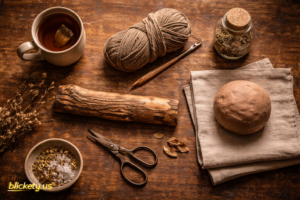
Build a ritual around the practice. Same time, same light, same cup of tea before you sit down. Ritual is how the nervous system learns that this time is different from work. The body needs to know this is yours.
Let the process be the point. This is the hardest one for people trained by optimization culture. The mug does not have to be perfect. The hem does not have to be straight. The yield from the herb garden does not have to be profitable. Something made imperfectly with your own hands is worth more than something purchased perfectly with a card.
Create a maker corner in your home. A place where your materials live. Where you can sit down and begin without setting anything up first. Less friction between you and the making means more making happens.
The Return Is the Future
In a world racing toward the future, black makers slow living is the answer — building it by hand, on their own terms, at their own pace.
That is not retreat. Not nostalgia. Not opting out. That is the most Afrofuturist act available right now — taking the ancestral intelligence your people carried through everything, meeting it with present skills and current tools, and making something that will outlast the algorithm.
The hands remember. They have always remembered. What is happening right now is just the rest of you catching up.
If you are thinking about how to build independent income while building your craft practice, this is worth reading next: Own Your Bag: Apps Black Creators Use to Build Independent Income
What craft is calling you? Drop it below.
FAQ SECTION
Q: What is the black makers slow living movement and why is it growing now? Black makers slow living is the return to handcraft — sewing, ceramics, herbalism, woodworking, natural dyeing — as a deliberate counter to digital burnout and algorithmic exhaustion. It is growing because over half of creators surveyed in 2025 reported burnout, and the body is rendering a verdict on the speed. Making things by hand is the nervous system reset that screens cannot provide.
Q: How is Black craft different from the general slow living trend? The general slow living trend is primarily about personal wellness and pace. Black makers slow living carries something heavier and more specific — the recovery of ancestral practices that were suppressed, dismissed, or survived through Black bodies across generations. Quilting, herbalism, pottery, and beadwork connect to African and diasporic traditions. The return is not discovery. It is ancestral recall.
Q: Can craft actually become income for Black makers? Yes — and it already is. The global handicrafts market reached $906.8 billion in 2024 and is projected to nearly double by 2033. Black makers are building sovereign income streams on Etsy, Shopify, Instagram Shops, and local markets. The shift from mass-produced to intentionally produced is a market signal, not just a cultural one. The maker economy rewards specificity, story, and craft — all things Black makers have in abundance.